When we got married, we had minimal premarital counseling.
We had never gone on a couple's retreat.
We had never read the same marriage books.
And we had never gone to therapy together.
And yet, we are still together 30 plus years later.
Sounds a bit like a humble brag, but it's not.
In many ways, we've been lucky.
In others, not so lucky, and we had to learn the hard way.
In today's episode, we're going to go through the good and the bad of premarital counseling and lots of other conventional wisdom that you've been told about your relationship.
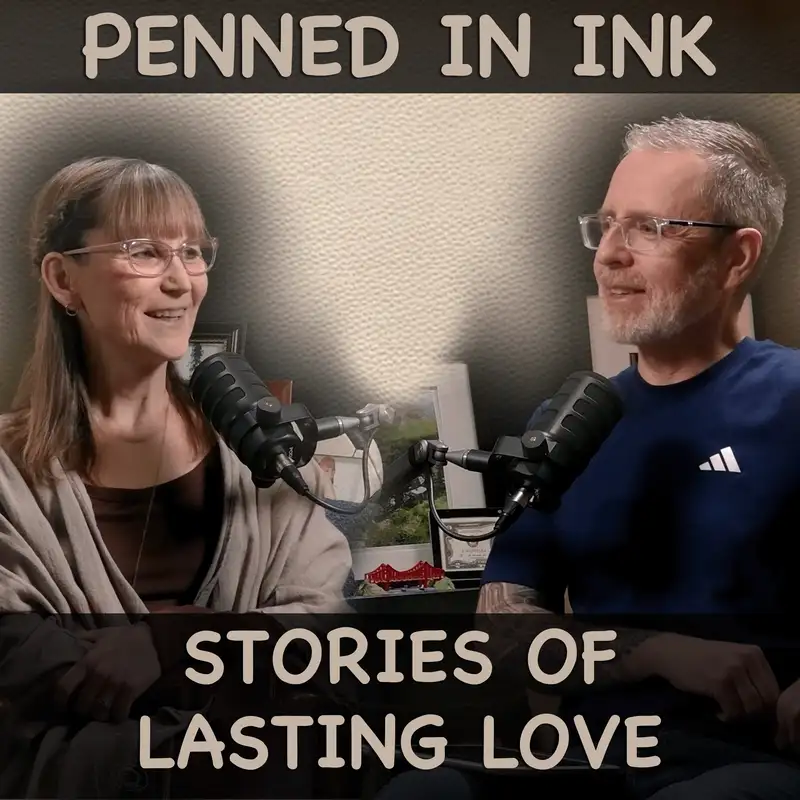
Welcome to Penned in Ink, a podcast where we discuss marriage and the power of long-lasting love.
We are discussing unconventional wisdom.
No, we're discussing conventional wisdom, the exact opposite of unconventional wisdom today.
So you have probably been told all sorts of things about how you should run your life as a couple.
And we've been told all those things, and many of them we've done.
If we look at finances and some other things, yeah, we're right on.
We do a lot of those things.
But in other areas, we've had to sort of map our own path and do our own thing.
So that's what we're going to talk about today.
And how are you doing today?
What's going on?
I'm doing well.
I'm doing well.
I was kind of laughing as I was listening to you because those are the things that I suggest in my mental health practice.
I am a counselor and I have private practice and I work with adults and I hear a lot of stuff, couple stuff.
And I suggest some of these conventional wisdom.
So I guess this is going to be a little bit of an episode of Physician Heal Thyself.
And do you follow your own advice in there?
Right.
Real quick, I'm Michael.
This is my wife, Melissa.
And as she's already mentioned, she's a mental health counselor.
We have been married over 30 years together.
And on this podcast, we just give you our stories as an intention of telling you what a healthy long-term marriage looks like, not what everyone looks like, what ours looks like, with the intent, hope, dream, vision, whatever you want to throw in there, of inspiring you on your own long-lasting love journey.
But I do want to make clear that this is not professional advice.
You're not paying me.
So this is just us and what we have learned and what we know and what we want to share with you.
Yep.
With that, let's get into this.
Let's set the landscape.
We say conventional wisdom, or in my case, unconventional wisdom.
And I have to correct it to conventional wisdom.
When we say conventional wisdom around couples and marriage, here are a few of the things we are talking about.
So I'm going to go through the list.
Melissa, you're going to give just a brief overview of what the heck that means.
And yeah, then we'll jump into where we don't follow it.
So the first one is premarital counseling.
You think you hear a lot of that.
What is it?
And why do we do it?
Give us the three sentence summary of that.
Oh, I don't know if I can.
You know me.
That's why I said three sentences because I know you.
Premarital counseling is to help you discuss the big things that should be discussed before you commit fully because you might not be connected on things and you want to know that in advance.
Perfect.
Love it.
See, you give you parameters.
Bang, locked in.
Right.
All right.
Reading marriage books together.
This is a good one.
If you've ever been to the self-help section of a bookstore, you will see there there are tons of book store.
People actually go.
I was getting one the other day in a place with packed.
Yeah, but they're all just drinking their coffee and reading their phones.
Right.
Well, actually, they were reading books for free and then putting back on the shelf.
Yeah, exactly.
But there are a lot of books out there to help you out.
And some of those you read together and discuss and they're supposed to help you.
Perfect.
All right.
Third one we probably will visit today is marriage retreats, couples retreats.
Yeah, I was going to say, and I don't have a whole lot to expand on that.
It's their their retreats where couples go, usually with other couples.
And it's it's an entire focus on your relationship.
Perfect.
And then the last one is proactive couples therapy.
I think we all know what couples therapy is.
What's proactive couples therapy?
Before there's a problem.
A lot of times people wait until things aren't going well.
And then they go.
You go before you learn some skills that you can some tools you could say that you can use later on when maybe things do get a little rough.
Yes, they do.
So those are four standard conventions that we are not saying are bad.
We're just saying, hmm, maybe we didn't do those things.
And let's discuss and talk about the good and the bad of following conventional wisdom.
Let's move into our Inked Moments segment.
On this podcast, we share lots of stories about ourselves.
But in the Inked Moment, we try to share a very specific story that is really related to the topic and use that as maybe a launching pad for future stories and stuff.
So let's explore our version of premarital counseling.
We said we're bucking conventional wisdom, but we actually did premarital counseling.
But let's discuss our premarital counseling.
Hit it.
If you can call it that, because there is formal premarital counseling where you discuss all the big things that you will want to know as a couple.
Not going to go into the second, but we'll get there.
And that is not what we did.
What did we do?
We knew that we didn't want to get married at the courthouse, but we're also not religious.
And so where does one get married?
How does that work?
And all the marriages or weddings that I had gone to because I was raised in a religion were usually religious ones.
Anyway, so you and I had gone to a wedding of friends of ours in college, and we really liked the minister.
He had a great message.
He was very modern, and we like that.
Modern in 1990, but whatever.
I think if we listened to it, it wasn't very modern at all.
But go on.
Yeah, it was modern for the time.
Anyway, that is a good point.
So we went to him to see if he would officiate our wedding.
And he had a bunch of questions for us because you want to get to know us.
Obviously, one to see if he would agree to do it because just because you ask somebody doesn't mean they're going to.
And I think we went three times where we got to know each other and he gave us a bit of feedback on what he believes marriage is.
And we discussed ourselves in our long relationship and then he married us.
Right.
So I think that just there is we just went to get our pastor to marry us.
Like there was no deep dive of actually exploring our relationship in our premarital counseling.
It really was just doing enough for him to say, yes, I will officiate your marriage.
The better way to approach premarital counseling is to work with someone.
And it can be a pastor.
It can be a therapist.
It can be probably some other people that do this sort of service.
But the idea is to explore deeply topics that really matter when you're talking about getting married.
And some of those topics you really need to drive into our money, religion and faith, children to have them, to not have them.
When are you going to have them?
And then in laws, extended family, how close do you live?
How often do they interact, et cetera?
That's an actual healthy exploration of premarital counseling.
And we did not do that for ours.
What was the downside of not doing that?
Or what do we miss by not doing that?
And do we advocate and think people actually should do that?
Well, what I believe we missed is we covered things like we both knew we wanted children.
We knew how many.
We had talked about how we wanted to be financially secure, but we hadn't gone in depth on any of those, like really deep onto them.
Yeah, we didn't talk at all about what were our views on money, what was our vision for long term.
And we did a whole episode where we talked about the question behind the question.
We had had very cursory, surface level conversations about money, children, maybe a little deeper in a couple of areas, but we didn't go nearly deep enough.
So we really had to figure that out as we were getting into our marriage.
Anything else that we would have benefited from and people benefit from premarital counseling?
Oh, that's a good one.
Because to answer the other question, I really think everybody should do it.
I think it's an important thing.
Yeah, agreed.
And we'll talk about what it means, what we define by doing premarital counseling.
No, I can't think of any other things.
I would say the skills for communication.
Oh, that's right.
In addition to good premarital counseling, in addition to having you explore these topics, we'll start to empower you with tools of how to discuss with each other, how to resolve conflict.
Because the goal of premarital counseling isn't to solve all these things or agree on all these things, it's to have the discussions.
And so a good premarital counselor will help you learn how to talk to each other and communicate things and translate some of that stuff for each other, which is my segue into you.
When we say premarital counseling, we really challenge you to find someone who challenges you and challenges your belief.
Because there's a lot of them out there who say, "Oh, I did premarital counseling." And no, you did what we did.
We sort of did the checkbox so you could get the license.
You didn't do the actual hard work of it.
You want to talk a little bit about Taylor and Carter, our daughter Taylor, and their experience with premarital counseling.
They got married a little over a year ago.
Getting close to two years now.
We talked a little about them a little bit.
Do you want to share that at all?
Or do you want me to?
I think you've talked to them about it a bit more.
However, I can get it started and you can fill in the gaps.
Which is, they did.
They went to the minister at the church where Carter grew up and they went to him.
A lot of it was logistics about the ceremony, what was going to be said, what wasn't, what Bible verses were going to be said, what did they want put into their ceremony itself.
That's my understanding of it as well.
And then, I think you told me the other day that they started looking into these things we discussed.
But they had already had all the conversation.
Yeah, so their premarital counselor gave them some assignment, some work to do.
And according to Taylor, they'd already done all the work.
And I asked her, well, how did you know to do all that work if you hadn't gone through premarital counseling and everything?
I have a very proud moment.
She said, well, because you and mom had been preaching this to us for a very long time, or to me, to have these conversations.
Because since we missed out on it, we I think have been a little clear in our communication to the girls of like, and we have twin daughters, 26.
So they're at this age where this is very relevant.
But we didn't wait until they were in their 20s to start having these conversations all along.
We've been saying, hey, here's some things you really need to know if you're going to build a long lasting partnership with somebody and really have those conversations early.
So they had done a very good job of already having those conversations.
And we share that story to illustrate that you don't necessarily have to have premarital counseling.
The key is, are you having the discussions that lay the groundwork and are your discussions going deep enough and broad enough?
And premarital counseling often helps you with that.
And we probably would have benefited from that.
Yeah, and then like you said, the premarital counseling gives that added edge or that added bonus of probably helping with communication and giving you the tools that you'll need moving forward in your marriage.
Yeah, and if you try it and you get someone who's just letting it all slide and pass and not to find another one, there's tons of them do it.
It's just like when you're finding a counselor, doesn't fit for the first one, find another one, find another one, find another one.
It's a little bit like houses, there's one on every corner.
You can probably find one that'll fit your needs.
There are a lot of these, so yes.
Wasn't an insult, it was more just a dig that if it doesn't fit...
No, it's true.
You have to connect or they're not going to help you.
Yep, let's move to another bit of conventional wisdom.
And this is one we actually did not mention in our laundry list at the beginning, but it's this idea of where are you supposed to learn about marriage and one of the growing trends out there, and I'll call it a growing trend because I don't think it was something when we were really young in our marriage, is finding a mentor couple.
Maybe thinking, what the heck is a mentor couple?
A mentor couple, if you think about it, think about your career.
In your career, mentorship is probably something that you've been exposed to.
You find someone who is further along in their career, maybe at your company, maybe in your field, and you build a relationship with them where you ask them questions, you learn, how did you get to where you are?
Same concept just applied to your marriage.
Are there couples in your life that have bits and pieces or experiences, are they where you want to be?
And can you build up a relationship with them?
So we grew up in Oregon.
Our marriage started in Oregon, we're married in Oregon.
We now live in North Carolina.
When we lived in Oregon, did we have a mentor couple?
Right, yeah, the concept wasn't there.
Like you said, it's a new thing, but we had seen my parents who have been married a very long time and seen them overcome obstacles and work through things and they're going strong.
And so that was an example of longevity and that's something that we saw.
Yeah, your parents, you've mentioned a long time, so we've been married 30 years, 30 plus years.
They've been married 50 plus years at this point, so they had already been married a very long time by the time we got married.
And so they're a great example of enduring in a marriage and having those rough times and facing those rough times and dealing with it and going through raising kids and coming out the other side.
Like they're a great arc of what a long-term marriage looks like.
They weren't the only ones we had in our family.
And there's a previous episode where we talk about my family, my family is full of divorce and I had not seen long-term marriage.
And at the time, shortly into our marriage, my aunt and uncle had what we thought on the surface was a very good marriage and they were financially very successful and relationally, from our perspective, they looked very successful.
They had good interactions, they had kids, they had lots of things going for them.
Their story ended up not being as good as it was, which we'll sort of revisit in a little bit, but we learned lessons from them because they were building a life that we sort of aspired to.
And then we did this thing where we picked our family up and we moved 3,000 miles across the country and we basically lost what now looking back might've been considered mentor couples in our life.
So what did we do when we got here on those fronts?
We weaned it for a while.
Quite a while.
But then we started meeting people.
We met people in our neighborhood that had long-lasting relationships and they were like, "Wow, they seem healthy." We met people through the girls activities.
You coach soccer and so we met some adults that way that were couples that seemed to be healthy.
And so we kind of found them, but it took a bit once we got here.
Yeah, so the thing that we never did is really find a couple that we treated as a mentor couple and leaned in and talked to.
But we did start to surround ourselves with couples that had characteristics that we liked and we aspired to.
This wasn't a formal thing that we did.
And I think the trend now is that people are really looking for this, searching it out and embracing it.
And that's not at all what we did.
We organically fell into relationships that we took stuff from.
And the thing we didn't ever find, and if you can find this power to you, is a couple that really embodied and personified many of the characteristics we were looking for.
We've done a bit more of a pick and choose.
We've got through the soccer club, we had a couple that when we very first got into that, we run a local soccer club, youth soccer club.
There was a director of that and his wife who were probably the most friendly couple that I've ever met with each other.
They just truly loved being with each other and their idea of any good time was always better if their spouse was there.
And I don't think we had seen that in a lot of our other couples.
They might've had respect and love and mutual, but they weren't like best friends.
And I think we really liked that piece of like, every time they're together, they give off positive vibes as a couple.
We had neighbors that you mentioned that were about 10 to 15 years older than us and they had raised their kids a little bit further along than we were.
They were established in the community.
They seem to be relationally good.
So we picked things about parenting and things that we liked from them.
But I don't think we ever had the single, hey, this is our mentor couple.
We didn't.
I think you framed it exactly right.
We saw characteristics of other couples that we were around and we liked those, but there wasn't any one couple that were like, you know what, we should spend more time and get maybe a bit more feedback, some constructive, like actually asking, how did you do this?
We were more, I guess, passive in that we watched it, but I don't remember ever asking anybody, wow, you guys are good.
How did you get to be so good?
And I think a mentor couple would be somebody you would ask them.
So the growing trend is people are looking for mentor couples.
Love it.
Do that.
If you can find and identify, that's awesome.
If you can't do that, the way we sort of stumbled through to it is we very intentionally took characteristics from multiple couples and sort of cobbled together, if you will, the view of what we wanted our marriage to be.
And in some ways that maybe is the ideal way because when you work with any couple or engage with any couple, they're only gonna show you what they want to show you.
So you don't really know exactly what's under the, which harkens back to I'd mentioned my aunt and uncle, they were great on the surface and their interactions with us were very positive.
We had lots of good learnings from them.
Turns out their marriage was really not very good between them and they ended up getting divorced five, 10 years later or something for a lot of things that they just never showed.
So I think this cobbling together is a good thing.
Another way you can get those, and this is not a plug for our podcast, but it is one of the motivations of why we are doing the podcast is that many people don't have a glimpse into what a healthy relationship looks like.
And so one of our goals with this is to just show you what a healthy relationship looks like.
And as we look to build our community and to interact with people who are watching, our goal is to just provide mentorship.
Here's what it can look like.
Not what does it have to look like, but here's what it looks like for us.
Can you put it into practice in your relationship?
Yeah, absolutely.
That was definitely a driving force for doing this is to show people that it can be done and that there are those of us out there that work on our marriage and that's a good thing.
Yep.
Let's move into areas where we clearly did not and do not go with conventional wisdom.
There's several of them that really jump forward.
And some of them we will advocate and say, you probably should do another.
We're like, nah, nah, here's just an alternative for that.
So let's jump into this one.
Individual learning versus shared curriculum.
Melissa mentioned earlier on that this read together and discuss is a conventional wisdom.
What's our approach on that?
Do we do that?
Have we ever done that?
Will we ever do that?
Will?
We have not.
We have not done that traditional here.
We're reading the exact same book and we're gonna go through it together and we're going to discuss, kind of like a book club.
That is not us.
Yeah, our goal is not book club.
We are not gonna do book clubs.
But what we do is, and we've always had this and it's not just in our relationship, but we both have learning mindsets.
What I mean by that is we're both curious and are always trying to consume information in lots of different areas.
And one of the things that we do on a very consistent basis is we take our learnings and we bring them back to each other.
And part of it is just, hey, I found this out.
This is cool.
Let me share this with you because I'm interested in it.
But some of it, and a good bit of it is, hey, I heard this.
I listened to this.
I read this.
What do you think about this?
Or, hey, I think you might really like this or you might benefit from this.
Why don't you dig into it?
Yeah, so I would say we're less formal, but we do a lot of that things that we hear.
And obviously I hear a lot in my practice.
Hey, have you heard of this principle or this way that people are doing things?
And we bring them and we discuss.
Yeah, that's actually a really interesting one.
You, not only from your professional boards and what your counseling organization is working on, you hear these trends or these things, and we'll talk about those, but you also have your client experience that comes to you.
And they're doing all sorts of different things that you're like, hey, have you heard about this thing or this way of thinking?
Or what do you think about this?
Not in a, hey, this client told me, but here are the things I'm dealing with in this area.
So our message here is that we always bring those learnings back to each other.
And we believe that shared learnings is way more important than shared readings.
Absolutely.
Okay.
The next one that we did not do is proactive couples therapy.
What is that?
Yeah, it's a growing trend.
Especially with Gen Z.
It really is.
Which, those darn Gen Zs, man, they're out there just changing the world.
Right?
Well, my field benefits.
Well, we could get into a whole discussion of other reasons why Gen Z is helping your profession thrive.
I was referring to this though.
Yes, exactly.
We'll keep it focused on this.
I don't do couples therapy, so it's not like me, trying to get more clients.
But it's using couples therapy as a preventative measure instead of waiting until things are going wrong.
So it's a way to gain knowledge and tools about communication, about dealing with hard times to deal with crises, but doing it in advance so that you're kind of ready for it instead of waiting until shit hits the fan.
And then you're like, oh my gosh, we need to go to couples therapy.
It's being proactive about it going before there are issues to strengthen your marriage.
Look at you, cursing on the podcast.
A couple episodes ago, she's like, I can't curse on the podcast.
I almost put in a disclaimer saying, pardon my language, but I left it out because you told me this is not the range.
It's allowed here.
You're not in session.
You're allowed to use adult words.
It's okay.
There is growing literature out there that this trend is actually taking hold.
And if you think generationally on this, baby boomers, Gen X, couples therapy has been in crisis.
You get to the end of your patients, your tolerance.
You have some crisis event and you go seek out help.
Millennials and Gen Z are starting to change that trend a little bit.
And there is some research out there showing the benefits from it.
I will put a little asterisk next to that that a lot of that research seems to be done in the field by clinicians who are providing services.
So it's a little bit like pharmaceuticals saying that drug interventions help.
Okay, but I will say this passes the basic common sense test because it is to your point.
It's teaching those skills.
It's preventative.
It's allowing you to have check-ins on a regular basis with some framework to it.
It's giving you skills that you might not have in communication.
It on the surface is a great thing because then maybe you don't hit as hard the rough times or you're equipped when you hit those rough times.
Now, did we ever do, and have we ever done couples counseling?
We have not.
Why not?
Because apparently we're not being proactive.
Yeah, exactly.
Exactly.
What do we do instead?
I think we got some cheat codes in our relationship that you probably don't have in yours.
So this is a little bit of transparency under the hood.
So our biggest secret weapon and why we don't do couples counseling is...
I'm a therapist.
Yeah.
So we kind of know the tools that we're supposed to be doing.
And we are very good at being willing to implement and work on those things.
And we haven't always been there.
I think when we were going through our early marriage, our early late 20s, early 30s, kids were young.
We weren't super clear on using these tools, but it wasn't due to lack of knowledge.
It was just lack of intentionality, which leads to another thing.
I have a psychology background as well.
So there are undergrad degrees are both in psychology.
That is a little bit of a leg up.
I understand when you come to these things with me and principles.
Yes, I've taken those classes.
I understand just because we're not active.
We're not actively doing a lot of those things.
And this is the simple skills like active listening and taking time outs and giving your partner time to process.
And there's a whole laundry list of conflict resolution tools or just communication tools that are very valuable in this field that we sort of knew.
We had the bag of tricks already.
Yeah.
And then this is a humble brag.
Yes, I didn't humble brag at the beginning, but I have a willingness to work on those things and to use those tools.
That's a big leg up.
A lot of relationships don't have that.
Their partner gets drug to couples counseling to that.
And it's actually worse than that.
They refuse to go.
Well, that's nothing yet.
If they go at all, I correct.
Exactly.
I see a lot where one half of the couple is not willing to go.
So the other one's reading the books, doing all the things, trying to make things better on their own without success because you can work on your stuff, your communication, your low self-esteem, your you can do that.
And you're supposed to when you go to couples counseling, do individual as well.
It's a pretty common thing.
But you can't do marriage counseling by yourself.
Yeah.
Well, I found a piece of research literature that talks about a lot of this.
I'll put a link in the description on that.
That's actually one of the points that they made in there.
Is that a large percentage, something like 70 percent of divorce couples never actually go to counseling.
And so there's a huge disconnect there of people just not officially trying.
And that gets back to your point.
One of the partners just simply not willing to do it.
So our close on this would be couples therapy is optional, but working on your relationship is not very well.
One more that we want to just slap in the face and say, "We didn't really do, but it is out there." And let's discuss this.
And this is finding structured support in your community.
And if you are in a church, that is the clearest, easiest way to find this.
Melissa and I are not in a church.
Let's discuss, not the church part, the community support part.
So how do we build our community?
And was it an official and as good as maybe a church community would be?
You have to find it organically.
And we spoke to that a little bit earlier about the girls had activities.
We met other parents through that.
That was one way, meeting people in the community, volunteer activities or work relationships.
You can get, you can make that support, in other ways other than through the church.
You might have easier access to a larger group of people in some of these formal groups, church settings, that sort of stuff being the same.
There are some, and you were looking up online, I think.
Tell me a little bit about that.
Meetup.
Meetup has quite a few different options.
There's a Facebook group for couples in our area that they discuss, they go out and do activities together.
And so there are other ways.
So there are some formal ways that you can find, but you have to look for them.
Yeah, and those are the old people's social medias that we just talked about, they're Facebook.
You guys probably don't use Facebook at all.
But there are other platforms that are designed to help you find, and I don't know if there's couples necessarily, but to find and build communities.
That's all cool.
Just be very mindful that you must surround yourself with people who have healthy views of relationships because just like in your finances, in your career and everything, you will become who you surround yourself with.
And if you surround yourself with people who don't like relationships, don't like their partners, you'll find yourself in a very slippery slope with your relationship.
So it can be done if you are in a faith organization, leverage it.
If you're not, if you're not, it's harder.
We think it's definitely worth doing.
And just know that it's gonna take lots of swings at it organically.
It's gonna take time to find those right people that you want to have in your circle, protect your circle.
And if you think about that, we gained a lot of that community support after we moved here within the first couple years.
And some of those have stayed.
The ones that we decided, and then some just through, okay, they're not really, it just kind of fizzled out.
We didn't have to say, you know what, we don't like you.
Or we don't like how you treat each other.
They just kind of fizzled organically.
Yeah, seasons.
Now, talking about building a community, one of our goals is with this podcast is to build a community.
So this is my shameless plug for the podcast that we noticed lots of you are listening and that you're engaging with us, but you have yet to subscribe or follow us, please subscribe, hit that subscribe button, hit the like button, follow, and help us grow this community because really one of our goals is to establish enough of a community that we become resources, that we as in the community, becomes resources that people can rely on for healthy, long lasting love.
Now, let's talk about were we always intentional with leaning into our marriage and being proactive on some of these things?
And the short answer is no, we were not.
So let's talk about the time period where we became much more intentional about leaning in on these things.
When the girls were young and I started my private practice, we were going in so many different directions and I do not feel, and I believe you agree, that we were not putting forth the effort into our marriage that we could have been doing.
It was not intentional at that time.
And do you remember the exact moment?
I don't think we do when we decided, hey, this needs to be better.
There was no moment for us.
It was a season of our life where we realized we were disconnected and we were not just, so we were comfortable in many areas and we were doing okay financially.
We were doing okay relationally.
The kids were cruising right along and doing stuff.
Your business started putting a lot of stress into your life and are changing commitments.
I started doing more of the childcare and the running around.
You were focused on your building, your career.
I have a very flexible job, so I was able to take on some more of that stuff.
That left you trying to find where your balance and purpose was.
I was taking on more responsibility, so maybe I wasn't.
I was in tuned and paying attention to some of the things that I was when I didn't have those.
So my life got busier, yours got less busy in an area, but busier than another.
More concentrated?
Yeah, and having to give up a little bit of control in areas that you weren't necessarily used to giving up control in.
So I think we had a lot of moving parts, a lot of stressors, and you were doing a lot of unknowns.
You were trying to start a business and that has all sorts of legal and all sorts of financial and all sorts of just everything in there.
And we realized we were out of sync.
We weren't necessarily disconnected.
We were just not in sync.
And it was not in sync on our communications around our finances.
It was not in sync about communication, about priorities with the kids.
It was out of sync with making sure that we're putting our relationship sort of at the center of everything we're doing.
I think we had a period of time where we're like, and there probably was a little bit of a crescendo around a few things in there.
We're like, okay, whoa, let's simplify.
Let's bring the emotional intensity down.
Let's bring the stress down.
Let's realize that, hey, we've got all these things that we're grateful for and are going really well.
This is starting to slide a little bit.
This is causing us stress.
We can't get rid of some of these things, but we can be more focused here.
We can manage.
So I think we had a season where we became much more intentional about it.
Now, if we had done premarital counseling, or if we had done better premarital counseling, or if we had done preventative couples counseling as a tool, we might have probably would have recognized those things a lot sooner.
So our words of hope and ambition for you is don't wait for that stress.
Start managing these things and it'll allow you to get through those.
Now harken back, we had a lot of the tools to get through it because again, our shared education, your career, my willingness to work, and that makes it sound like you weren't willing to work.
I know.
But I mean, just saying, a lot of times there's a partner that's not willing to work when you're struggling with these things.
We had a lot of the tools in place.
We just needed sort of the slap in the face to, hey, like use them.
Like I brought you to the water, drink.
Drink.
Yeah.
All right, let's move on to a another segment that we like to do, which is called, from His Perspective, from Her Perspective.
Normally we put a gender lens on this where we say, hey guys tend to do this and women tend to do this.
This is really gonna be much more of a, his perspective, as in I'm gonna tell you something from mine and hers, or most of them tell you something from hers.
And it doesn't necessarily, well, actually you'll see, it doesn't apply across genders.
But give us a perspective on this topic of contradictory or things that you, if you could start your marriage again, what would you do?
I would have better understood the importance or the helpfulness of the proactive counseling, the premarital piece.
You know, I wasn't that far into my career when we got married.
Actually, I was still in grad school.
You might say you weren't in your career at all.
I was not in my career.
You were working at Red Robin.
And going to grad school.
And so I was still trying.
I was still learning the things.
If I would have realized that that can make your life easier in many ways, doesn't make it easy, but it could have made some of those seasons easier if we would have done that.
And going back, I wish I would have said, hey, maybe we should explore premarital counseling or counseling when we're not having any struggles, but we just want to have more tools for a time that maybe there are struggles.
Because I think even though I wasn't quite educated enough yet, I still knew that there were gonna be struggles because every couple has them.
Yep, very good.
So that's your perspective.
That's my perspective.
So my perspective is if I could start my marriage all over again, I would be very intentional with surrounding myself with men who actually like their wives.
I think there is lots of couples that are, even healthy couples that are doing well, that have men in there who don't speak with a passion about their wives.
They don't speak about marriage as a super positive.
They fall into those tropes of, oh, happy wife, happy life, or the ball and chain, or oh, I gotta check and see.
They fall into all these woe is me sort of things we see in the movies that just drive me nuts.
And it took me a long time to fall into, and this is mainly at my work, ironically.
I've got five or six guys in my work that have had long marriages, and I've worked for the same company for 25 years.
And when I got there, these guys, for the most part, five or six guys, which is a rarity, I admit it, A, that I'm still working with the same guys 25 years later, but B, they're all still married.
And when they talk about their wives, it's all positives, not that their relationship is all positive, but you can just tell that they respect their wives, they respect being married, they respect their families.
And it took me a long time to find that.
And I didn't realize the power of having that.
And again, I think maybe if you're in a church setting where you have more exposure to groups and you have more exposure to a larger pool of couples, maybe you'll gravitate, I would have found that earlier, but since we didn't have that as a thing for us, if I could start my marriage again, I would look for positive men in marriage as role models.
Yeah, absolutely.
Because they were there.
Like you said, you've been working for, it just wasn't something you went, aha.
Yeah, exactly.
All right, let's move to our Pen to Paper segment.
In our Pen to Paper segment, we give you a practical challenge or reflection to help you build your own lasting marriage story.
We have talked in detail about areas in our marriage where we went against conventional wisdom.
Looking back, we see areas where investing in our relationship earlier would have greatly benefited us.
That's the inspiration for today's reflection.
So here's our challenge to you.
Name one investment in your relationship you have been putting off because things are good enough right now.
That could be a book you both wanna read, a conversation that you have been putting off, or you want to lean into a couple whose marriage you admire that you have never actually asked about.
Just take one concrete step this week.
All right, great challenge there, Melissa.
Now, unlike some of our other challenges, which we don't do in the moment because we've done those exercises, this is actually a challenge that we are in the middle of doing ourselves.
We mentioned that our goals for this podcast are to build a community and to share our passion for long-term lasting positive healthy marriages.
But there's a secondary benefit to this podcast, which is this is a marriage exercise for Melissa and I.
We are learning how to work together in a professional creative endeavor.
We've done lots of things around.
We've done a youth soccer club.
We've done work around that.
Melissa has a private practice.
I do her accounting and a lot of her business, legal sort of stuff on that.
This is the first time we've leaned in on a creative journey together.
And we have very different backgrounds when it comes to this, very different working styles.
I work in video production, communications.
Melissa works as a counselor.
Wildly different views on the creative process.
And to be 100% transparent, we're struggling to find our right rhythm on how do we design these episodes and create topics and all that sort of stuff.
And Melissa has a couple of different times expressed her lack of confidence in being creative.
Well, I argue you're creative.
Well, there's this book out there that we are listening to together and sort of discussing.
So this is where we're trying to do one of these conventional wisdoms.
And the book we're actually listening to is "The Creative Act, A Way of Being" by Rick Rubin.
And I don't know if any of you know who Rick Rubin is, but he's the co-founder of Def Jam Recording.
And he worked with some of the biggest bands of our childhood, Run DMC, LL Cool J, Beastie Boys, Public Enemy, then he went on and he did a whole career where he's worked with like the Red Hot Chili Peppers and Metallica, Johnny Cash.
Basically, if you're a big music artist, he's worked with there.
And he's got a book where he's talking all about his view on creativity and art.
And the really high level is art comes from lots of places.
And we have such a narrow view on art.
So Melissa and I are trying to find a common shared language around creativity that allows us to be more effective at our podcasting and building our communities.
So to tie this all together, this podcast creation is a growth exercise in our relationship.
And to get better, we are learning more about it, the creative process, and we're working on this together.
That's today's Pen to Paper segment.
With that, let's share a few closing thoughts before we wrap up this episode.
We want you to know that we didn't have a roadmap.
We made up a lot of the stuff along the way.
Yes, we did.
Much of it worked, I think, but then there were some things that we would do differently if we could go back.
What we do know for certain is this, couples that invest in their marriage, keep learning, keep growing.
Those are the ones that will stand the test of time.
You don't have to do this our way.
You just have to find a way that works for you.
Whatever that looks like for you and your partner, start while the times are good and work to build the type of relationship that will endure the test of time.
With that, we wanna thank you for joining us, and we invite you to connect with us by joining our free Penned in Ink community.
Here we share free digital guides and the occasional updates to help you build your long-lasting love.
Click the links in the description to join now.
Also, as a reminder, leave a comment, ask a question, and let us know your thoughts on today's topic.
If you like this content, give us a like, leave a positive review, and remember to subscribe to get notified of future episodes.
Thanks all.
Thank you.
Subscribe
Penned in Ink is a storytelling podcast about marriage, commitment, and the art of building a life together. Hosted by Michael and Melissa Penwell, high school sweethearts celebrating 30+ years of marriage, each ep...