Here is something nobody tells you when you get married.
The version of your spouse you fell in love with is only the first chapter.
The people you become across 30 years together are more interesting, more complicated, and honestly, more worth knowing.
Nobody tells you that part.
Today, I think we're going to talk all about that.
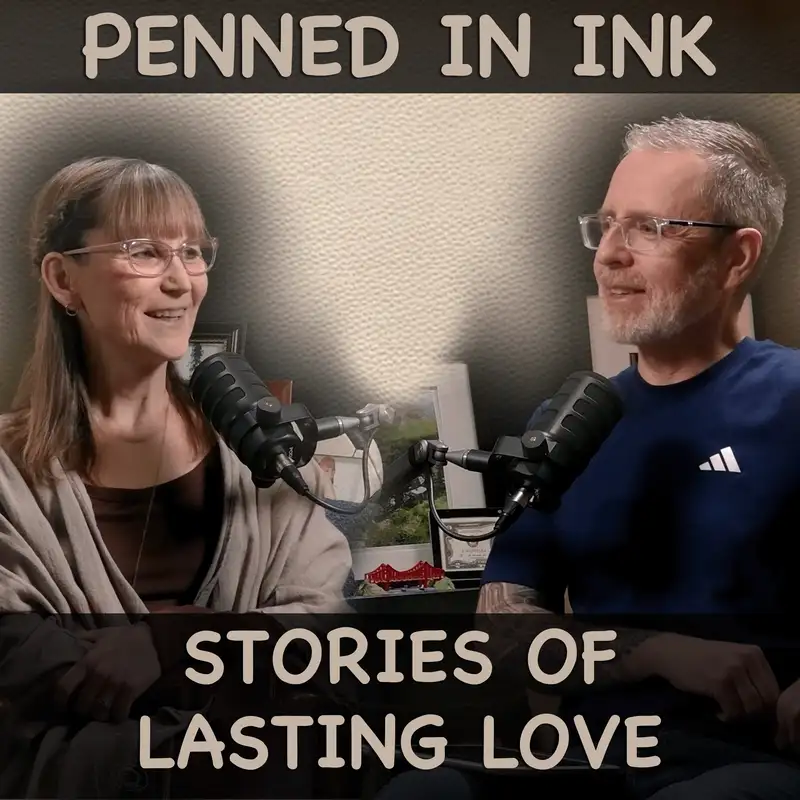
Welcome to Penned in Ink, a podcast where we discuss marriage and the power of long-lasting love.
[Music] All right, Melissa, you said that you get better and more friendly and all these sort of things over time and that somehow I'm worth knowing more now than I was 30 years ago.
I don't know about that.
Let's discuss.
Let's discuss.
We met very early.
We started very early.
We were very different people.
You say that as if that's a bad thing.
It isn't a bad thing, but I can honestly say I like our relationship.
I like us better now than I did back then.
Then it was good.
Now I feel it's great.
All right.
Let's talk about that today.
I think the message for today is that over the course of a long-term marriage, you will go through many phases.
You will grow and your relationship will take all sorts of peaks and valleys.
And one of the things we recognized very early on in our post-marriage time was that not only were we romantically compatible in building something, but by gosh, we were friends.
Yep.
And I think we're going to explore what growing all together means today and get into a few different things that maybe you haven't thought of yet because you're super early on in your relationship.
And we just want to give you a glimpse of what, looking back over 30 years, how our friendship has grown and why that's important, why anybody should care.
We'll introduce ourselves because there might be some people who have not seen this before.
I'm Michael and I'm here with my wife.
Melissa.
And we've been married over 30 years now.
And on this podcast, we show you what a healthy long-term relationship can look like.
Not what every healthy long-term relationship looks like, but what ours happens to look like with the hopes and goals and dreams of inspiring you to build your own long-lasting love.
Now, we bring 30 years of marriage experience, but Melissa brings a little bit more to that.
What is your profession, Melissa?
I'm also a clinical mental health counselor.
I'm in private practice and I see adults and I hear a lot of stuff and I bring some of those to our podcast.
Yep.
So we don't give clinical advice.
We just share stories of ourselves.
But when I say Melissa sees a lot of this in her work, it's because she works with a lot of adults who are going through a lot of relationship stuff.
And as we get into today's topic about growing old and what that looks like, there's definitely lots of things you see relationship-wise on this topic.
Definitely.
All right.
One of the things we really want to start off by framing is that growing old together is going to happen in a long-term relationship.
There's pretty much no argument or disagreement about the fact you're going to get older.
But there are two versions of your later marriage.
There's a version where you have leaned in, you've worked together with each other to build something that at age 55, you are super tight and you're clicking right along and life is good.
There's also the other side of that where many relationships unfortunately don't lean in.
They don't build.
They don't build, in our case and our argument, they don't build the friendship.
It's really necessary to sustain a long-term relationship.
So we're going to dig into that a little bit.
We would say that choosing the right person is incredibly important, but it's not enough.
Chemistry is not enough.
Love is not enough.
There's lots of things that are not enough.
So we have tried very intentionally to work on building our relationship, our skills to endure over a long time.
So let's start.
Well, let's jump into a couple stories.
We often do stories in here.
And I think it's really important for us to bring you into our world to show you some things that we've gone through.
So let's talk first about when did our friendship go from being easy going to something that we actually had to be intentional and work on?
Is there something that stands out to you or a period of time that stands out to you on that?
Yeah, there were a couple, but the one that really stands out is it was after we moved here.
Here being North Carolina all the way across the country from Oregon.
Yeah, I moved here, grew up over there, drug our family at age girls.
We have twin daughters.
There were three when we came over here.
So we drug our whole family, moved to the East Coast, left all of our family on the West Coast.
So yes, that's here.
They love about it.
Yes.
So we came here and we had gotten settled and then we had kind of got caught up in the daily, our daily lives, doing stuff with the girls.
They were involved in sports.
They were then they started school and then I went back to work and with all of the moving parts that we had going on, it did not feel like we were putting the effort into our relationship and we had not that we were disconnected, but we weren't as strong as we could be.
Yeah, we went through a phase that if you're not in it yet in your early on in your relationship, you will probably go through which is life will get incredibly busy.
And now we are super good at making sure to stay connected in our relationship because we are now we preach very much that our relationship has always been the center of everything we've built, right?
Our family, how we address our careers, our lives.
We are the center of it, but we went through a period of time where that center wasn't as aligned and as tight as it was and we didn't realize that, hey, if we don't be as intentional on this as we are on say building our career or we are raising our kids or we are adding anything else that you do in life that maybe that piece is going to slip.
So as we share stories today, we're going to share some stories of things that we consciously and intentionally have done along the way and how this changed.
Yeah, that right.
Yes, and it's not like we caught everything right up front.
No, this is looking back at a lot of it.
Yes, it's definitely looking back and you know, so don't berate yourself.
If you find, oh gosh, we've been in that situation for quite some time and we've done nothing but it's okay or don't be surprised if you're everything's cruising right along right now and you find yourself entering those phases.
Yeah, just recognize when you enter them.
Maybe a little earlier than we recognize some of ours, right?
It's perfectly normal.
It's you're not weird.
It just it just is well, you might be but we're not saving because of this not because of that.
You're not weird, but yeah, it's just it's just the evolution of relationships.
Yep.
Now to anchor this episode.
We're talking about growing older together and we when we were in our 20s and 30s, we communicated pretty well.
We shared lots of things, but let's start.
Let's go to our Inked Moments, which is a segment where we share a really concrete example from our past that is related to today's topic and let's talk a little bit about the first time we actually encountered a little bit of health scares and what how that sort of impacted our relationship.
So you want to share yours first and then I'll share mine.
Sounds like a plan.
Yeah, I'd been having troubles with my ankle.
I'd had the MRI in the doctor's side at hey, you know surgery might be a good idea to work on this tendon and I'm like, okay, well get the surgery scheduled 2018 early 2018.
I remember that like it was yesterday.
Anyway, we had just got back from a trip and I caught pneumonia two weeks before ankle surgery.
I had really been looking forward to that ankle surgery as in getting this fix because I wasn't used to not being able to do everything I wanted to do physically.
Yeah.
So Melissa is very athletic works out at the time you were running a lot and as I described, I think maybe just in our last episode Melissa is adorably rigid.
So when she has it in her mind that this is the schedule or on she wants to stay on this you had a surgery scheduled maybe we're in the best physical health to do it and then you had your surgery to continue.
Yes, it probably shouldn't let me have the surgery because I still have pneumonia at the time.
Should not have but but and then shortly after that while I'm recovering from the surgery, they did some blood work and they were worried about a blood clot.
So then I spent time in the emergency room with Michael and I actually think I think the girls came Taylor Taylor came with us Alexa Taylor came with us and it was just yeah, so we'll get into how that impacted our relationship how it impacted me.
It was the first time that I had to lean in and do a little caregiving in our relationship of a physical nature.
Maybe emotional caregiving had been done up to that point helping each other through struggles that way.
But this was the first time that either of us hit some physical barriers and needed a little assistance getting around showering daily care like all those sort of things that maybe are a glimpse of where we would be in 20 30 years and again, this happened 8 9 years ago 70 years ago.
But you just said math wise there.
Yeah, so we've been married a long time.
But the first time we actually had a physical sort of thing.
Well, let's pivot and I'll share my story which is not quite as concrete as that but it talks about the growing sort of awkwardness even if you've been together with somebody for a very long time.
I am blessed and I have very good health and I have always had very good health and so my first health scare came around kind of a personal where well, I don't really want to say what it was, but let's just say the the proctologist was involved and a colonoscopy was involved.
So not the most hey shout to the world sort of issues you're having and something we had not ever talked about because I've been super healthy and so trying to go to someone who you have a long-term romantic relationship with and start talking about things that are anything but romantic.
You like to tell how did I bring that subject up to you?
Because the first time I'd really had to right and you were very matter-of-fact about it, but I did notice that being the therapist that I am that you brought it up when we were on a walk and we weren't looking at each other, you know, because we had the dog with us and we were walking next to each other.
And so there was an eye contact while you were telling me.
Yeah.
I mean when you're telling somebody that you're crap and blood, it's really not what you want to be, you know, sharing it.
It was you're sharing it to the world.
But yeah, so it was it was our first time of having maybe a more intimate conversation around personal health and we had had before.
So hopefully you are not anywhere near that sort of situation and you're nice and young, but I think we're going to talk about today is are you preparing yourself in your relationship to have your best friend that you can literally tell anything to that's going on in your.
body, in your relationships, in your world.
So I think that's our Inked Moment for today.
And we'll revisit some of the impacts of that because one of the things we haven't talked about yet there is did that have an emotional impact?
The first time that I was sort of showing, well, I'm gonna have health issues, and I think it did.
So we'll talk a little bit about that.
Let's move on and talk a little bit about the role that time plays in your relationship.
There will come a time in your relationship where you have sort of an epiphany and you realize that, we've been married, in our case, 30 years.
Huh, I wonder if we have 30 more years ahead of us or if we've had the bulk of our relationship time together.
This whole thing called mortality comes into the mix.
And we bring that up not as a, oh my God, we're all gonna die, because clearly we're all gonna die, we know that.
But more as a, if you look at time as a motivator, would you make decisions differently?
Would you try to build something now in awareness that maybe you won't be able to do something later?
Your ankle might be a good thing.
Are there athletic things you might want to do and really prioritize now rather than waiting until your 50s or 60s to prioritize those?
So let's share a story that sort of brought, maybe not the time piece, but brought the physicality piece to us.
You wanna share a story about Alexa and Taylor's diagnosis as well, but share that?
That was 13 years ago.
And we found out that the girls have muscular dystrophy.
We have twin daughters, they're now 26.
So they were 13, 13 years ago, see my math there in half.
Great math.
And obviously there was a focus on her diagnosis, their diagnosis, but it brought to mind ours of, hmm, okay, muscular dystrophy is a degenerative muscle disease, what are some things that we might want to do now, not just with her, but you and I, because we know we're getting older.
What are some things, right?
Do you wanna climb Mount Kilimanjaro?
You're probably not gonna do that when you're 70.
I do not, man.
I had enough time going up to Old Manastor in Scotland and that was like 2,000 feet, I'm going up to whatever.
Yeah, so we are very good in our life and our relationship of taking lessons in one area and kind of applying them across our things.
We've talked in a previous episode how we made some financial decisions a little bit before this diagnosis time and we started really getting momentum around how we managed money and we're like, well, dang, if we're managing money better working together, what other areas of our life can we work together on?
So that was where we took a lesson in our finances and applied it to other areas.
This is an example of an area where we took the lesson of diminishing physical abilities and Alexa and potentially Taylor being on sort of a quicker decline, if you will, and saying, hey, what are the things that we want to manage and actively do and prioritize?
And we looked at each other to your point and said, hey, our physical fitness might be getting stronger, but reality is time is going to bring that down.
So what are the things we want to do?
And this will lead into another topic we'll talk about, which is what other things do we need to do to maintain our physical that maybe we weren't doing at that point?
So we'll revisit our health decisions.
The kind that came out of this, but this was the first time that time as an actual thing to be, it sounds silly, but just to be aware of, actually can change how you process things.
Anything else to add on the time front?
Definitely, and I didn't think about that when we got married at 21.
Yeah, what are the things that we want to do while we're at our peak?
And I think the big point here would be before that we had spent the time on our relationship, building an emotional relationship, a relational connection that could survive a very difficult time.
Our daughter's diagnosis, them moving through there was a really stressful time for the family, but we were so solid that we were able to navigate it.
We had our first health scares that came a little bit after that, which we destroyed the story on your first surgery, and we sort of short shifted that, but it was like a three month recovery, and it was a very protracted, and the pneumonia made me worse.
Just because it ended up being able to breathe.
Yeah, so you go from a period of two parents helping out everything and running your house to sort of be carrying maybe a 70, 30 load around the stuff, but we had done the relational work that that hard time was not hard on our relationship.
It was just a hard time in general in life to get there.
So our question to you is, are you working to build a relationship that works through those hard times, or does your relationship really only work when things are going well?
And I think that's sort of, we put that as something for you to think about and reflect on, and if you're not building something that can stand through these tough times, what do you need to do to build that?
Because I do think anybody can get there.
That's the optimist in you.
I don't think anybody can get there, but I think most people should strive to get there.
Most people, but first they have to acknowledge it.
Yeah, exactly.
It has to be a goal and building your trust and building your communication and building your support while times are good is what allows you to deal with changes that are coming.
Yeah, don't wait till the world is falling on you before you work on these things.
Yeah, okay.
Let's move into the next segment.
We gave the story of your ankle surgery, and I think the lesson that we wanna, or the thing we learned coming out of there, the first thing we really had to experience was this was the first time that either one of us really started to slow down, and this was a very literal slowdown.
It was the first time that I had to become more of a caregiver role.
You had obviously had the flu and done sicknesses throughout our type, okay, fine, that sort of stuff.
You raised our girls as a stay-at-home parent, so you did a lot more of the caregiving nursing thing.
I did nursing them as in the kick of growing, nurturing them.
I worked outside the house for most of those years.
This was one of the very first times where you were physically struggling and I had to provide assistance.
Let's start by just, well, how was that for you?
Because you're very independent and very healthy up until that point.
Very much was, yeah, looking back on it.
It was not a good, I don't have fond memories of that time.
There was definitely emotional, a huge, emotional piece to that.
Define that more, was that feeling sorry for yourself or was that not wanting help or was that, what was that?
All of the above.
It starts out at the beginning of rehab that you're like, okay, cool, I don't have to make lunches.
I don't have to make dinner.
I don't have to do the laundry.
It feels good for me for about a day.
And then, and we are talking the entire first month because it started with the pneumonia on January 5th and the surgery was three weeks later.
It was a, and then rehab and all of the issues going through at least February.
So two full months of not being able to do your normal activities.
And when you're used to, what am I, adorably rigid?
When you're used to a certain schedule and, hey, oh, I want an apple.
You get up and get an apple.
Relying on somebody else when you have never had to do that before.
It's a little humbling too.
Sure.
And for me, from my perspective, I'm not the most patient on those sort of things.
So that was probably the first time that I had to really check and be more patient about someone needing help.
I, I mean, I guess caring and nurturing is maybe not my default state.
Maybe that's the way of saying it.
So I had to learn.
I had to learn to do it with me because I think it was your default for the girls.
Yeah, fair enough.
It was one of those things, but for me as your spouse who has always done.
Yeah, although you were on bed rest and I did a lot of that stuff during there, but the dynamic was a little different.
Yeah.
Yeah, this was more of an acute injury, illness.
It just had a different vibe to it and everything.
In addition to doing physical care, it was the first time that I had sort of seen you vulnerable and emotionally maybe not as stable as you usually are.
So you're pretty even keeled and emotional intelligence is like very even and you don't run hot and cold, but I think that was probably a time where I saw more moments of self-pity and frustration and those sorts of things.
What else about that experience?
You're laughing about something, is there something there?
No, I was just thinking, I can look back on it now and say, okay, a lot of that was valid.
But I think at the time, I'd throw a pity party for myself and I beat myself up a little bit.
I don't know if I ever shared that with you, but it was like, why aren't you healing faster?
Why aren't you able to do this by now?
Are you having to rely on somebody for everything?
It was vulnerable.
Part of the time it was fine, but for the vast majority of it, it was not.
And so looking back, I don't feel it was my finest moment that I couldn't just accept the help.
Yeah, I mean, it does take us, yeah, it takes learning to accept the help.
And I think that's actually a good segue into moments like that are difficult in the period.
But would you say we came out of that stronger in our relationship or weaker?
And if you say stronger, you nodded.
What ways?
Why was that something that forged our bond and set a push us away?
Well, I've always known you to be reliable and to be able to take care of me.
That was the first time that it was so in my face.
And there's something that felt good about that.
You never, at least to me, you never complained.
You never said, oh my gosh, you want another bowl of soup.
Not once, it was, I don't know, there was just something there that was like, wow, he really loves me.
I knew you loved me, but just the way you showed it, like I said, I'm sure when you left the room, because I basically stayed in our bedroom for a month.
Yeah, you did.
For their normal circumstances would be a good thing.
So that's why it was too easy.
That was too easy.
But yes, I don't know where I was going with that.
You totally distracted me.
Sorry.
No, there is something about showing up for your partner when they need it that forges the bond when you come out the other side.
And it's not in my nature to have been dismissive and to not help you through those things.
But again, that goes back to, are you building the type of relationship where your partner's there for you?
Or is this an area where you need to work on?
Are you showing up more consistently for your partner than they are?
Just a little bit of self-reflection there.
Now, coming out of that recovery, you still have lingering, people share a little story about our, a couple of times a week ritual right now.
One of the habits we got into once you were back up in mobile is you've got nerve damage in that ankle.
And so you've gone through all sorts of different rehab techniques with there from the vibration gun to the steel plate to the-- Toothbrush.
The toothbrush.
My toothbrush.
Yeah, all those sort of things.
But one of the things that does help it is just massage on it.
And it's sort of on the outside of your ankle.
And when we sit down at the end of our evening and we're watching Netflix to kind of chill at the end of our evening, you a lot of times will lay down and if your foot's close to me, I'll rub your ankle.
And that's something that we're eight years later on.
And it probably happens a couple of times a week where we're sitting on the couch and your foot's there and I'll rub your ankle.
And it's always at the end, you're like, "Oh, thank you, that feels so much better." So that's a way that continual care has sort of become part of that.
Because, I mean, honestly, if I was selfish, I'd be like, "Run with your own dang ankle.
It's been eight years." But it's just part of our way of showing affection and care.
And that's still something that's a lingering issue for you.
Yep.
All right.
That's very much appreciated, by the way.
You do say that every time.
So I won't give you crap by saying, "Well, you never say that." Because you say it every time.
All right, well, let's move on to maybe a delicate subject.
We talked about time and that you can't fight time because it's gonna win all the battles.
Let's talk about what time does to a 25-year-old's body who's now a 45-year-old, and, "Oh, I wish for my 45-year-old body.
I'm 52.
I'll take the 45-year-old body.
Is that an option?" Isn't that hilarious?
Because when you said that, I was like, "Oh, I can remember my 45-year-old body." And you're right, it's not that much later, but...
Well, yeah, but we'll be 60.
We'll be like, "Oh, you remember how good we were in 52?" Right?
Yeah, so anyway, that resonated with me.
So just gotta say that.
So let's talk a little bit about an area where I think a lot of people, again, they don't intentionally think about this and they don't intentionally plan for this because, well, hopefully you're in your 20s and 30s and you're at your peak fitness.
You're healthy.
And when we start talking about relationships and intimacy, and let's talk physical intimacy, it might be easy in your 20s and 30s and your body is, again, is fit.
There's your body...
I don't know, let's talk about that.
What do you think about that?
The body is not as fit.
You know, I think we've aged pretty well, but muscle and fat redistribute themselves with each decade.
Yeah, I thought I was all trim and slim.
And then what did you tell me in our show prep?
How did you position this?
I'm sorry, but it's true, okay?
I'm struggling a little bit with my body changes.
However, I'm a bit more comfortable with my body changes because Michael's having them too.
What?
Yes, and if it was just one of us, I think that would be really hard for a couple.
We might wanna explore that in a future episode if one is like really...
Well, and I guess if you have a marriage where there's a big age, just grab that and see.
Yeah, that would be another thing.
Let's say you use the wrong word there.
So yes, if you...
So we're the same age.
So we sort of hit our, go on, yes, sorry, I'm interrupting your story of...
Anyway, so I'll say what I said that didn't sound very, but what I said was, "Hey, I feel a little bit more comfortable with the little belly that I've gotten because I noticed you have one too." Maybe I could have phrased that differently.
She came right at me, she's almost poked me in the belly.
I didn't know such a thing.
Yeah, how do we embrace the fact that our bodies are changing and aging?
I think we showed just a little bit of it there, humor, because, I mean, okay, yeah, we're not as physically fit as we were before and that's to be expected.
So no groundbreaking, earth shattering sort of deal.
Has that, and we're gonna talk physical intimacy because I mean, obviously your changing body doesn't impact emotional intimacy, although I guess maybe it could, but for this we're talking about intimacy.
Physical intimacy changes over the course of a marriage.
I think a lot of young couples or early marriage, either A, they think this is the way intimacy is always gonna be, or they think, "Oh, it's gonna just go downhill from here and it's gonna become something that is not good." And then if you hit confidence issues with your changing body and you don't have a healthy view of what my partner's changing as well, you can hit negative periods.
For us, has that been the case?
You don't have to be explicit, I'm just asking.
No, I was just going to say, because I do know of some women as they've gone through the aging process, maybe in their 20s, they were fine with having sex with the lights on or during daytime, and then sometimes that changes as they get older.
They're like, "Oh, that lighting is not flattering.
It'd be better if it's dark." We haven't had those kind of, but I've noticed a couple of times, maybe during physical intimacy when I've sucked in my gut a little bit, just because even if I'm not even looking at it, I just know it's there, but in general, this is what I've decided when we started talking about this, is I still have a libido, and so that kind of overrides the, it's just like, "Okay, I don't look the best, but man, I still would like to." Well, that's funny, so that speaks to a level of comfort, right?
So I think that speaks a lot to, maybe the core message of here is that your intimacy will change over the course of your relationship, and in many ways, it gets better because you're more comfortable, you have more trust in your partner, you're maybe less worried about the, our dog is sneezing down there, she's interrupting our conversations.
We'll give her a second, though now she's scratching, breaking our flow in conversation.
You wanna lay back down?
Okay, Ginger, go lay down, honey.
All right, so my point there was, you talk about, I think that's a comfort thing you're talking about, and it's a trust thing, and it's a knowing you're not gonna be judged in intimate situations, and that comes with years of growing intimacy versus maybe the ease of early intimacy.
Anything else to add onto there?
Yeah, that just, it's something to be aware of.
Let's talk a little bit about, as your body's changed, as my body's changed, conversations around that.
Do we openly talk about those things, and let's talk about communication around that.
Right, I think that's a difficult one for a lot of people, because you know all the stories, you see it on the sitcoms, where the wife turns to the husband and says, "Do these genes make my butt look fat?" Like he's ever gonna say that, right?
But I think there is, it's trying to decide what you can say, and what's the right thing to say, because, let me tell a story.
Yeah, do, because I got a couple stories too, so share a story.
Okay, my story is this, when we moved out here, it was only a few years after having the girls, I was not at my slumest.
Oh, I know which story you're telling here.
And I think there was a time where I didn't have a scale, but anyway, I found out I had gained prior to, like in the three years after the girls were born, like 25 pounds, and we moved out here, it was warmer, because it's warmer out here than in Oregon, and none of my shorts fit, and I wanted to go walking, and I turned to Michael and said, "Why haven't you told me that I've gained so much weight, "that my seasonal clothes do not fit?" I was livid, and what was your response?
I mean, probably any sane man's response, I'm not about to say something about that, and yeah, so yeah, go on, any more of your story?
No, it was just, and now, I was very upset at the time, because I wish you would have said something, because I think I would have started, maybe I wouldn't have gained those 25 pounds, what was I doing during that time?
Well, I think that's to interrupt you, but I wanna interrupt you, but I think that actually is gonna lead into our next topic, which is at what point did we change our health journey from being an individual journey to being a shared journey?
And I think back then, it was very much an independent journey.
You were dealing with, and we'll get into this in a second, but you were dealing with all your health requirements, however you manage your health, and I was dealing with all mine, we weren't working together on this at all, so that would be an example of time was just driving.
We weren't doing anything intentionally together to help each other on there, so the concept of telling you or approaching the subject that you had put on weight, like, I wasn't gonna do that, whereas now, it probably would be a very different conversation, so we'll circle back, put a pin in that, we'll come back to that.
Yeah, so my new view of this is, I totally understand why you didn't say anything.
At the time, I was upset, in a way, but looking back on that and thinking about it, I'm like, I could see how that would, that would be a very difficult discussion to bring up with something, and it's not like I gained 100 pounds where my health might be, my heart eat, my heart, or something that I might be up.
But even those are very hard conversations to have, and depending on what your dynamic is, and it's a very hard conversation for a parent to have with a child at times, if a child is overindulging or not being active enough or doing any of those sort of things, so it's not just a uniquely relationship.
And I would honestly say, and maybe this sounds sexist or whatever, but whatever, I think it would be easier for you to come at me if I had gained 25 than me to come at you.
Like, there's a societal difference there that is probably worth exploring a little bit.
Not by us, but I mean.
Very true, but at the time I was just mad.
Yeah, exactly.
Yeah, I get that.
I get that.
We visited in a previous episode, you shared very nicely about some mental health struggles you've had around food, and this came after that.
This wasn't during that time.
This was a few years later, and it was around, if you know anything about mental health and food-related issues, they're usually, they're very often not about food.
They're usually about control and some other stuff.
And we had a very busy time when you were starting your business and doing all that sort of stuff.
So you went through a period of time where you struggled around food, and up until that point, you and I didn't communicate much around that piece of it.
So now, when we talk about physical changes in the body, I have that history in my subconscious, well, not even my subconscious.
I'm very aware of that.
So I don't ever joke about weight.
I don't ever joke about changes.
I don't, nah, that's not true.
I was just gonna say, ever.
There are some changes that I do joke about, but I tread very humorously and kindly and comically into those areas.
I never say those things in a manner that you might take them as a criticism or a true attack on you for those things.
So I think our histories change how we have these conversations as well.
So for you and I, your story was one before we really communicated on it.
Now we would communicate on those things a lot earlier, but also I would be much better at those communications now because I have that sort of history of, we know how to talk to you, I know how to talk to you about these things.
You know that when I come at you, it's from a position of helping in health, not as a criticism of you don't fit in the shorts or the jeans.
Right.
Yeah?
Yep.
All right.
Exactly.
I think this all leads into that concept again.
Are you building a relationship that you can have those sort of discussions and you can help each other?
Or are you building one where you're just gonna go parallel and not have those discussions?
That is a nice pivot into health.
So there was a time we just mentioned where we were both responsible for our own health and we just, I did whatever I did, you did whatever you did sync up on that very much.
Where are we now?
How do we view our health and why now?
It's a lot more in sync.
I guess you could say it's collaborative.
We talk about what the things that we're trying to do in order to be healthy.
And I figure you just work out and you're good.
And I'm sure you know that about me.
But through some of the things that you have been working on, it has put that my, okay, maybe I do take in too much sugar.
You're not telling me I do, but just by watching you and that's something that you've been working on.
Okay, yeah, that makes sense.
Let's have, let's get the ketchup that doesn't have sugar added to it.
And we do that together.
It's more of a, like I said, a collaborative.
We're working together on a lot of our health stuff instead of unilaterally.
Okay, so let's go into some real concrete examples of ways that we, one of our early messages was you either grow old because time just happens or you grow old together with intentional and you do intentional things.
Let's talk about food.
You've always been very mindful of what you eat.
I much less so.
I don't worry about calories.
I don't worry about types of food and that sort of stuff for most of my adulthood.
Probably shortly after the health stuff that I sort of had going, got a little bit of advice about, hey, you know, watching sugar consumption, a few other things around that had put on five or 10 extra pounds.
I'm a pretty light framed guy in general.
So five pounds might not sound like much to most people, but for me percentage wise, it's a bit.
And so one of the things that I sort of consciously did was, okay, I'm going to start eating better.
And when you run a house with another person and I don't do the grocery shopping, you do the grocery shopping in our relationship.
Now all of a sudden we're working together.
If like, okay, what are you eating?
What are you not eating?
And if you ever tried to eat like low sugar or non-sugar added food in America, it's super hard because it's added to everything.
And I think you had some frustrations along the way of me saying, well, honey, I'm not going to eat that.
I'm not going to eat that.
And if you shop cost consciously, which we do, we're very mindful of what we spend in groceries and stuff, healthy food is more expensive.
So prioritizing and changing and a few little like not heated, but pointed moments of like, hey, yeah, I know you've got a good deal on it.
I'm not eating that.
Because I can't eat that.
So, or cause I'm choosing not to eat that being to help doing stuff.
So I think that is one example.
And let's talk about the, we'll get into some more examples of how our shared health comes in there.
But why?
Why do we care about shared health with each other?
Got thoughts on that?
I do.
You want to be able to, or at least we want to be able to keep up with each other.
Right?
If someone never goes out walking and does a lot of sitting around and eating the poor foods and the other person's more active, hey, let's say.
Lifestyle alignment.
Right?
Exactly.
It might make you have to choose different vacations you're doing and maybe somebody isn't getting their needs met.
Oh, I really like being out in nature with you.
I like to hike with you.
You can't go more than a mile or something like that.
That is not my goal.
I'm just saying in general, this is, and I think it could cause people to be disconnected.
Yeah, fully agree.
And we have some big goals, big things that we're looking to do.
We were very fortunate and did a trip to Scotland a couple of years back that we absolutely loved.
And we were just before turning 50, I think, right?
Yeah, it was just before 50.
It was right after I turned 50.
Right after you turned 50.
So we did a lot of hiking, we did a lot of outdoor stuff, and we sort of gave ourselves a goal of, we wanna come back and do this again.
There's certain areas we didn't go, and we wanna do it in a way that we can still hike and do those things.
So now it's a shared goal, a shared vision.
So now we sort of are much more mindful of the food part or the exercise part.
Right.
Another thing that we've done intentionally around shared health is we do daily walks and we do those for several reasons.
On that list is physical, getting out.
I have a desk job, desk jobs are brutal.
So that's my, make sure I get out the outdoors time.
We also do it for an emotional check-in.
We do it for a way to keep our emotional connection, our emotional intimacy going in this way of debriefing on schedules and that sort of stuff.
But it is also a very concrete example of maintaining each other's health.
What other areas do we walk together now on health stuff?
Well, I was just thinking after dinner every night, I get up and I get my vitamins, I get your vitamins.
I bring them to you, right?
We've talked about, okay, what kind of things do we need to do to be our healthiest?
Yeah, I mean, supplements and those sort of things.
I hate taking all those sort of things.
And so this is one of those where we're working together and Melissa's helping me actually be more disciplined in taking those things.
Because I've gone 50 years with never having to take any of those sort of things and now being more intentional with them.
The another area I think we're much better at now too is openness on actual doctor's visits and health visits and those sort of things.
You had a little bit of a scare recently in breast cancer.
Breast cancer runs in your family.
So you had a little scare around that.
And we're much more open and talking about those, not from only the, hey, I'm having an issue or hey, I got a doctor's appointment, but how are you emotionally processing this?
What are your fears?
When do we get worried about it?
When don't we get worried about it?
Talk a little bit about when I went through my first health scare that I shared earlier, how did that change your thinking or impact or any thoughts around that?
You were right in saying that you've always been so healthy.
You were injured once in high school and pretty severely, actually twice.
Correct in a sports injury.
Correct.
And I do remember both those, but those were so far.
But that was a time where I didn't go into panic mode.
I don't believe it in that when it comes to, okay, you have one symptom.
Let's, and you had your appointment schedule, but it did make me pause and it did give me, I thought, by the way, I didn't tell you this.
So for just the briefest of seconds, like less than five, I was like, ooh, what would my life be like if Michael wasn't here?
It was very brief because once again, I wasn't gonna catastrophize over something that wasn't even a thing yet.
Yeah, well, I mean, but that's a, I don't remember it with that because that was not something where I was at all worried about it.
But it's been so long since I've been to doctors and everything.
I went to the doctor earlier this year and my blood work came back a little uneven and I'm like, what?
What?
And so I had to do some follow-ups on that.
And honestly, I have another follow-up.
I still need to do on that.
But even just me of like, wait a minute, this not being healthy, this is some bullshit.
I'm not interested in this.
And so even for me, it's like, oh, what if this is, so it's easy to catastrophize.
But I think that's where having somebody that's your best friend that you can kind of say, okay, I'm worried about this or I'm not worried about this or I'm not worried about this and bouncing that off.
So we're much more open on just health scares and those sort of things.
Again, because coming out of the experience of your pneumonia and your ankle surgery and then just getting better at communication, that's sort of the maturity of a long-term relationship.
And we started this conversation by saying that the person you married is just the first version of them, right?
In our 20s, we wouldn't have had those conversations.
We wouldn't have had the, we wouldn't have shown up for each other.
And I wouldn't say I would have been more dismissive of it.
I just wouldn't have understood the gravity of some of those conversations or the need to have those conversations.
So again, these are conscious decisions you're making or were making, and we hope you are making them in your relationship to show up for each other.
That make sense?
Yeah.
Anything else on that topic?
No.
It just got me thinking, you know, it's just stuff happens and we'll be prepared for it.
Let's move into, let's do a little bit of a gender lens on some of these topics.
So we have a section or segment we like to call from his perspective, from her perspective, or from her perspective, his perspective.
I don't know, that's one of those two, perspectives.
And we just want to talk a little bit about how you as a woman have sort of processed some of these physical changes and how you're dealing, you're experiencing aging.
And I'll put a little bit of my perspective on aging so far and how it's impacted our relationship or how I'm dealing with it.
We've talked a little bit about just the intimacy part and that's been relationally, but I think women perceive the changes of aging different than men do, or at least, and we'll very personalize this, you perceive it a lot differently than I do.
So you want to talk about that a while?
You want to start?
You want me to?
I do because I do believe, and not just me, but there is the gender piece there.
I'll be honest.
No lie to our audience.
I love when people say truthfully.
No, just please lie to me.
That's really why I'm here.
I came for the lies, not the truth.
To be honest.
Sorry, I didn't mean to interrupt you.
To be honest, I think about it more of myself, right?
If you knew half the stuff I thought about this ache or this pain or how I look in this or how, oh my gosh, it's more about me to, for me it's internalized.
Yes, I occasionally think, oh, I wonder, you know, what does Michael think about that?
But for me, it's something that impacts me personally as a woman.
So we've talked about this a little bit.
So you do certain things when you prepare to go outside the house that I would never do and worry about.
And it's all about presentation and everything.
And you've told me this multiple times and it just boggles my mind that you do that for yourself.
And I always push back and say, really?
Because are you doing it for society?
Are you doing it for other women?
Because I know, because I believe you're not doing it for me in a lot of cases.
And you always come back with I'm doing it for myself, which is just a, I don't know, man, because this is a lot of- As a woman, and I've had, I just had this discussion with somebody two weeks ago because they were having a cosmetic procedure being done.
And- Don't do share.
No, I will not.
It's a client story, so I cannot share.
Oh, boo.
It's private, man.
But she and I got in this lengthy conversation about, it gives me confidence to look good.
I feel better about myself.
Yes, there is that piece.
Oh, is somebody looking at me funny because I didn't put my makeup on?
But no, it makes me feel good and it gives me energy.
And it just makes me happy that I look the best I can be for me.
And I don't know if guys really get that.
And this other person said, exactly, this is for me.
I'm not doing this for anybody else.
I don't like how this looks.
I'm getting it.
And it's for me because it makes me feel good.
And I guess I always push into the, how are you defining what looks good?
And that's where it gets very societal driven.
And women tend to, or you tend to, let's just go to you.
You tend to do a lot of things that fall into the looking better category that I just like, according to who?
How do you define that as looking better or not looking better?
And so I'm not disagreeing.
I just don't, I don't get it.
So I'll come to, from my perspective.
Yeah, I do.
And this is, I guess I can actually, I can already hear the counter arguments and the comments on this, so let us have it.
But, because there are some men who definitely let themselves physically go.
And it's weight and it's appearance and it's the clothes you wear and the way you do your hair and that sort of stuff.
And I would be lying if I said I have a style that I like.
And that, I mean, the brands that I like to wear and the looks that I go for and my hair to be a certain way.
But if I gotta run out the door, I don't give a crap about any of that stuff.
Does that make sense?
So it's, yeah, it's just a very different perception.
So when we talk about the changing body or the aging body, the things that bother me about it is what are the things I'm choosing not to do because I know it's gonna hurt or I know that the risk of injury is there but it's just not worth the pain I'm gonna have tomorrow on it.
So an example would be, I grew up playing collegiate sports.
I played soccer in college and we're in World Cup time.
So this is, yeah, I love this sort of time.
And we run a local youth recreational club.
It's got about a thousand players that play for it.
So we're involved in the community soccer and the referees and some of, well the referees at the end of the season, they sort of organized a free play and had a game and everything.
Five years ago, I would have played in that.
This year I sat on the sideline and commentated and made wise ass comments, primarily because I didn't want the pain of the, not the injury side of it, just like I wasn't up for it.
So those are the things that bother me more about aging.
It's the loss of, and I say loss, it was a conscious choice, like I could have played but the downgrading of abilities is much harder for me than the five pounds I put on or the laugh lines that when I edit these videos are just like bang on the side of my head.
So yes, you can look at those laugh lines.
Those things don't bother me nearly as much as the what I'm not doing.
So that's how, and I think a lot of men probably perceive it that way.
It's less about the beer gut or the receding hairline, although that probably bothers a lot of people, not gonna what I don't have that problem.
I think those are the things that men deal with more than the how does my butt look in these shorts sort of things.
Yeah, definitely.
And I'm just gonna tell a really quick story because I thought about saying it in-- Isn't that to be quick?
Watching your, well, I'm going back to an earlier segment where we were talking about watching your spouse slow down and what that looks like.
Michael and I met playing soccer when we were eight and it was a big part of your, I loved, you were fabulous.
You were so much fun to watch.
So when you stop playing because your knees are you were, you're like, I'm not playing that over 40 league, man.
Anyway, I was a little bit sad because I really enjoyed watching you play.
And I guess I never really realized when I watched you play your last game that that was your last game.
So see, look, it makes me a little sad even now.
So that was something that I noticed with you slowing down was that's a part of what I used to watch you because you did some adult stuff and I'm with the watch.
And yeah, it was a, aw.
Oh, single tear moment.
Yep, it was.
So anyway, I was gonna say that earlier, but just left it out.
And then when you...
No, that makes sense.
So any other ways that you're perceiving or that women tend to perceive these changes that may be as different than men?
Whew, good question.
Well, as women, we compare ourselves to others a lot.
So there's that comparative piece.
Like I know some people that, you see, I saw it.
I can't remember what I watched recently, but somebody that was going on some TV show, going to a class reunion, and so didn't eat the week before because she wanted to fit in a certain dress.
And I don't think that was a dairy girl.
Fantastic show on Netflix, if you like.
Northern Ireland content is hilarious.
But anyway, just watch.
And we do, I think there is that societal piece.
I put on my makeup before I go out because it makes me feel good, but there are some societal things.
I might not wear something because it's a little young for me or something because I'm worried about how other people will view that.
Yeah, and that definitely is, I mean, that's more even just than an aging topic.
I mean, I think we've commented on this.
There are a handful of men who care that you did your nails.
There are way more women that'll comment on your nails than there are men who will ever comment on your nails.
So there are definitely things appearance-wise.
So I can see that going to the body aging as well.
Anything else?
Come to mind on that?
Not off the top of my head.
Well, let's move to our last segment here, which is our Pen to Paper segment.
In our Pen to Paper segment, we try to give you an action, a challenge, or reflection that's around today's topic that will help you sort of take a lesson from this and put it into action in your own life.
So in this episode, we've explored aging together in your marriage.
The person you marry is just the first version of the person you will fall in love with many times in a long-lasting marriage.
For us, the people we have become across 30 years together are more interesting, more complicated, and honestly, more worth knowing.
Melissa, do you want to take us through the thing?
We were thinking that this week, you have one conversation you've been putting off about the future.
Don't make it a planning meeting.
Don't talk about logistics.
This should be a personal conversation with your spouse.
And for inspiration, you could say something like, "What do you want our life to look at like when we are 55?
And what are you most afraid about getting there?" Discuss.
Okay.
Is this a fix it and build it and map it all out conversation?
Not at all.
And the other big thing, don't minimize.
People have their feelings.
People have their, don't say they're wrong.
Don't see, don't, no.
An acknowledgement.
Okay.
So I am a planner.
I'm a problem solver.
I'm an action-oriented guy.
That is not what this is.
This is not a time to fix all your, or put all your plans in place.
This is the conversation that we hope starts you on the path of actively managing, growing old together.
Going from the passage of time, just being in parallel, to, "Hey, what is our vision for the future?
What do we want our relationship to look like at 55?" This is assuming you're coming from the age of 25 or 35.
If you're already at 55 and you're planning for your 65s, adjust accordingly, but have that conversation about what you think your future will look like and what you want to go.
Because for us, the shared vision of what we want to do and what we want to accomplish and what we want our life to look like has helped us lean in on making shared health decisions, shared aging decisions.
Yeah, yeah, definitely.
And I also want to put out there that this isn't a one and done.
If you have this conversation at 25, about 55, you'll probably have it again.
You're 30s and you're 40s.
And the vision shift, because you never know.
You never know when somebody's going to get diagnosed with something or the vision's going to change.
Yeah, which is perfect.
That brings us right to our closing thoughts on this segment.
This is the type of conversation that builds genuine closeness.
So go deeper on this conversation.
Don't let it be on the surface.
Revisit these vision talks over your decades together.
And yes, we're hoping for you to be together for decades upon decades.
We've had them multiple times and we will hopefully have them for many more decades.
And you need to start now.
There's no urgency, but time will not stop for you.
And the habits and the skills you are building right now is what lays the future, lays the foundation for the future you're trying to build.
So that's today's Pen to Paper segment.
Well, I think we actually mapped out a few closing thoughts.
Anything you want to cover before we sort of step through these closing thoughts?
We've talked about aging.
We've talked about being intentional with it.
We've talked about our friendship growing through these things.
You've tried to convince me that I'm better now than I was 30 years ago.
I guess I'll take that as a compliment.
Do please, because you were great.
Now you're even greater.
So you're gonna say that we're greater, aren't you?
All right.
So growing all together is something you choose, not something that just happens to you.
Unfortunately, a lot of people just let the passage of time happen to them.
Please don't do that.
Sometimes, and maybe many times, the choices you're making aren't the sexiest of choices, but they are the choices that lay the foundation and compound over time.
Make those decisions now and start building your foundation.
It gets easier and easier.
Don't be in the middle of a storm when you go to face these sort of things.
You are not too young to think about this.
I know you're probably thinking, oh, I'm early, I'm in my marriage, whatever.
Nah, it's never too early to start these things, start building them now.
And those partners who last at 55 and are super tight, odds are they built a lot of that on friendship and intentionality.
Really build your friendship with your partner and be intentional with it.
Beautiful, I love that.
All right.
Well, with that, we wanna thank you for joining us today and we invite you to connect with us by joining our free Penned in Ink community.
Here we share digital guides and updates to help you build your own long lasting love.
Click the link in the description to join us.
And also remember to share a comment, ask a question, and let us know your thoughts about today's topic.
I feel like the gender banter and some of those are probably prime for giving us your thoughts, so give us your thoughts in there.
And if you like this content, give us a like, leave a positive review, and remember to subscribe to get notified of future episodes.
Thanks everyone.
Thank you.
(upbeat music)
Subscribe
Penned in Ink is a storytelling podcast about marriage, commitment, and the art of building a life together. Hosted by Michael and Melissa Penwell, high school sweethearts celebrating 30+ years of marriage, each ep...