It just made us feel really tight, you know, really, really in tune with each other.
And when you're in a long lasting relationship, you don't always feel in tune.
If you and I had not been in a financial place, or if you and I had not been in a relationship place, that would have been devastating to come through because if you aren't strong and have, if I didn't have you to lean on during that time and we weren't good, it would have just made all the stressors even more.
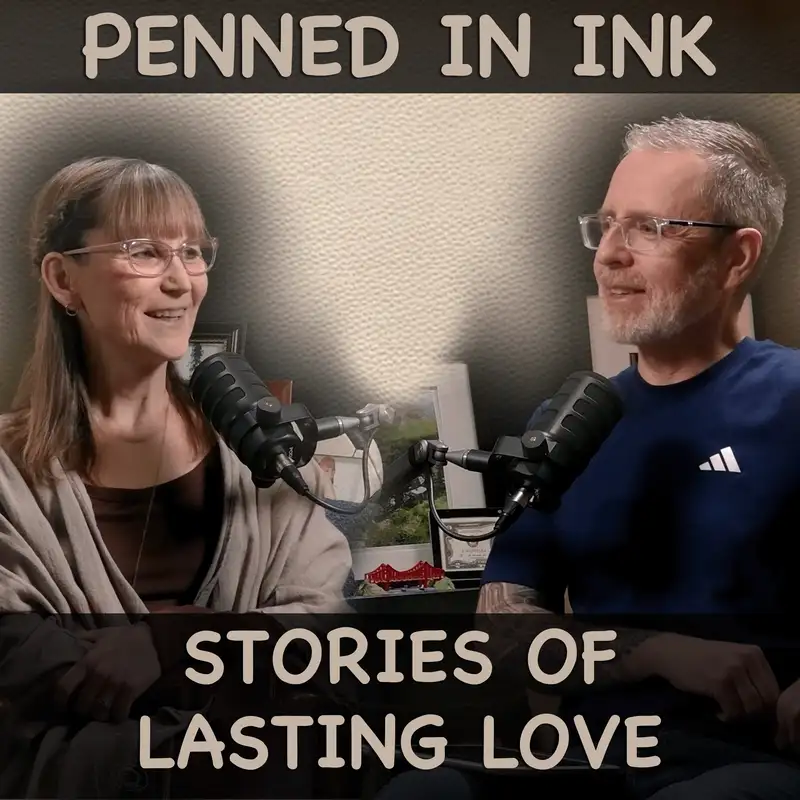
Hello, and welcome to Penned in Ink, a podcast where we discuss marriage and the power of lasting love.
Today, we are here, Melissa and I, with our puppy dog, Ginger.
If you got a catch of her down there, if you're watching us on the pod, we'll see how long she sticks around.
And if we have to tell her to stop snoring, it's on the way through here.
Today, we are gonna talk about our 30 years together, dating, marriage, all the milestones and big decisions we've had to make.
Well, not all of them.
Let's just say that a few highlights of those.
The big decisions, big milestones, and the power of celebrating together.
That's what we're gonna talk about today.
How are you doing?
I'm doing very well.
And you?
I'm okay.
We'll see how it goes.
We had a good start to our morning, which we'll get into a little later.
We're talking milestones.
Yeah.
I think we celebrated a sort of one this morning.
We did, yeah.
All right.
In our first few episodes, we explored our origin story.
We talked a little bit about our professions.
We've given you a bunch of starters to give you a sense of who we are.
And in our next few episodes, we're really gonna start digging into some of the modern challenges of marriage.
Things that people deal with all the time.
Commitment fears, financial stress, societal pressure, and many more topics.
But to round out the discussion about who we are, who our relationship is, and why you might care what we have to say about marriage, we wanted to dig it a little bit into the topic of celebrating milestones and making big decisions together.
We're gonna go through and share some really big milestones we've hit.
We're gonna talk about big decisions we've had to make, how we've made those decisions, and give you guys some insight that might hopefully help you as you're facing big decisions and celebrating big milestones.
All right, I think that's it.
Yes, sir, let's go.
Ready to celebrate?
Ready to celebrate.
There's some good milestones we have in here.
We do.
Let's talk first, before we get to milestones, let's talk about big decisions.
How we make our big decisions and use a few of those decisions as illustrations, right?
So let's talk about the first big decision, which was pick up your family, move 3,000 miles across the country.
How'd we make that decision?
How'd it impact us?
Talk about that decision.
Yeah, that's, I'm trying to think that might be one of the biggest decisions I've ever made, or we've ever made, excuse me.
Yeah, it was all about you.
I think after getting married and having kids, it's probably the third one, because that changed our life significantly.
Without a doubt, without a doubt, yeah.
And it, Michael came to me and said, hey, we have this opportunity.
An opportunity.
The company I worked for got sold.
We had a decision to make.
We either go and move with it, or I get downsized and change jobs.
Look elsewhere.
And at that time, I was a stay-at-home mom.
And, and so it, you having a job was very important.
Yep, sole earner at that point.
Right, exactly.
You came to me and just laid it out.
This is what's happening at my job.
These are our options.
And we just started to discuss.
Let's talk a bit about how we make our decisions.
I came to you, I pitched an opportunity.
I knew that opportunity was full of promising things for my career, but it had lots of concerns for you and I. Our family lives close.
Our kids are young.
You have infrastructure and support and friends and family.
If you pick up your family and you move 3,000 miles away, you lose all those things in immediacy.
So we had conversations, multiple to your point, of what's the upside, what's the downside, pros and cons list, all those typical sort of things.
How did we finally decide to do it?
What was it, what was your deciding factor to it?
Well, first off, I want to say that my first reaction was, oh, that'd be kind of cool.
I'd always lived in Oregon, born and raised in the same city I was born.
I had never lived anywhere else and had barely traveled.
I didn't live 50 miles away from your house.
So with my first breath, it was, wow, that would be cool to try something new.
And in my second breath, it was, all the family is here.
Every, your side, my side, everybody is here.
And the girls are only three.
They're the first grandchildren.
Can we do that?
What impact does that have?
Not on us as a couple.
I didn't have any qualms about that.
I think we'd be fabulous moving elsewhere.
But what impact would that have on those around us?
Right.
Is it a fair statement to say that after weighing the impact on others, the impact potentially on the girls, the impact on us, it ultimately came down to, is this an opportunity that you and I wanted to explore and wanted to take on?
Is that how you would, I mean, that was a deciding factor, yeah?
That's exactly.
I think it's very important to think about others outside yourself.
But when it came down to it, you and I had made a commitment to each other and it was about us now.
And the deciding factor had to be, how does this impact us?
Is this good for us?
Right.
We decided it was.
And by extension, good for our family.
Correct.
Career-wise and location-wise, it was actually a really good decision.
We decided we were gonna move here for five years.
That was our minimum commit.
Gonna go buy a house, cross country, five years.
We've been here 22, 23 years, something at this point.
So it worked out pretty well.
Let's fast forward to another big decision we had that came three years after we moved.
We were here when the girls, we moved here when the girls were three.
By the time the girls were five, six, seven, the decision of, do we expand our family or not?
I'm gonna let you lead this one because I think you have the strongest views on this topic and how we came to this decision.
Definitely.
And I don't mean to correct you, but it was more around age four because it was before they had started school.
It was within a year, year and a half of us moving here.
Gotcha.
I don't remember what I was doing.
And how dare you correct me?
I'm not sure exactly.
I don't know why I was doing it, but I was folding maternity clothes.
I think we were going through some boxes of things to get rid of.
And I came across maternity clothes.
And in my head, I hadn't gotten rid of them yet, even though the girls were four.
I hadn't gotten rid of the maternity clothes.
And I think there was a reason for that.
I was still feeling the pull potentially to have another child.
Having twins is a big undertaking and it's a unique experience.
And in my head, I believe my thought process was, I would like to try to just have one.
What is that?
Is that something that's easier?
Is it more rewarding, less rewarding?
I didn't know.
And the pregnancy was really hard.
So it would be so nice to have an easy pregnancy, whatever that looks like, and have one child.
And what does that feel like in relation to, I love the girls, I love that I have twins.
I wouldn't change it in a heartbeat.
But that was my thought process was, do we want to try and have one more so that it's a different experience for us?
How receptive was I to that?
Not very.
It was, it made sense.
We had decided on two, we had two.
They were getting to a stage that, if you can ever say a stage with twins is easy, easier, right?
Out of diapers, going to school in a year or two.
It was an easier time for us.
So the thought of it felt like starting over.
I think that was part of your logic in it.
And you might've used a sports metaphor.
Hey, right now we're one-on-one.
We'd have to go to zone defense.
That would probably be a smart-ass comment I would make along the way.
It was, it was.
Let me give you a little bit of my perception on that.
We had always talked about having two kids.
You mentioned that.
Two was the plan from the start.
And in a joking sort of manner, I told you, you didn't say it had to be two pregnancies.
You said two kids.
And you didn't give me a parameters of two different times.
So we just knocked them all out in one fell swoop.
But for me, when you came to me with this, I was already very comfortable because to me, my family was complete.
We had talked about two kids.
We had two kids.
As you said, we had entered a phase of life where it was really solid with them and we were progressing.
Okay, so I wasn't overly open to that as far as it wasn't on my list.
How do we get to the decision of not having more kids?
Once again, kind of like with the relocation, it was many conversations.
And I, if I remember correctly, we've talked about me being a crier.
I believe I cried about it.
I'm sure there were, I don't remember any tears, but I'm sure there were tears involved.
The hope was I'd come to you and you'd be like, yeah, let's go for it.
And that's not the response I got.
The response you gave was a genuine one and I appreciated that.
And what it came down to for me was, I remember it, you said, Melissa, I feel our family's complete.
However, if you feel that down the road, you're gonna regret not having one, I'm on board.
And you said that and I, once again, the initial response was, yay, cool.
Then I went away.
I thought about it.
Michael really doesn't want another one.
He doesn't really want another one.
And, but he would do this for me.
That's huge.
That's not how I want to have an additional child, is with one 100% on board and the other one partially on board.
And it made sense to me what you had said.
So I process that by myself.
I don't think I talked to friends.
I didn't talk to family.
I process that all by myself and went, you know what?
No, this, I would want us both to be 100% on board.
And you weren't and that was okay because we had discussed why.
And I felt good about that.
And it was fabulous.
Interesting, because you didn't share anywhere near that much contemplation or reflection during the process.
Probably not.
No, definitely not.
Nope, no probably about that.
Previous episodes where we have talked, I tend to hold things close.
Right.
Not as much anymore, but back then.
A major thought that crosses my mind is even when you think you're communicating really well, if a partner in your case holds things close, or in my case thought I was just giving you space and not realizing how much thinking you were going through, there probably was additional levels of communication that should have happened there.
So even though we were communicating well, I don't think we were communicating.
Fully.
Fully.
Thoroughly.
Yeah, and I think that talks to a little bit about if you're gonna hold back your thoughts, it's really hard to have clear communication.
Interesting.
You're much better at that now.
I think I'm much better at that now too.
I give you space, but I also press you to find out what's going on more than I did then.
Correct.
That's some good insight.
Cause I had not, I don't know if I was aware of how deep you had gone into your thinking on that.
I had.
We'll have to explore that in a future episode.
Cause there's a lot there.
Yeah.
We're not gonna belabor that, but that was a big, big decision in our life that, yeah, you gave a lot more thought to than I maybe realized you did.
And to this day, I think it was the right, 100%, the right decision for us.
Well, I do too, because I was set for two.
I never had that big thing, so it's always felt right for me.
Yeah, I had not once, funny enough, once the girls started school, things got even easier for me.
I didn't look back.
Not once did I think, oh, maybe we, nope.
Well, we'll come back to that because we believe a lot that once you've made a decision together, you're moving forward from the decision.
And that's done.
You can't hold that decision against somebody once you move forward.
And we'll revisit that cause it's very relevant for a topic down the road here that we're gonna do.
Well, let's cover one more on this.
I think that was, well, way better and way deeper than I thought that was gonna go.
So that was good.
I'm glad.
The last one I wanna talk about really quick is, fast forward another few years, correct me on the timeframe, which apparently you're willing to do at any point.
Drop it at.
Some point before the girls were adults, we decided that we needed to get our financial house in order.
I listened to you during the day.
I worked at a computer all day long.
I put on talk radio in the background and sometimes it's financial talk.
Sometimes it's news talk.
Sometimes it's not podcasts cause I really wanna listen to podcasts and understand them.
I can't do that if I'm working.
So it's usually typically background music or background noise.
But I was listening to this financial guy who talked a lot about frugality and really saving your dollars.
And this was prime.
Melissa was stay at home.
So I was sole earner.
We were really choosing, this was couponing days and all those sorts of things and really trying to make the most out of our dollars.
Well, one day this radio show got switched to a different radio host who spoke all about the power of getting out of debt and getting rid of your consumer debt.
And this time we had lots of student loans.
We had a little bit of car, I believe.
And then we had a mortgage.
And the girls were starting to get to the age where they were going to want to do things.
And those things were gonna cost money and we really weren't in a position.
So I came to you with the concept of let's really cut and let's get rid of all this debt before the girls wants turn into things that are- Like maybe needing cars at 16 or- Yeah, that's bigger than that.
I'm thinking like going to gymnastics or playing in sports or shoes and the trendy jeans or whatever the things are that preteens and teens end up wanting.
What was your reaction when I came to you with that?
Was it more receptive than when you came to me asking for another child?
We weren't asking for another child, but we're trying to build our family.
It was, however, I felt that we had already cut back quite a bit.
And I was like, wow, where else can we cut back?
I didn't think that there was much more that we could do.
I was obviously proven wrong.
There's a lot you can do, but when you're already spending, I spent a couple hours a week doing couponing and had a friend that has, she still has it, a blog and talks about all the deals and everything.
And I follow it and I was already doing so much.
We were already doing so much.
We didn't eat out very often.
We were like, where are we gonna come back in order to make these larger payments to pay down this debt faster?
And I didn't see how it could be done.
So I needed a little education on it.
I wasn't listening to the talk radio.
I can't do that in my job, but.
Yeah, it was a time of sacrifice.
And to your point, there were many, many areas we could cut.
And some of them were more impactful than others.
We got rid of all the extra fat.
We got rid of the cable TV, which was before streaming days.
So that was a big cable bill.
We got rid of that.
I didn't have a cell phone, so we had no cell phone payments.
We cut, we didn't eat out very often, but this meant we didn't eat out at all.
We did a lot of things.
And then I also picked up side coaching gigs and that sort of stuff to bring up more income.
There's two ways to reduce debt.
You can cut or you can bring in more.
It was a very busy time to do that.
But I think that was a big decision.
And the only way it really worked was us being on the same page with it.
If one of us had not been fully in, it would have been a stressor for us.
It was already stressful enough going without, then you, because it's very frustrating when you make enough money, you should be able to do things in your mind, but you're carrying a debt load.
So that was a big, big decision.
So we'll talk a little bit about the benefits of that decision and how it's really impacted us.
But let's go ahead and close this first area with our Inked Moment.
And now we're gonna start pivoting a little bit toward the concept of celebration and milestones.
And we're gonna share a memory.
This was actually not from all that long ago.
One of our big milestone celebrations was we threw a 70s themed 50th birthday party for me two years ago.
And let's talk about why that was such a good celebration and how unique it was for us to do something like that.
It was fabulous, by the way.
It was a banger.
It was a good party.
It was a really good party.
We- Banger, that sounds like an old, that's an 80s comment right there.
It's gotta be an 80s thing.
Well, you need to come up far out.
Do you need something from this?
Yeah, exactly.
Yeah, exactly.
Birthdays around our house are typically low-key.
Family, well, it was different with the girls, but for you and I, low-key, we go out to dinner.
We open a few gifts.
We might go to a movie, low-key.
Right, very low-key.
And we don't host parties, couples.
We don't do a lot of entertaining.
Right, and when we do host, it's usually ones and twos or very small groups.
So the idea of hosting a lot of people and then across our friends groups, your friends, my friends, our couple's friends, some work colleagues, some of the girls' friends, because our girls were, at the time, 23, and we knew a lot of their college friends.
We knew lots of people that were across all different demographics that we said, let's just bring them all.
And as you would expect, if you have good people in your life, they all got along great.
I think some of them made friends that maybe they didn't expect.
And it was just, it was great.
But you're not used to being the center of attention.
How did that feel for you, being everybody who's coming together for Michael's 50th birthday party?
I would say, yeah, I guess I was technically the center of attention, but we made it such a party that it didn't really feel like that, which is good.
And I'm very good at socializing.
It's just, I don't like it necessarily.
If you said, what do you want to do on Friday night?
I'm not going to be the list of, let's go to a party with 20 people and talk, but I'm pretty good at that.
So it was fine.
No, the best part was getting to spend non-scheduled time with people.
You get to see them in a different light.
You get to experience it.
And then for me, the two months leading into it, because we planned for a very long time on this party, and we did a costume party, which is not in my wheelhouse at all.
I do not like costumes.
It was a 70s theme, so we went hippie, which actually is a good note.
I'm actually wearing the shoes that I wore, but I wore bell bottoms and other, I had a mustache that was terrible, but it was very on genre.
Anyway, I really liked the whole fun of planning it.
And we'll put some pictures in the video of, it turned out great.
The decor was great.
The party was great.
The food was good.
The drinks were good.
It was fun.
But for us, it was, let's acknowledge a big milestone.
Let's do it together.
Let's bring in the family.
And I think we had some big smiles and good parties.
So yeah, it was a good memory.
That's what I was gonna say, is great memory.
That's the part of acknowledging or part of acknowledging milestones.
You remember that.
We threw an awesome party.
And so we will always remember that.
And we'll remember the planning, the girls.
We all did it and it just, it was a bonding thing for the four of us.
And it was a lot of fun.
That's a great segue into our next segment, where we're gonna talk about the power of celebrating milestones.
Why do you celebrate milestones?
They're, yeah, the milestones are important, but the celebrating of the milestone is really where a relationship strengthens.
Let's talk a little bit about the things that get stronger in a relationship.
Sort of, I think I said the first thing, it strengthens relationships.
It does, that's a bond you have.
We can always say, oh, remember when?
It did, it brought us all together.
We talked more during that time.
We always talk a lot anyway.
Right, building of the bonds and celebrating and taking that pause from your life to celebrate is a really big deal.
I would say, not maybe the 50th birthday, but just milestones in general.
Celebrating those milestones, especially if it's something you've worked really hard for, gives you confidence that you can go attack the next thing.
If we just plow through milestones and we don't acknowledge them, then you don't get all the benefits of having reached a milestone.
Taking a pause, taking a beat, celebrating it, gives you that momentum to go celebrate the next thing.
I think they also set you up for, if you acknowledge the celebrations and you have those good positive momentums coming out of those, it puts you in a better position when you hit issues down the road, because you know you're going to get to the next celebration because you've celebrated the past one.
You're going to get to that next milestone.
Builds resiliency in you.
Celebrating a milestone or an accomplishment, now you take that confidence, you take that boost of positiveness.
When the next one comes that maybe challenges you, you've got a little more motivation to push on through it to get to the next celebration.
As humans, we tend to focus on the negative stuff.
Right.
It's called negativity bias.
And it's kind of, you can get 99 compliments on your outfit for the day.
One person says, I don't think those shoes go with that shirt.
And you forget the other 99.
So to have those positive interactions, to have those wins where, oh, that went well, or that feels good.
When something does happen that is negative, we're better able to deal with it, because life is full of difficulties and struggles.
And that resiliency is what makes us power through.
And it's a healthy thing.
We want to, I tell people all the time, the goal of counseling is resiliency.
We're not gonna take all your problems away.
You will always have something that you're dealing with.
But if you feel good about yourself and you've had some wins and you've celebrated those milestones, you're more resilient and able to push through and do better with issues that come your way when you've had wins and you've celebrated them.
Right, I mean, top of the negativity bias, the whole thing in sport is the wins don't last as long as the losses hold onto you.
We remember those losses, those almost wins, war.
So that's the importance of celebrating the positives.
Let's talk a little bit about, we'd say why you celebrate.
Let's pop through some big celebrations, because this is about celebrating, revisiting milestones.
Let's talk our 25th anniversary that actually turned into your 50th birthday party, because the 25th anniversary happened during COVID.
We had planned on taking a trip and that got delayed and delayed and delayed.
And by the time we finally took it, it was a little bit down the road.
So we did our biggest couples trip, which was just the two of us got away and went to Scotland for, I don't know, 12 or 13 days.
It was long.
Yeah, it was long.
And it was the first big trip we had taken that wasn't a family trip.
We'd done some really big family trips and we had done little weekends with us.
But I mean, beyond just saying it was an awesome trip, why was that important for us?
Because it was an awesome trip.
Amazing is the word that comes to mind, but you and I work from home.
We spend a lot of time together, but it was a different kind of, seemed like it, to me, it felt stress-free.
It felt we were doing something together that we had never done before.
You had never been to Scotland.
I had never been to Scotland.
We were doing something together.
And I think that, you know, that strengthening the bond.
And I just, I don't want to say I came out loving you more, but it was, it just felt really good to be with you over there and all of the things that we did and all of the fun.
It just, it just made us feel really tight, you know, really, really in tune with each other.
And when you're in a long-lasting relationship, you don't always feel in tune.
It's, it just happens.
But that, it was just really good from start to finish.
Yeah, I think just the same as celebrating the 50th anniversary or the 50th birthday was something that's out of the norm, which breaks your habit, breaks your cycle, allows you to really deeply experience and go into something.
That's what travel does for us.
Because we work very hard.
We're very much, you know, in our lanes working really hard.
Our work-life balance part is when we travel, we try to get totally away.
And if you are, maybe, maybe you're in a long-lasting love and you have kids.
I think we get absorbed with all the family time and inclusion of kids and we lose the coupleness.
And I think to your point that your intense connection ebbs and flows in a long-term marriage, you don't stay in that first year of, of, you know, passion.
You have bits of passion.
And I think one of the things that's really fun about just the two of us traveling is you put all that stuff aside and you get to just be together again.
And so, yeah.
And then the other part is every time we see Scotland, every time we see pictures, every time we see anything that resolves that, we're, we've got a whole index full of memories that come from there.
Or we see a shot on a TV show.
We're like, holy God, we know what that is.
So those really build those lasting memories and strengthens our bond.
Let's talk about another one.
This one is maybe not as core on just the two of us.
This one is a little more a family celebration, but the girls graduating college, you might think that's their, their, their milestone and their accomplishment.
Why did that matter for us?
How'd that help us as a couple?
Not every child graduates from college.
I think for a child to do that, they have to have a base of support, assistance when times are hard.
There are so many things.
And we gave them that.
We gave them that base that they had, that they, they did all the work.
When it came to their studies, we didn't do it.
You know, I believe they got their work ethic.
They got their strength.
They got their intelligence from us.
And so their success in that area was also ours.
We helped, we helped them get there.
Right, and we put back to the work we did to get out of debt when they were very young, we put them in a position where college was more affordable for them.
Like that was a goal for us.
We had done a lot of budgeting and planning and not everybody has the desire to do that.
Not everybody has the capabilities to do that, but we were fortunate enough and we made it an intentional enough priority that we had a role we wanted to play in that financially for them.
They took a lot of work.
And I think we took a big sense of pride in you and I of, hey, we accomplished that goal.
And back to the fact that we had twins, that's two happening all at the same time.
They left the house at the same time, but the bills came on the same days too.
And yeah, a lot of you who are in long-term marriages and have kids, if you know they're a year or two apart, you might still have several in college.
So it's not a totally unique, except it's just intense because, you know, you get two tuition bills and they went to the same college.
So the registrar there loved us because they sent us lots of bills.
That was a big milestone.
And again, having accomplished that, not only freed up resources for the next goal, but it showed us we had the ability to hit the next goal.
And for me, it got me excited about, let's go hit the next goal, right?
So I think that was a good celebration.
And then another one, and this is the last of the big milestones we're gonna talk about today.
Well, actually there's one more we'll talk about, but the last on this list is our daughter, Taylor, got married about a year ago.
And maybe a theme here, maybe we do throw parties that are pretty good, because we threw a pretty big party for that too.
So let's talk about how getting your, one of your daughters off and launched into her married life was a celebration and a milestone for us.
Yeah, that was so much fun, stressful.
And Taylor and Alexa did a lot of the work.
Once again, kind of like with the party, there was a bonding experience, there was a shared goal.
And I took some pride in that she found somebody that she wanted to spend her life with, and he's a great guy and- He's all right.
Anyway, and it just- I kid, I kid, go on.
With each of the things, it's just, you know, high school graduation, then college graduation, and then they found fabulous jobs.
And then this was just another one that was just, wow, our kids are successful adults.
And that was the goal.
I think that should be most parents' goals, to have successful adults, whatever that looks like.
Everybody's might be different, but- Right.
This is pretty, pretty successful and- Back to you and I, what was the value to our relationship of that particular milestone?
You know, we saved for that.
We, once the- You did put some money into that, yes?
Once the college, once we were finished funding the college funds, we turned right around and we started a wedding fund for both the girls.
You hadn't thought that was the next big one, but that really was the next big pivot.
It was.
We could have stopped there after the college and just kind of, you know- Yeah, none of these were obligations.
These are things we chose to do.
And you get some relationships or some children that think it's your obligation.
It's not your obligation, it's your choice.
And we made the choice.
We wanted to do some of those things.
You hit on the big planning, obviously coordination again.
So driving those bonds with the girls, although they took the lead on that, lots of decision-making, lots of fun, lots of pride and all that.
I think for you and I, it's just one more step on fully having your kids launched that was fun to celebrate.
Yeah.
That's my sort of big takeaway on that.
Yeah, definitely.
Yeah, that was a good party.
We got one more, I mentioned earlier, there's one more milestone we wanted to talk about.
Well, I actually want to dig just a little bit deeper on the topic of resiliency.
How does celebrating milestones prepare you and make it easier to go through times of struggle?
So we're gonna introduce one of our big struggles.
And I think we alluded to this earlier, maybe in one of our earlier episodes.
But in 2013, at the age of 13, one of our daughters, Alexa, was diagnosed with a rare form of muscular dystrophy called fascioscapular humeral muscular dystrophy.
That's a big, long word.
One of her first challenges was to learn how to spell that and how to pronounce that.
But that's a genetic disorder that, and she's very open about this.
So we're not sharing anything that she hasn't been very open about.
I give her a massive amount of credit.
From very early on, she has chosen to embrace it and just be what it is.
But it's a muscle condition that weakens her skeletal muscles progressively over time.
At the time she was diagnosed, she was 13 years old.
She was playing competitive soccer.
She was playing for the junior high and she started having some difficulty keeping up.
And we'll go into much further details about her process of how she got to her diagnosis and what it did to us, because it was a very, I think the easiest way to say it, it was a very big time of change for the family.
And that our family dynamic has never been the same since that.
There's no way to sugarcoat when your child gets a lifelong diagnosis.
That is a time of stress.
And for us, we wanna put this in context of resiliency and what had we celebrated before?
What had we done before that put us in a position to handle this?
Now, we had mentioned earlier on that we had spent very conscious effort in getting out of debt.
And if anybody's gone through any medical sort of stuff, you know lots of financial comes with that.
And if you're very fortunate and you have good health insurance, you still have big bills that come with that.
And in our case, we had travel and we had hotels and we had, because it wasn't something you could just go down to your local pediatrician and they diagnose.
It took months and it took physical therapists and it took neurologists and it took, I mean, it took a whole slew of doctors.
And we finally ended up down in Charlotte, which is not that far from us, three or four hours, to a specialist who diagnosed her and everything.
But it was a very long journey to get there that had some financial issues to it.
And for me, I very, very, very vividly remember coming back from the day of diagnosis and it was a very tough day.
And Alexa, I don't think, was fully understanding what was going on.
You and I had a much clearer understanding of what had happened.
And I remember halfway back through the drive, like I remember the bend in the curve.
Yeah, like I don't drive that way to Charlotte very often, but when I do, I'm like, oh, that's where I had that thought.
And it was, I'm pretty sure I said this to you at the time, that, thank whatever, that we had done all the work to be in a good, solid financial position, because that allowed you and I just to focus on helping her and the family through medical.
And if you and I had not been in a financial place, or if you and I had not been in a relationship place, that would have been devastating to come through.
Because if you aren't strong and have, if I didn't have you to lean on during that time and we weren't good, it would have just made all the stressors even more.
So for me, that is a really rock solid example of making the big decisions, doing the hard work, but celebrating those milestones, building those bonds, strengthening those bonds, really impacted when we hit a time of challenge for the family.
That was a lot on that, which we're sure.
I was just thinking, if you can ever be ready for something, we were as ready as you could be, I believe, or something like that, because of all the things you just noted.
We had a focus on each other and our finances and our children.
And we were as prepared as one can be when you find out that your 13-year-old has a lifelong disorder.
Yeah, it was a big milestone.
Now, let's clarify a little bit.
We weren't out of debt.
We were just in a very good working relationship around it.
We had very big goals and we were relationally solid, which is always easier to handle big issues, big challenges when your relationship is solid.
And I mentioned in the very first episode that when done right, marriage is a force multiplier.
I think this is one of those cases for me, one of those examples where independently it would have been really hard to go through that.
It was still very hard, but having someone who you know is equally going through that with you was a good thing.
Another point to that is we weren't out of debt and we didn't know exactly what Alexa's diagnosis really meant for her.
There's a variable nature to this.
She goes through periods of decline where her muscles will deteriorate faster.
And they don't really know when that's gonna happen.
That can happen in a year period, it can happen over a five-year period.
And at the time she was pretty mobile, but that was not gonna be guaranteed that she was as mobile there.
And reality is that was probably gonna be her peak mobility because it's a progressive decline of muscles.
We had not traveled, we had not done anything, any of our big family things at this point.
And we were getting very close.
And this time we were being very aggressive.
This was, let's get rid of the house debt.
This was not consumer debt.
This was, let's get rid of the mortgage.
We're very close.
And I was getting beat up on mental at this time.
I was not, we were so close, but we weren't there.
And we're huge soccer fans, we're huge EPL fans.
And one of the trips we really wanted to do is we wanted to go to London to see you.
We're Chelsea supporters.
Sorry if that bothers anybody.
We wanted to go see Chelsea play in person.
That was something we had really, and that was part of our vision of why we were doing all the work to get out of debt was so we could save and then do this big trip.
And I remember, again, a walk of ours and being very frustrated of we're close, but we're not there.
We don't know how her, like, should we go now?
Should we stop this?
Should we just spend some money and do this?
And this is one of those times where the strength of our bond really came in, because you were the one who's like, no, we're super close.
Let's do this next six months.
Let's finish this.
Let's stay on schedule.
Then we'll go do that.
And it was a good bolstering of when my, my focus to finish the goal had sort of waned, which I was, that was very rare for me.
I was really very focused on that.
You were like, no, no, no, we've got a plan.
So for me, I think that helped us through that, another point of resiliency.
And then fast forward, we finished that goal and we were able to take that trip and it was awesome.
And we've been very fortunate in taking that trip a couple more times.
And now when we do that trip, she uses a wheelchair and it's a very different from that very first one.
Yeah.
I shared a lot on that.
Anything else you want to add?
No, no.
I, I was just, because I had forgotten some of it.
Yeah.
Again, we rehearse.
We don't actually share the stories.
We just rehearse.
You had wavered a bit.
And I remember now as you say it, but in both sides had merit, right?
Finishing it off, but also taking a trip before we know how impacted she would be.
And once again, though, right decision.
I mean, financially, that was the right decision.
And you were, you were clear enough thinking at that moment to keep us on the track, to do the right way of financially right.
It was a financially responsible way.
And we try to be, try to be responsible in many areas of our life.
And that was an area where, no, this is the responsible way.
And we try not to make emotional decisions or snap decisions.
And that would have been an emotional decision.
And it doesn't mean it would have turned out terrible.
It just wouldn't have been the path we're supposed to be on.
Great.
Let's move to our closing segment.
Today's episode has been all about big decisions, making them together, and then celebrating milestones and how celebration can help you forge lasting bonds.
These bonds are critical for getting you through those rough times, giving you momentum to attack your next big, big goal.
In our Pen to Paper segment, we are going to give you a practical takeaway or an action step or a challenge to help you write your own lasting marriage story.
Today's tip is to mark small celebrations.
We've talked a lot about large milestones today, big decisions.
Those are rarities.
You don't hit 50 very often.
You don't take a 25th anniversary very often.
Your kids don't graduate very often, but small victories, small things, milestones, small decisions happen all the time.
So what are some small decisions we're talking about?
I'll start with an example of a small decision.
Melissa is someone who does not like conflict.
And in her private practice, running your own business, there is conflict.
You might have a issue with a vendor.
You might have a client who has an outstanding invoice.
You might have a number of things that are tough conversations or conflict that you're going to have to deal with.
When those occur and you get through those, we stop and acknowledge.
And that was a hard conversation, well done.
What's some other small things we celebrate?
Yeah, we talked earlier about me being somebody that keeps things close to the chest.
Sometimes I have stuff in mind that I want to talk about and I keep putting up.
I finally do it and there's that relief.
And I say, oh, I've been meaning to talk about that for a while and you typically respond.
Well, thanks for sharing or thanks for bringing it up.
And that feels good.
I would consider that a small win.
That's something that happens hopefully more frequently than the big milestones.
Yeah, another one that comes to mind is learning a new skill or trying to put a new behavioral change or a new habit you're working on.
It might be, hey, I set a goal to work out more.
And so you're working out three or four times a week and acknowledging, hey, this is progress.
Or one that comes to mind is I have a few pet peeves and I remember about a year ago, I traveled up to visit my dad.
And while I was gone, one particular pet peeve I'd sort of harped on was we have these pantries near our kitchen that you have a habit of not fully closing, you don't latch them.
And while I was gone that weekend, you took some effort to train yourself.
I'm gonna use the word train yourself, new habit.
And you got to the point where you're closing.
I think it took me a few days once I got back and realized the closets were, or the pantries were being closed.
But that's an example of you consciously making a nice change to something.
We celebrated that, I celebrated that.
It took an annoyance that was minor, but it was still an annoyance.
We celebrate the little victory there.
Any others come to mind?
I've got another little one.
We celebrated this morning.
So our son-in-law, he had set a goal for himself and for him, this is a big milestone.
For us, it's a little milestone because we weren't really impacted.
It was a small moment, but he had set a goal for himself to train and run a half marathon.
He needed some motivation to keep his workouts going and everything.
So he trained really hard and he ran his half marathon this morning.
So we went and cheered him on and celebrated that.
So in our world, that's a small milestone because it's our son-in-law who's doing something big in his world.
And we were just cheering.
But the whole point is we went and celebrated that.
That was a morning activity to acknowledge something that was great.
And that for him, it's a much bigger milestone and he'll help use that to launch him on us.
But that's for us, it's celebrating your son, who's doing something cool.
It's a good way to start our morning.
Why do, what are some ways that we celebrate?
When we say celebrate in these cases, we've talked about big banger of parties.
That's not what we're doing here.
What, how do we celebrate this?
Well, positive reinforcement.
Hey, good job on that.
I'm proud of you.
I know that was hard for you.
Good work.
It seems so simple, but it's very impactful.
Right.
I think that is one of the ways, thoughtful gestures, leaving a note.
You're not a big card person, but still, Valentine's Day, a little tiny card that says, I love you.
And very simple gestures.
Right, and some people, you know, whatever their, I don't like this term, but you hear it all the time, whatever their love language is.
If they like food, you make them a special meal.
Or if there's a special treat they like from the gas station, if they're a gas station snack sort of person, you pick up their favorite snack.
Or if you're like me and walking our lovely dog, who's actually stayed here the entire episode, which I'm shocked by, is not always my favorite task.
If I've had a long day, you'll, you'll, it's maybe not a celebration, but it's those little things that you'll do to, that might be a way to celebrate somebody's, oh, I know you've had a long day, or I know you had that stressful conversation.
I knew you had that work thing coming, or there was something else.
Let me take care of this thing.
This may be a chore for you more than an enjoyment.
The importance of acknowledging small celebrations is they happen way more often than big ones.
And if we spend our time and our energy celebrating those, you're gonna have a lot more celebrations.
And then all those positive benefits of celebrating come into play.
Yeah, you get discouraged if you're just celebrating the big ones that only come every couple months or even years.
That's discouraging.
You want something that makes you feel good.
Yep, and the last thing I would say on this, they help you keep things in perspective.
We often don't feel like we're making progress.
And if you only celebrate the big milestones that don't come along very often, it's hard to know you're making progress.
So celebrating your little wins along the way gives you that positive boost.
So celebrate your small wins.
They're important.
They actually happen way more frequently.
Celebrate more often.
And they really are more important than people think.
They're like, oh, but that's just, I'm like, well, that's important.
That's validating.
It feels good.
Acknowledge them.
And we put this all in the celebrating milestones.
Celebrate your small decisions too.
Sometimes the small decisions get them out of the way.
Be proud of making those small decisions.
We don't necessarily celebrate our decisions like we celebrate our milestones.
But if they're hard to make and you just make them and move on, hey, good job, we're moving on.
We put that behind us.
All right, that's our Pen to Paper segment.
Awesome.
Well, you want to wrap up?
Anything else we want to talk about here?
No, that was fun.
I really, really enjoyed that.
Yeah, there's some good segments today.
All right, as I mentioned at the start, this just sort of wraps up our relationship overview.
We've told you our origin story.
We've told you our careers.
We've told you why we chose commitment.
Next, we're going to dig into modern marriage and modern marriage topics, challenges.
There are a ton of them.
This is where we're going to get into the meat of some of the deep dives where we've had the luxury of saying, we'll talk about that in a future episode.
Well, those are future episodes.
They're coming.
We'll go deeper on some of these topics.
All right, we want to thank you for joining us today.
We invite you to connect with us, make a comment, ask a question.
If you like this content, give us a like, leave a positive review, and remember to subscribe, get notified for future episodes.
All right, thanks everyone.
Have a good one.