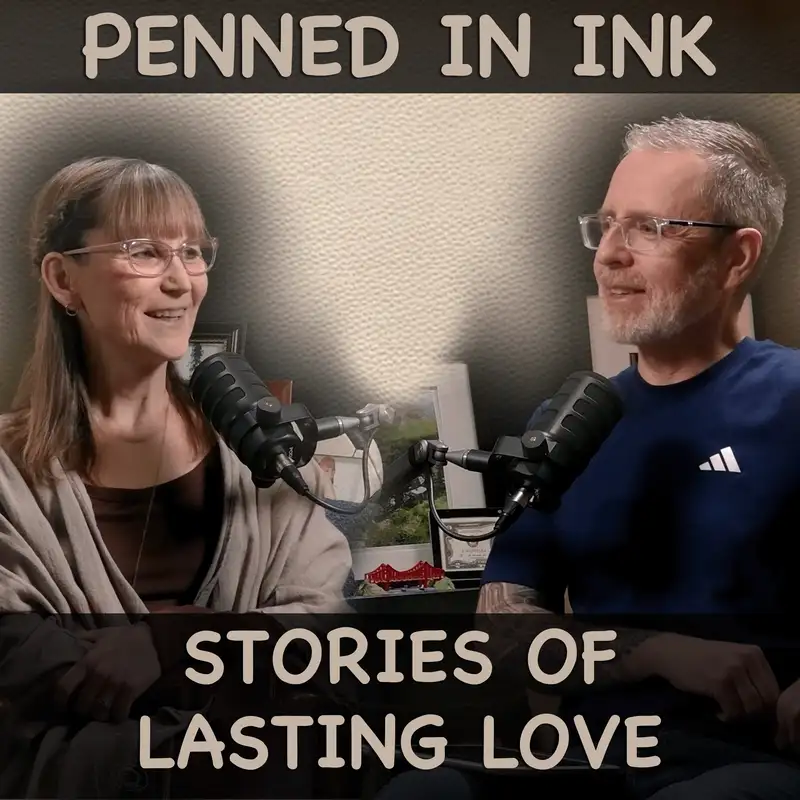
Hello and welcome to Penned in Ink, a podcast where we discuss marriage and the power of long-lasting love.
For those of you who might be joining us for the first time, I'm Michael, I'm here with my wife, Melissa.
We've been married over 30 years, and on this podcast, we share stories of our life together with the goal of helping you form your own long-lasting love story.
One thing we love to do is to celebrate a milestone, and today we are recording our 10th episode of Penned in Ink.
Pretty nice.
Double-digit numbers are always fun, we like round numbers, and I look forward to hitting triple digits.
Well, that might take us a little while to get there.
That's okay.
It's a good goal.
Nice.
It's good to have goals.
In each episode, we dig into a topic from our relationship, something that we've dealt with or managed, that we think you are dealing with or managing or trying to get through yourself.
And today, we are going to talk about conflict.
All relationships have conflict.
Maybe you fight like cats and dogs, maybe you are more low-key in your disagreements.
But either way, one thing is true.
In long-lasting love, there will be conflict.
How you resolve conflict and heal from hurt is a strong indicator of your potential success in a long-lasting love.
So today, we're going to dig into the topic of conflict.
Sound good?
Yeah.
You ready to do this?
Let's go.
We're going to go into some stories from our over four years together.
Four years.
Four decades together.
And look at how we resolve conflict in our relationship, how it's changed over time when we were young and sort of learning how to communicate, and now how we are probably a little bit, let's say a lot better at communicating than we were in our early days.
And we're going to go over some tools and tricks and things that have worked for us.
Some things that Melissa has learned in her many years as a mental health therapist, working with families and adults, I was going to say couples, but you don't do couples counseling now.
Not anymore.
But working with people to resolve conflict in their relationships.
And we'll share some stories along the way and probably some, yeah, don't do this, because it doesn't work.
Sound about right?
Yeah.
Sounds great.
Anything you want to add before we get on to here?
Just to normalize, I guess, that everybody has conflict, even the best, even the strongest of relationships.
You're going to disagree on things.
You're different people.
Yeah, for sure.
And I would say every relationship is going to have the conflicts.
The ones that are successful are the ones that learn how to communicate effectively, but to heal and repair quickly, because you're going to have conflict.
And to your point, yeah, that's normal.
It is.
All right.
So you ready to drop all your counselor wisdom on us today?
Oh, yeah.
Let's see what I got.
Yeah.
Melissa's coming from the background of many years in the profession of counseling.
I'm coming from the background of many years in marriage.
So that's how we're going to go at it today.
She brings the expertise.
I bring the street knowledge.
There we go.
We've done it.
All right.
In your relationship, you might see that you are revisiting the same areas of conflict over and over again.
And for us, that has certainly been the case.
Over our three decades of marriage, longer together, there are certain areas that we continually have conflict in.
And conflict's not always a bad thing.
Sometimes it helps us grow.
Sometimes it helps us find clarity.
And other times, it's just a pain in the ass.
So we're going to talk about a few areas that we have experienced conflict in our life and continue to experience.
So what's the first one you want to talk about?
Probably the money management.
It's the one I'm least comfortable with.
So let's start there.
Let's get this out of the way.
Exactly.
Melissa and I are super aligned when it comes to financial goals.
Where we are not as aligned is to the details around managing money.
Does that sound about right?
Is that the conflict area we have?
It is the conflict area.
So I know what my views on this conflict area are, but let's start with what your views are.
Where do you think the conflict lies around money for us?
It lies, once again, like you said, not in that we're not aligned on our goals.
The goals are there.
We're not aligned on the monthly, what does the budget look like this month?
And you'll say, oh, what do you think?
We have, you know, got a bonus at work, where should we put the money?
And I don't participate as well as I would like to.
I would like to be more involved, but that's 100% on me.
I don't because I'm not comfortable with it.
She's pausing here.
I'm just letting her go and go and go to see where this is going.
Yeah, it's the, Melissa and I, like I said, agree on the long-term and we're always aligned on those.
But every time you're asked to contribute on a monthly basis, I'm like, hey, what are we doing this month?
What's the goals?
What's the priority?
Hey, why don't you take a pass at our budget for this month?
It is like I'm asking you to walk across hot coals or something because you hem and haw and four days later, there's still no, you haven't allocated money and put things into buckets and we don't have a plan.
Yeah, so I think that's a continual point of execution.
I would say another area is we're big believers in having the details of our financial house in order.
How familiar and comfortable are you with all those details?
That's a leading question.
It really is.
And it comes down to, and it may be morbid, but it's something we talk about on occasion.
If you get hit by a bus and you die, will I know how to, where all the numbers are for the retirement accounts, the savings account?
How would I access that to have things in order for myself?
Because I'm moving forward with that.
And the answer is not very.
Right.
Now, are you not very familiar with it because it doesn't exist or because you?
It totally exists.
We have the ducks are in a row, you know, I know where to find everything.
However, the actual, once again, execution would be very difficult for me and it would take quite a bit for me to unravel.
Yeah.
So I think this is an example of an area where we're very strong, yet we still have room to grow an area of conflict in here.
From my perspective, it's something that we spend a lot of time and effort to make sure that if one of us passes away, the other person can just financially keep moving.
And I feel like you don't grasp a lot of the details because you don't spend the attention on there.
So again, point of conflict, something we're working on.
We'll check back in 10 more episodes and tell you how we're doing on that because it'll probably still be an issue.
It has been an issue for a few decades, so it'll probably still be an issue down the road.
Let's pivot to another area of conflict, maybe one where you're on the other side, where I'm maybe not as detailed on it as I should be.
Let's talk about, and this is a little bit back, we have two daughters, they're now 26.
Melissa was a stay at home mom for the first six, seven years before she went back into the workforce.
And as a stay at home mother of twins, Melissa really believed in her routines and her patterns and her ways things needed to be done.
And my style and parenting and doing things sometimes didn't match what her view was.
Let's talk about that a little bit.
Parenting style differences.
Parenting style.
Kind of like with the money, we agree on the biggies, right?
We had certain things.
We didn't use corporal punishment.
We...
Spanking.
Just translating what corporal punishment is, that's a nice term, but yeah, spanking.
Right?
We were aligned on the big things.
What we wanted for the girls, school-wise, how we wanted them.
We aligned on all of that.
It was, like you said, the day-to-day stuff.
They're twins, identical twins, and I wasn't into dressing them the same, for instance.
But I liked them to coordinate and maybe the same pants, but a different top.
Or we had two Winnie-the-Pooh outfits, and I wanted them to wear them on the same day.
They were different Winnie-the-Pooh outfits, but still Winnie-the-Pooh.
I wanted them...
And you would say, hey, I'll get the girls dressed.
I'm like, great.
Let me finish my makeup.
And then they'd come out in the outfits, and I'd cringe a little bit, and I probably did say something.
Did I say something?
I mean, probably.
Yeah.
I mean, that's a micro example of something that in my world I wouldn't even think twice about, but you were very particular about.
And there were other examples where it mattered, and we were aligned.
Nap times, or rest times, or what to eat.
Those things we were aligned on.
I think a lot of the little details, the differences between how a non-full-time parent and a full-time parent might do something, or just simply the difference between how a father will interact with your child and a mother would interact with a child, would cause a little bit of friction.
But I would also say that that sort of characteristic parenting was just one of those avenues.
It could be the way that you run your house.
That concept of, I carry the majority of the load in an area, and I need your help on there.
But then when you help, I want to criticize or tell you you're doing it wrong.
That applies to a lot of areas for a lot of people, going beyond our example, but thinking about someone who might be listening to this going, oh, yeah, I try to help, but when I help, you tell me I do it wrong, or I try to help, and it's like, and then you redo it.
I think redoing it is about the most insulting thing you can do.
Do you have an example of that?
I so do, because it comes up in therapy all the time with, a lot of my clients are married, and it's the dishwasher.
The person that usually loads the dishwasher wants it a certain way.
This is the way that silverware goes, this is the way, and their spouse or significant other will have done it while they were gone, and they come back and they rearrange it because they didn't like how it was.
And I mean, I just heard that a week ago.
Yeah, massively insulting.
Right?
And that's not, they're not trying to do that.
I truly believe it is not a malicious reason for their doing it.
Yeah, but does the thought process that goes with that of, oh, it's not helpful and they did it wrong, because I bet you that is the thought process that goes with it a lot.
And that might not be intentional of, I'm redoing it, but it is a rejection of the fact that the help was given, but not the way I wanted it.
Okay.
And if it's in those areas where it doesn't matter, it's just different, that's where you've got to learn to give and take and let those things go.
If it matters, if it truly is something where it's not going to work or it's harmful, then yeah, you need to correct.
But there's lots of times where the dishwasher's good, it probably doesn't matter.
Yeah.
It's about if there's a real reason, a functional reason why it's done a certain way.
Because I've also known of a lot of people that have said, hey, I stopped helping because every time I did, it was redone or I was criticized.
Like why would I even help if it's not appreciated?
Right.
And back to the budgeting stuff or the financial stuff.
If every time you did it, I went back in and redid it, you'd stop doing it.
Yeah.
Good example.
Let's move on to one more and then we'll rapid fire through some other areas.
One area that we have sort of struggled with is how much time to spend with family, extended family, in-laws.
This was really in earlier days, partially because we moved 3,000 miles across the country, which sort of negates this issue.
But early on days, we had disagreements around holidays or weekends or special events or not so special events in somebody's view that maybe one partner views as a special event.
How much time you spend at those versus...
Yeah, definitely.
And I think that's pretty common for a lot of people, unless they're single children or orphans, they're really...
It's going to come up.
And I do remember that vaguely, that we did have some, and it was usually, my family did a lot of things.
Oh, say vaguely.
There's no vaguely about this.
We had conflicts around this and yes, it was your family, because you are more actively social with your family than I was with my family.
It made sense that there was going to be more opportunities for conflict of like, hey, weren't we just there or wait, aren't we going there next weekend?
Why are we going down again this weekend?
Those sort of interactions.
Yeah.
Yep.
Make sense?
I think that's accurate.
All right.
Now, we did a whole episode on conflict in early relationships.
Episode five digs into a lot more of the details about what we struggled with on those early days.
Let's just rapid fire through, and I'll hit this list here, of other areas that you might be experiencing repetitive conflict in your life.
Might be around personal versus private time.
How do I get my own alone time when we're building our couple's relationship?
Or it might be with, I want to spend time with my friends, or family in this case, versus as a couple.
So just finding that time balance might be a continual conflict.
Division of labor around the house.
We definitely talked about this.
Who carries the emotional load?
Who carries the workload around the house?
How do you divide chores around the house?
Digital boundaries.
Just wrapped up an episode that's launching very soon around establishing good digital boundaries for your relationship.
Jealousy.
Intimacy.
Well, this probably goes on and on and on, but I think that's sort of the gist of it.
Yeah.
Yeah.
It's quite a few of them.
It's the more common ones, I think.
All right.
We just shared a few areas that we have personally had recurring conflict.
What areas do you find yourself revisiting over and over again in your relationship?
Let us know in the comments.
Let's now pivot to conflict resolution.
We've gone through several areas where we have reoccurring conflict, but the real important part is how do you resolve those conflicts because they are going to happen.
Now, there's all sorts of tools that you can use to resolve them.
Some work great for us.
Some might work great for you.
Some that wouldn't work at all for us might work perfect for you.
As a reminder, Melissa is a mental health professional, so you spend your days helping people work through how to resolve conflict in their life.
We have found a few tools that work really well for us, so we're going to discuss a few of those.
Now, before we get into that, we did want to mention that we've pulled together a guide for you to help step through some of these tools to put into action in your relationship.
Link to that free guide is in our YouTube description or in the episode description, so feel free to look at that, but we're going to dive into a couple of those to start.
Now, Melissa is going to lead most of this because, well, let's be honest, you've got the professional background in this, and I'm just going to chime in when I disagree.
Hmm.
Sounds a little familiar.
Exactly.
All right.
So let's start with listening.
I think that's where we start.
It's one of the main components of communication is listening to the other person, and not just listening but actually hearing them.
There is a difference.
I can listen and tell you the words, but did I process it?
That comes down, active and reflective listening, nodding your head, acknowledging that you've said something.
That's more active.
Reflective is what I hear you saying is, you had a rough day at work.
I'm sorry.
Is there anything I can do to help?
That's more reflective.
But both of them are strong tools that we are definitely better at now than when we started dating at, oh, gosh, I'm not even going to say it, when we started dating in our very early days, in the early days of our marriage.
Yeah.
This is one of those skills you absolutely have to practice, and you will get better with it as you practice.
And to your point, it's not about just hearing the words that are said, but it's understanding those words.
And one of the tricks, tips we have done is we've gotten much better at not just saying the words back, but putting them in your own words.
That's that reflective listening part that you're talking about, because it's great to nod your head and say, yeah, I heard you.
And it's even one thing to, were you listening?
Yeah, you said blah, blah, blah.
No, no.
Did you hear me?
And actually put it in your own words so you understand.
We've gotten tons better at that, so just actively listening.
Something that we have built into is some ground rules around how we argue, right?
And I don't know that we went through a formal process, but I think going through a formal process of agreeing how you're going to argue is probably something, yeah, talk about that a little bit.
Yeah, I think that's important.
And I agree with you.
We didn't sit down and say, wow, we've been arguing quite a bit recently, let's sit down.
Let's talk about how we should do that moving forward, because what we're doing isn't working.
And some good ground rules to have are like no name calling, no yelling, no accusing.
No digging up things that are not part of this argument.
Right.
Let's talk a little bit about our personal style, because 20 years ago, I was much more hot tempered than I am now.
I'm a lot calmer in my 50s than I was in my 20s and 30s, but we were never yellers.
We were never screamers.
We were never name callers, but you see that all the time.
Yeah.
Oh, I see it a lot.
And for hearkening back, which makes sense because this is about our story, I used to internalize quite a bit and didn't share.
I know that's something that I used to do.
It made me uncomfortable.
I just, ah.
You weren't as open about sharing stuff as- I wasn't.
No, I kept stuff to myself, but then I realized with experience and then going to grad school, that doesn't work.
It serves no purpose whatsoever except to upset you.
It doesn't resolve the issue.
It doesn't make you feel any better.
It just, it honestly feels terrible.
Yeah.
And so that's a difference where I used to internalize and now I share.
Yeah.
There's a lot of ground rules that we've grown into that if we were to say, hey, what are our ground rules?
If we were to do this exercise, if we were to go back and use that guide and go through our ground rules, it would definitely be no yelling at each other.
It'd be no name calling.
It would absolutely never be cursing at each other.
Like, I mean, we just don't do that sort of stuff.
I would also think that this goes into the next one, which is we take timeouts.
We don't try to resolve every argument in the moment.
So talk about a timeout strategy.
Yeah.
And especially for us, I'm one that often needs to think, I need to process.
So process internally, but then discuss it.
And we might be in the middle of something and I'm getting overwhelmed or I don't think it's productive.
And I might say, hey, you know what?
This isn't working for me right now.
Can we talk about it after dinner?
I think that's a really important part of taking a timeout is letting your partner know that you do plan, not that you're going to ignore it now.
That's what people worry about.
They worry that if we don't discuss it right now, and that's where conflict comes.
People are forcing the other one to talk about it when they're not ready to or don't want to yet.
But identifying, I need a break from this right now, but can we talk about it after dinner or can we talk about it on Saturday?
So I have time to process and work through my thoughts and feelings on this.
Yeah.
I think I was reading a little bit about the difference between how men and women process.
And I think there's a lot of times where, and I know I do this.
I simply go quiet.
Like, I don't want to talk about this right now.
And we've been together long enough that you know that when I go quiet, that is our timeout because I'm not going to go any further on this.
I was just going to say because you're never quiet.
It's a dead giveaway.
Yeah.
Yeah.
Definitely.
So I go quiet.
I don't want to stop the conflict from happening in the moment.
It might be to give you time to collect your thoughts because there's sometimes that more than not, it's time for me to just take a break because one of the things I think I've learned over this is that a lot of these arguments, let's be honest, they don't matter.
They don't matter at all.
They're stupid.
They're in the moment.
They're irrelevant to our long-term goals, our long-term vision.
And if I try to win every one of those arguments in the moment, why?
It doesn't matter.
And so by going quiet, it gives me time to just decide, was this really something I cared about?
Because sometimes I don't really care about it.
It just kind of annoyed me in the moment or it was something that I wouldn't have done or I want it differently.
It doesn't matter.
It doesn't matter.
But if it's something that matters, then I'll come back at it later.
Yeah.
You're smiling.
Give me details on that.
Why?
No, because I know you don't like the term, but you just described it.
Oh, no.
Here we go.
What term is it?
I don't know.
What is it?
Choosing your battles.
You're not a fan of that, but that is what you just described, which is, is this something that is important enough to me that we need to have this level of a discussion about it?
There is no way that absolutely everything, does it really matter if X happens?
How does that really affect me?
And the way I describe it to people is, if you're not sure, don't do it right in the moment.
But if it sticks with you for days, it usually means that you chose not to address that and have that battle per se, but it apparently is something that you need to talk about because you're unable to think past it, let it go.
Yeah.
I mean, one of the biggest indicators of long-term success in your relationship is choosing which things to fight over, choosing which things to lean into, because to your earlier point, we are different people.
We're going to see things different.
We're going to have disagreement, but if those disagreements are minor, just let them go.
They don't really matter in the big scheme of things.
Yeah, absolutely.
And these are some great tools for people, but there are times, in my professional and personal opinion, that there are certain things that you just can't get past and maybe you need to seek professional help.
Yes, examples.
Yeah.
Is there a recurring argument that has been going on for years and you haven't been able to let it go to stop arguing about that?
No.
Just to clarify, not minor things like we're talking about with our financing, but like a core argument that it gets revisited or gets hashed and brought back up every time there's a conflict.
Sorry.
Go on.
Yeah, absolutely.
There are things like infidelity, either sexual or financial.
Those are typically things that you, I at least, haven't known anybody that's been able to get past those on their own.
They almost always need help.
Yeah, that's great.
So the tools that we're sharing in the guide and that sort of stuff are great for resolving the vast majority of the conflicts you're going to have, and it's a mix of tools.
We went over a couple tools.
There's more in the guide that we didn't go into, partially because we don't use them.
Doesn't mean they're ineffective.
It's just not part of our core.
And those will resolve the majority of issues, but to your point, there are some that you absolutely need professional help in, and so don't think that you can solve all these by yourself.
Sometimes you need that assistance.
Absolutely.
So we've built a solid set of conflict resolution tools that we use in our relationship, but how do you resolve conflict in your relationship?
Do you use any of the tools we just went through, or do you have some tools that we haven't shared?
If so, put them in the comment, and remember, click the link in the description to get your free guide for conflict resolution tools.
That brings us to our recurring segment called Inked Moments.
In Inked Moments segment, we share a memory from the past that is related to the episode topic, and we thought today we would share a somewhat recent memory, and it kind of illustrates some of the tools and things we were just talking about, and it was a, I don't know, it was an argument, a conflict, a feelings hurt.
I'm not sure what it was, so let's explore it.
We were traveling, and we had this trip planned, and weather got in the way, and it changed all of our flights last minute, and we got in this situation where instead of taking two very leisurely, nice flights to our destination, we got stuck on this two transfer, three flights nightmare, but I had a commitment that I sort of had to get to, so we needed to get there.
So we scrambled, ran to the airport, literally, as they were calling last boarding, were kind of sliding in, movie style, like, hey, let's on the plane, made our first flight, took the first flight, three, four hours, transitioned, got on our second flight, fine, got on, had a little bit of food, and by this point, I would say we were a little tired, it had been a long day, it had been an uncomfortable day in travel, and Melissa and I travel differently.
Our anxiety levels are different, our endurance is different, our acceptance of change are just levels of just suffer through it are different, and I get sarcastic, or- You don't say.
Yeah, exactly.
Exactly, nice.
I get sarcastic, or I don't necessarily stop just being kind of a smartass in those situations, and so we were getting back onto our third flight after having some food, and Melissa was walking up to the thing to show her ticket, and her phone turned off and everything, and she ended up not scanning her ticket, caused a little bit of a slowdown, and it was like, I don't know, 20 seconds, it wasn't much, but I made the smartass comment of, oh, you're one of those people holding up the line as we were walking down the aisle, fine, didn't pick up the fact that that was not an appreciated comment that I had made.
We got on the plane, and Melissa had made some comment about how late it was going to be when we got to our final destination, and to my ears, this was like the fourth or fifth time you had made this comment, and so I made some probably rude comment about, my God, it's like, you'll be okay.
How did you respond to that?
Not well.
The tipping point was you hit it when you made fun of me when I was trying to scan, because I'm not, I'm nine times out of 10, maybe even 19 times out of 20, I have my stuff together.
You were being a smartass.
It wasn't just that, it's the day was stressful, right?
We barely made that first flight, and that kind of set the tone for the day in my head.
I tried to recover from that, but it was just, there were a couple other things that happened along the way.
Back to the comment that we manage our travel stress differently.
I wasn't stressed by that at all, we made the plane, cool, we're on to go.
You carried that stress through the rest, okay, so let's fast forward, you got a little teary.
I did.
Made a mistake, but we're in a crowded packed plane, not the time to have a discussion about all of this.
So what's your recollection of how we dealt with it in the moment?
You apologized.
Yeah, of course.
I do remember that.
And I believe after a second, I was able to say, I'm fine, thank you, I'm just tired.
Yeah.
So I immediately sort of like realized, okay, I'd pushed a little too far, that third or fourth jab was probably unnecessary, and I apologized, but recognized this was not the time to talk about it.
Correct.
So the key here is that we still had three, four, five hours of travel ahead of us.
Did that wreck the next four hours?
I don't think so.
Did it?
No.
I think we both rallied and said, okay, let's get to our thing.
And I think honestly, the rest of the trip was fine.
And we did our car transfer, got to our hotel, got settled in.
The next day, as part of our vacation part, we went for a hike.
And on this hike, I took the chance to come back and say, hey, let's revisit what happened yesterday.
Clearly, I had poked too many times, like I admit that.
But your response to me felt out of proportion to the jabs that had been thrown.
We had a conversation about it in that moment.
That sound about right?
It's totally accurate, yeah.
And we through, it was almost like a therapy session, through processing and discussing it, we found that it wasn't just what happened that day, as in most times when you have something that's on the bigger side.
It's not just about that moment.
There was, and I know a lot of people hate this word, but it's a real word, and it's a real therapy word, trigger.
It was a trigger for stuff that I had kind of worked through from my past, but not totally.
And I think that was, and it was a good moment for us.
I believe we let it go after that.
We were able, during the hike, we discussed it and we put it to rest and we didn't mention it again.
Well, no, I would actually, I would correct that slightly, that we've traveled several times since then, and we've been better at travel because we actually learned, I learned a little bit more about what was going through your head in that moment to make sure that when we're traveling again, not that I'm just not making smart ass remarks, but that I'm aware of where you might be triggered and stuff, and we can resolve it before you get triggered on that.
So I would say that, yeah, it didn't, we didn't continue it after that discussion, but we actually learned from that and sort of made it better on our next trip.
That is a memory from our near past.
It sort of illustrates that conflict's gonna happen, and how you resolve and how you heal and how you repair, and your willingness not to fight in the moment, not to dig in and not to make a scene, and then to have the goal of, hey, or have the understanding that, yeah, that person might've just hurt me.
Maybe it wasn't their intent.
I mean, maybe it was at times, but it wasn't necessarily their intent, but it still was something that didn't go right.
How do we figure it out?
How do we resolve it before?
Yeah.
Good?
Yeah, absolutely.
All right.
Are you okay to move to the next segment?
I am.
I was just thinking though, you've built up, and we've been together so long that I don't want to say goodwill, but that's what was coming to my head, enough goodwill with me that I never believe you do it intentionally.
It never feels malicious to me, because that's just not who we are.
As you were saying that, it made me think, yeah, there probably are some people that do it because they just feel like it.
Well, and that's the difference between maybe an early relationship and one that stands the test of time.
I think that's a valid concern or observation or reality in early fighting, or if you haven't set good boundaries on how you fight, that you are my adversary, and I'm trying to hurt you during those fights, healthy marriages, healthy relationships, don't do that, so don't do that.
Yeah.
I mean, so I know probably about it.
I'm sure that's the case in some, but again, set your boundaries and your ground rules of how you fight.
I would consider that an out-of-bounds.
100%.
Yeah.
You're a person that you care that much about.
You don't want to hurt.
Period.
Right.
All right.
Let's jump into another recurring segment.
This one is one we call from her perspective, from his perspective, and this is exactly what it sounds like.
We put a little gender lens on a part of today's topic and a focus area, so we're going to talk a little bit about the difference between someone who is problem-solving oriented and someone who is emotional validation oriented.
Define emotional validation oriented to me.
I read the words, and as I'm going, what the heck does that mean?
I know what problem-solving means, but what does the other mean?
Emotional validation, to be told that your feelings are valid and that they're real and true to you.
Okay.
So clearly, I'm a problem-solver by default if I'm asking what the heck an emotional what is.
Validation.
But I'm sort of joking.
I mean, I've raised young daughters, and I live in a house with three or lived in a house with three women.
I'm quite aware of the difference between when do you want a problem solved and when are you just trying to vent about something that happened.
I think it's stereotypical that men tend to be problem-solvers by nature and women tend to feel more and want to be just validated.
Is that your observation?
Is that true?
And is it true for us?
It is, except what you just said was that you know when somebody's not looking for the problem to be solved, and it's a unique talent.
I will tell you.
I've learned that skill.
Okay.
I didn't have that skill in my 20s.
Yes, I agree, and I think most people do have to learn that.
It's not necessarily instinctual, and it is.
It's something that I have found in my practice is that oftentimes people just, even for me, sometimes my clients just want me to say, oh, my gosh, you're right, that was a terrible week.
I'm impressed you're not crying right now, and I get that a lot, and then it wasn't always that I worked with men, and the first couple men that I worked with, they really, we got to the end of our first session, and whereas the women went, oh, I feel so much better after talking about this, the men were looking at me and go, okay, now what do I do next?
It was such a stark contrast to what I was used to when I mainly worked with women and children.
Yeah, it was very interesting, and so you mentioned stereotypical, but it is.
I've seen it that a lot of the women want validation, but sometimes they do want, and so something else I'm very fond of saying is if you don't know, ask.
You say, hey, you get to the end of your story about you telling me, and I say, wow, it sounds like a hard, sounds like you had a hard day.
I would ask you, hey, I have some thoughts on that.
Would you like feedback, or do you just want a hug, right?
And I think it's important.
If you don't know, ask.
Sometimes you can totally tell.
Other times, you don't.
Yeah, so a couple thoughts come to mind on this.
First, I never just want a hug, so that's never my solution, so just put that out there.
That is never something, but if you are in a long-term relationship, or from my perspective, if you're a father to young ladies, young women, you have to learn to ask that question.
Are you looking for a solution, or are you just venting, and I can't tell you the number of times for us, but also for my daughters, where they would be explaining something, and I just point blank, ask them, hey, are you just wanting me to listen, or do you want some feedback on that?
One of the things that I think we, as problem solvers, the mistake we make is we always jump in with the problem, or the solution in our mind, and sometimes, even if they want the solution, if you jump in with it unsolicited, they don't want it anymore, and just the fact of setting the expectation with you that, hey, I'm going to give you solutions if you want them, let me know you want them, over time, you or my daughters, they ask for the solution more often, because they know that if they just want to vent, they can vent, but more times than not, now they'll be like, hey, what's the solution, and I'll give them thoughts on that, so you have to ask the question.
You have to be willing to not try to solve it, and I think as your relationship gets further along, and as your kids get older, it's good to not provide the solution.
Sometimes, even when they're looking for a solution, you shouldn't try to provide it.
Let them work through it.
It's good for them.
That's how they grow.
It's funny, because that's the premise of counseling.
I'm not supposed to tell people what to do.
They beat that into you in graduate school.
People do not.
They have to own it.
They have to feel good about having come up with a solution and been able to, you cannot tell them what to do, and the people that have seen me know, they'll ask me, they usually joke because they know I'm not going to answer, what should I do, Melissa, and I can't tell you what to do, but hey, would you like help exploring the options, and we'll explore the options, and then they get to, you take ownership from that.
Telling people what to do, it's not as healthy as helping them figure it out for themselves.
Just to wrap up on his perspective, her perspective, typically men want to be problem solvers.
My advice to men who are problem solvers is that if you're working with someone who just needs to vent, just needs to express the emotions, be okay with that.
Listen to it.
Ask them if they want feedback.
If they don't want feedback, cool, move on.
Don't force the feedback.
If they want the feedback, then do it in a way that is positive and open, yeah.
Before we move to our closing segment, we want to discuss how conflict can actually be a source of strength in your relationship.
How could that possibly be?
How could conflict and arguing actually make you a better relationship?
You actually said it a few minutes ago, which is after we had that conflict on our trip, that you moving forward, that helped you understand, so you learned something about me.
That's never a bad thing.
That's always going to be a positive, that you learn something about somebody, especially if it helps you in the future work with them.
You don't like absolutes.
Did I?
When you throw out absolutes, that's always a positive thing.
I'm like, wait a minute.
One of the things I learned about people I don't think helps at all, but I will agree with your premise there that, yes.
In the relationship.
Yeah, that in your relationship, when you go through and you come out the other side of a conflict, if it's done in a healthy way, there's an opportunity to learn something that A, I might not do that again, or I, in this case, I learned how you were perceiving what I was doing, how you were feeling what happened in that moment, and I can avoid that.
Yeah, that's a great one.
How else does conflict actually strengthen a relationship?
It gives you confidence.
Hey, we argue, especially if you've had a history of relationships that broke up after an argument, by working through an argument with your partner, it gives you the confidence.
You come out the other side, and you're still together.
Oh, wow.
We had an argument.
We worked it out together, and now we're fine.
It didn't end in a breakup, and for the most part, it shouldn't end in a breakup, if you've talked about it.
And you mentioned something that's interesting there.
If you've been in repetitive relationships where arguments have led to breakup, then your tendency is to, oh, no, we're arguing, we're going down this road again, and that's an interesting thing.
And I think over time, we're so far removed from that, that we don't get security by existing through conflict, but I can see how in an early relationship, every successful conflict, every successful resolution just sort of goes, oh, yeah, we're in this together, cool.
That's a great one.
I haven't thought of that in that clear thought.
What else?
Well, you have an increased buy-in in the final solution because you came up with it together.
And if you've come up with it together, then you feel it's not just you tell me what we're doing or I'm saying what we're doing.
We came up with it together, and so we both, confidence is not the word, but we're committed, I guess, to whatever that solution was because we came up with it together, and it wasn't a unilateral this is what we're going to do.
Anything else?
Any other ways that it can, I mean, if you put these tools to practice, I think you become the frequency of your arguments or your conflict reduces when you get better at resolving those ahead of time.
So we talked about active listening, and we talked about reflective listening, or we talked about taking your time outs.
I would say in our relationship, the number of actual true conflicts we have is way lower now than it was 20 years ago because we avoid them by simply listening better or resolving them early, or we take the pause.
And so instead of having these rolling fights, we take a pause, we come back, we address it in a single situation that the less fighting is actually an outcome of having your conflicts or less conflict.
Yeah.
Does that sound right?
Yeah, I would agree.
Okay.
Anything else?
No, sir.
All right.
That brings us to our final segment, our pen to paper segment.
In the pen to paper segment, we like to share a challenge or reflection with you is based on today's topic.
This episode has centered all on fighting fair, resolving conflict, and building strength through conflict.
Our challenge to you today is to implement a new conflict resolution tool in your relationship.
We discussed several earlier in this episode that we use, so feel free to pick one of those.
Or if you want to start with a rather simple one, use the I statements communication tool in your next conflict.
So Melissa, hit us with the low down on what is the I statements tool.
It's where you start explaining to somebody how you're feeling by saying, I feel.
Instead of saying, you're a jerk, I am unhappy with our relation.
It's I feel.
And it has- That sounds super simple.
Easy.
I can do that.
I feel.
Well, the not so simple part of I feel statement is oftentimes people will say, I feel angry because you.
Because you is basically just a you statement in disguise.
You need to say, I feel, and then how you're feeling, and then that's usually falling out.
I feel, you state your emotion, and then you say when, you describe the situation, and either you say because or and, and then hopefully you can say, this is what I need instead.
It seems super simple, but like I said, a lot of people will still throw the you in there.
I feel angry because you.
That's not an I feel statement anymore once you've said it like that.
So I can give an example.
Yeah, I do.
Because I feel that this is crazy, that this would not work for us, so I feel like you need to do a better job of explaining this so I understand it.
All right.
That was not an I feel statement.
It was an I feel that you need to.
I feel you need to.
An example of a non-I statement that would be good to change to an I feel statement is, you're always out with your friends, you never spend time with me.
Once again, not only is that not an I feel statement, it has two absolutes in it, never and always.
Instead, you could say, I feel lonely and disconnected because we don't spend dedicated time together.
I would like for us to set aside specific one-on-one times and schedule some dates on a consistent basis.
I feel.
I didn't say you in there.
I hope I didn't.
You didn't.
No, that's nice.
I like that.
So from my perspective, you would have to plan to have that level of conversation.
I don't think those statements would flow right off my tongue.
So I think maybe with this tool, it helps to collect your thoughts and have them ahead of time before trying to use this.
Is that a fair statement?
It really is.
I don't think I would argue that way.
It would take practice to be able to argue that way or try to resolve conflict with I statements for me.
Is that fair?
Yeah, I do think it, and you know, that one, maybe I made it a little too complex.
No, it's good.
I mean, it illustrated the issue.
I'm just saying that.
Yeah.
That was well thought out.
I don't think I'd be that well thought out.
Yeah, that's a good one.
I think, these I statements have got me going, like, I started with an I. I think that that's a good one.
Yeah.
So back to our pen to paper, the goal is to encourage you to try a new conflict resolution tool in your relationship, right?
That might be the one to start with, or one of our earlier ones might be the one.
So try it out.
See if it works for you.
And remember, we put a link in our description to a guide, free guide for you that outlines this I statements tool, plus the other ones we talked about today.
So pick one and turn your conflicts into a strength in your relationship.
Bingo.
All right.
Anything else you want to talk about today?
Wow.
No.
It's a meaty subject because sometimes some of the things that people talk about don't hit every relationship, but every relationship has conflict.
Yeah.
And I think hopefully what you've gotten from us today, in addition to the practical tools that you can put into practice in your relationship, is that your ways of managing conflict should adapt as you get further and further into your relationship.
And just because you're struggling with it now, doesn't mean it has to be that way and doesn't mean it will always be that way.
And also don't think you're perfect at it.
We're still learning and we're still adapting and getting better at this, and we're 30 years in.
I still don't think we're perfect at it.
Well, as we were talking about our- When I was last year.
I think this year we're good.
It was only a year ago.
And that's, yeah.
Relationships evolve over time and so should all aspects of those, and that includes conflict.
Yep.
All right.
Well, that brings us to the end of today's discussion on fighting fear and turning conflict into strength in your relationship.
We hope that you have heard a few things today that help you navigate your next conflict.
In the next episode, ooh, I like the topic of this one.
In the next episode, we'll take a look at the influence of friends and family may be having on your relationship.
We'll start talking about the outer circle.
Your immediate relationship being the inner circle, we'll start talking about the importance of positioning your relationship at the center of your decision-making and treating everybody outside of that as your outer circle and how do you manage the relationships with your outer circle.
Ooh, that's going to be a good one.
I like that one.
With that, we want to thank you for joining us today.
We invite you to connect with us.
Join our Penned in Ink. community for updates, free relationship guides, and more.
You will find the link in the YouTube description or in the podcast show notes.
Share a comment, ask a question, let us know how you manage conflicts and work to heal in your relationship.
And if you like this content, give us a like, leave a positive review, and remember to subscribe to get notified of future episodes.
Thanks all.
Bye.