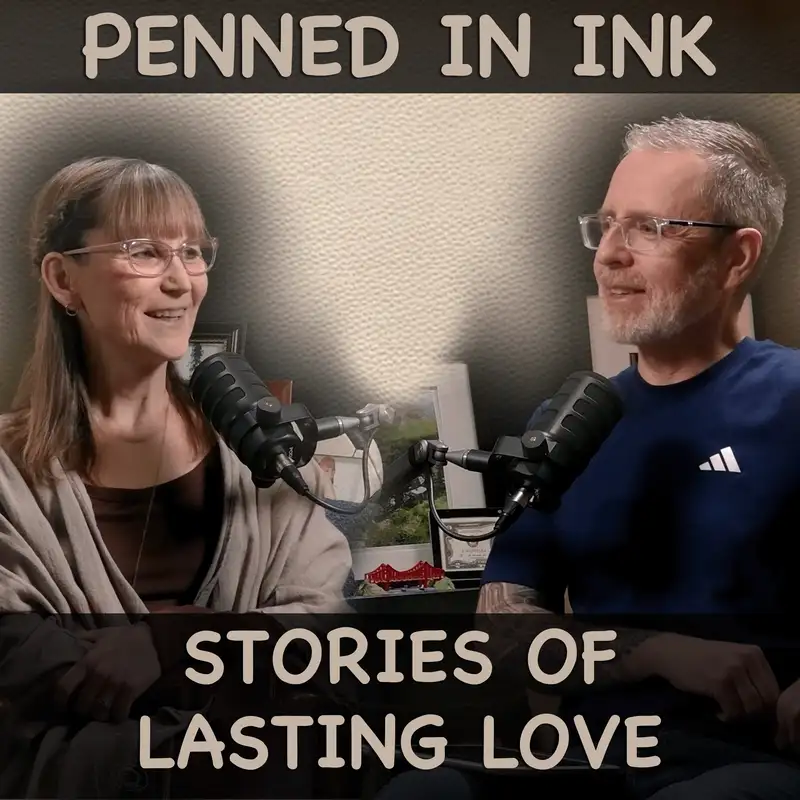
Hello, and welcome to Penned in Ink, a podcast where we discuss marriage and the power of long lasting love.
Today we are discussing intimacy in all of its wonderful forms, emotional, physical, intellectual, spiritual, and more.
To reintroduce ourselves, I'm Michael.
I'm here with my wife, Melissa.
We've been married over 30 years, together even longer.
And on this podcast, we discuss long lasting love, marriage, with the intent of giving you a look at what a positive, long lasting love looks like, okay?
Perfect.
If you are joining us maybe for the first time, Melissa is a mental health professional, a counselor.
So this is a mix of sort of her professional experience with our shared life experience.
However, it is not, what is it not, Melissa?
It is not to be used necessarily as advice.
I'm not advising you what to do in a professional capacity, but there will be stories of things that I have heard and things that I see in my work.
Yeah, so every once in a while, it's good just to remind you that Melissa has the professional knowledge, but we're not dropping professional knowledge.
We're dropping personal knowledge.
Perfect.
All right?
That's a good way to put it.
Now, just to give you a little behind the scenes on this particular episode.
This is take three for us of this particular recording, because I have experienced some technical difficulties in recording.
It's hard to record a good audio podcast when you forget to start the record on the audio.
So version one of this, I thought was great, and it had no audio.
So that was a little rough.
And then we had an issue with version two.
So we're going for version three on our nice morning here.
With that, well, what else?
Yeah, anything else?
That was my omission or confession of behind the scenes.
Very nice, very vulnerable.
Yeah, I feel vulnerable on this.
It was my apology to Melissa because I don't think she's super happy to be recording again this morning.
It's all good.
But I think it's going to turn into maybe our best podcast ever because, well, we've practiced it several times.
Very good point.
There you go.
I hadn't looked at it like that.
I love that, changing a negative into a positive.
Yeah, because I am usually not the optimist.
So there you go.
Yeah, so that's my form of apology to having to do this a third time.
All right, here we go.
When I hear the word intimacy, my mind jumps to, well, sex.
But apparently, intimacy is much more than just sex.
When we were planning this podcast, I already mentioned that Melissa has a clinical background and I kind of take an outline at what we're going to talk about or topics I think would be good.
Melissa goes and kind of reviews that and gives her thoughts on that.
And then we sort of discuss and figure out where we want to go with the discussion.
And Melissa's first thing was a definition of intimacy.
And I'm like, there is no way we are going to start this podcast with a definition of intimacy.
But then I read the definition and went, that actually frames the discussion pretty darn well.
So my second apology of the morning is to say, hey, I think we should start with a definition of intimacy.
So Melissa, give us a definition of intimacy.
All right, it's from the American Psychological Association.
And they have defined intimacy after a bunch of research to be an interpersonal state of extreme emotional closeness, such that each party's personal space can be entered by any of the other parties without causing discomfort to that person.
Intimacy characterizes close, familiar, and usually affectionate or loving personal relationships and requires the parties to have a detailed knowledge or deep understanding of each other.
So more than sex.
In a nutshell, very nice.
Yes, it is more than sex.
Yeah, honestly, I thought that was a really good definition because as we're gonna see as we go through this discussion, intimacy takes many forms.
And in a long-lasting love, you have to sort of nurture each of those forms.
And some of them are, I think, in my opinion, more important than others, but they're all play a role in a long-lasting love.
So let's dive into it.
We always like to start early on in the podcast by digging back through our time together and pulling out stories or memories that are relevant for the topic.
Given that we're talking intimacy and just the simple fact that intimacy in any relationship is a journey.
It doesn't stay the same.
It changes over time.
We thought a good place to start would be, just give you the highlights of our journey together as a married couple or as a dating couple to show you sort of where our background is.
And then that gives us a framework to discuss intimacy.
Melissa and I were college sweethearts, started dating in high school.
Fast forward to when we were really developing our relationship and it was our college years.
Out on your own, building your friendships, your connections, school, knowledge, work, building our relationship together.
So our real formative years were college time.
Made the decision that we were gonna spend our lives together coming out of college.
Had a period of maybe, what, three, four, five years where we were dual income, working, you were going to school still.
Really just the two of us developing our relationship and our intimacy journey there.
And then we had kids when we were, what, 25, 26, somewhere right in there.
Our daughters now are 25 or 26.
So that's interesting symmetry there.
And we are now empty nesters.
We've been empty nesters for the last three to five years or so.
And each of those phases of life from being very young and immature in high school to being young adults and sort of exploring what it means to be yourself in college through early careers, through family, and now into empty nesters have posed their own challenges around intimacy and times of growth.
So that's sort of our journey in a very quick nutshell.
So let's look back and kind of dissect some of those phases and what intimacy looked like along the way.
So let's start with early intimacy for us and for anybody when you're early on in relationships.
What does that look like often?
It's usually really intense attraction and infatuation, wanting to spend every moment with them.
Or if you don't, if you can't spend the time with them, calling them, texting them, all of that, it's really intense and you feel it at that level.
And it's pretty common for most relationships to have that period.
And we definitely had that where it was, we were in college, it was like, okay, what time are you done with classes so that we could get together?
And I think that's pretty typical of most relationships to start with that infatuation.
Yeah, I think that's a sign of a lot of early relationships is how do you carve out the time to be together, to spend together?
And it might be a physical draw, but it might be a, man, I find this person fascinating.
I find intellectual, we were in college, so a lot of our time was classes and shared experiences and new events and that sort of stuff.
So ours was a physical draw, but it also was an active draw.
It was an intellectual draw.
So yeah, those are very common of early.
For us coming out of college, we moved into maybe a secondary phase where we had decided we were committing to each other long-term.
How did that change and what level of intimacy starts happening for us and then most people when you decide to commit further in a relationship?
Right, it becomes deeper.
And there is, I don't wanna say the beginning isn't a true level of intimacy, but a true, or it's not just based on the physical or the immediate attraction.
It's hopefully at this point, you've started the emotional connection.
You've started to get to know each other and you're like, wow, I really like this person.
I love this person.
I wanna spend time with this person because of who they are, not just because I'm attracted to them.
And so it gets into that deeper emotional intimacy.
Boundaries start to come down a little bit more too, right?
I think when you're early on, even though you're very attracted to each other and want to spend the time together, there's also a level of reservation and maybe not being your full authentic self.
Those words always make me laugh.
You're authentic, you're true self.
I work in marketing.
And so when they start talking marketing speak about being authentic and everything, it always gives me a little bit of the icks, but.
Here's a word for you then.
I like the word genuine.
Maybe in the beginning, we're not quite genuine.
We're just putting our best foot forward.
We're only showing the best of who we are.
And as we get to know each other more and that emotional connection begins to deepen, we're more genuine, we're more likely to share who we are.
Or what we think is our best self.
Tell the story that you shared earlier about meals.
Oh, yeah.
Because you thought this made you the better self to be it, but probably didn't even register.
So share that little teeny little story, if you will.
Right, I was, for whatever reason, I didn't want to eat in front.
I was embarrassed to order what I wanted.
When you eat?
Right, exactly.
And the example I provided to you there, like, really?
Well, your dad, we all went out to dinner.
Like, we had only been dating less than a year.
And so we were in high school and he took us out to dinner at a Mexican restaurant.
And I had like maybe three chips, you know?
And then I think I got probably a taco salad or something, only ate part of it.
Whereas I would have loved to have eaten a whole basket of chips and salsa.
And, but I was embarrassed to do so.
And you did at the Mexican restaurant on your birthday.
Right, absolutely.
But I was still trying to keep the illusion alive that I was this dainty, you know, I don't know, sweet, you know, I don't know.
Yeah, I think everybody understands what you're talking about.
It was bizarre.
Looking back on it, I was like, seriously?
You wouldn't eat?
But that talks to the progression that intimacy takes, the safety of being more genuine, being more yourself.
And we'll get further in our next segment into what that really looks like.
But I think that's a natural progression.
And we've hit on two types of intimacy.
There are lots of types of intimacy, intellectual intimacy.
Do you talk about, you know, the big topics in life?
Do you dig in?
Are there things that challenge you on an intellectual basis?
Spirituality, we're not particularly religious in our relationship.
Well, we're not religious in our relationship, but we are spiritual.
We believe that there are things above us and the universe sort of has, we won't go into the woo-woo-ness of all that, but we don't believe we're the top of the chain on things, but we're not necessarily religious.
So we talk about spiritual things.
I think there was another, oh, the obvious one where I started, physical intimacy.
Physical intimacy is another type of intimacy that really is important in romantic relationships.
Yeah, and before we wanna give a disclaimer for our family and friends that may be watching that we will alert you when we get to that part of the episode where we're gonna be discussing a little bit more about- Yeah, we probably should have led with that early on.
We do have friends and family that listen and we are gonna talk about physical intimacy, but it's a section that's down the road.
And if you've made it this far, wow, you were brave to come into the intimacy episode.
Probably should have put that much more at the top.
But anyway, we will give you the alert.
And then if you choose to listen past that, that's on you.
It's not on us.
These are very funny episodes when you're talking about, not taboo topics, but just very personal topics.
Sensitive.
Yeah, and the emotional.
We can talk about that, no problem.
But when we start talking about physical intimacy and how we keep that alive, that's a little more detailed.
A little more.
All right, one thing I wanna close this little section with is all of these forms of intimacy, they ebb and flow over the course of a relationship.
You might not always be emotionally connected and feeling in sync.
You might not always be physically connected.
That is very natural.
And that certainly we are not immune to that.
We have had phases in our life where we've been more aligned in these areas and phases where we haven't.
And we'll discuss a few of those as we go through today's topic.
That's very natural.
I think the challenge for every relationship is to identify when those areas are out of sync or not meeting your expectations.
And then to be very intentional and work toward them.
We've done really good in that at times and other times we've struggled.
So we'll talk about that a little bit.
So I think that's a good little exploration of our intimacy journey.
All right, time for you to weigh in.
Where are you in your relationship and your intimacy journey?
Are you in those early days of infatuation and all the excitement?
Or maybe did your early days start with an intellectual challenge or an emotional connection?
Tell us in the comments, share your stories.
Let's discuss where you are in your intimacy journey.
Let's now spend some time really exploring emotional intimacy.
I think we give service to like all the different levels of our types of intimacy.
And I don't think they're all built the same.
I think there's some that in a long lasting relationship, if you have those, your rate of success and staying together are much more, much higher.
For me, physical, we'll get to, but emotional connection is really important in a long lasting love.
So let's dig into that a little bit.
What does emotional connection and intimacy look like as your relationship progresses and how do you create powerful emotional connections?
That's what we're gonna dive into next.
Sound good?
Yeah.
We talked about in our coming out of college, moving into our early marriage days, what did it look like for us to become more emotionally connected?
And what does a healthy emotional connection look like in a relationship?
Yeah, it's something that strengthens over time.
It's not there right at the beginning.
It's as you get to know each other.
It's, you can tell when you have a stronger emotional connection.
You start to feel comfortable.
I started eating around you, which is good, right?
Yeah.
You get more comfortable.
You start to feel safe to talk about things.
You feel secure.
You don't worry that, oh, if I tell my person this thing, they're gonna be, oh my gosh, you're just out there, I'm gone.
Right.
There's a greater level of acceptance and lack of judging and a deeper understanding of the security around communication.
Because if you are always afraid that you're gonna say that thing that wrecks the relationship or say that thing that offends or say that thing that hurts, then it's hard to really grow past that, right?
So you become, yeah, more safe that allows you to then open up.
Right, absolutely.
And there's mutual respect.
Both people allowing the other to talk about the things and to listen to them and not laugh or not judge.
Support, if they're struggling, if they're going through something and it looks like they need, not that they're in over their head, but they could benefit from some support.
It's giving that and knowing when that happens.
And then it's basically just caring.
You care about somebody more when you have a deeper emotional connection.
They're like, you want them to be happy, you want them to be successful, and you want them to feel that emotional connection as much as you do.
I love it when you just go and go and go.
Again, there's several things in there I wanna talk about, but I'm like, don't interrupt her, don't interrupt her, don't interrupt her.
No, I think there's a lot there.
I think the, let's talk real world about some of the ways that manifests for us.
We have areas where we disagree, like views we disagree, be it current events or whatever.
But over time, we talk about all those sort of things and we realize we're different people, we have different views on those things.
We don't have to be lockstep and agreed on all those things.
And maybe early on in your relationship, you're afraid to express that view that's gonna be not agreed upon.
And now we just have healthy discussion on stuff.
And I look at you sometimes and go, that's crazy, that doesn't make any sense at all.
Not to judge you, but just that it doesn't align with what I think is right on those things.
That's part of emotional development is the freedom to be yourself and express.
One of the things that I think is really important or beneficial of that is you and I can be a sounding board for our thoughts on things that I might not say out to somebody else.
I might not say that to somebody who's going to be that judging voice or is gonna immediately disagree and be very confrontational about that.
For example, you have clients that bring all sorts of stories to you or things they're doing or decisions they're making or points of view that you share them to me.
And I'm like, what the hell?
That makes no sense at all.
And we'll openly criticize and talk, but it's safe and it helps us be better at kind of processing and understanding.
Is that a?
It is.
And just another disclaimer, I'm not talking about, I don't talk about my individual clients.
Yeah, you don't tell me this person.
I just say, hey, there's a view that I've heard multiple times over the last year in my practice about this concept when it comes to relationships.
Or you're coming at, have you heard of blah?
Yes.
And I'm like, oh yeah, I heard about this.
And she's like, I've got a person who's going through X, Y, and Z and dealing with this.
And yeah, so yeah, it's not personal information, but it's topics.
No, and.
And it's a natural part of a counselor's process to need to process that yourself.
So you get challenged with things like, hey, have you heard of this?
What are your thoughts on this?
And if it's something I have views on, then we'll dialogue about, what does this mean and what are your views on this?
And I think, without putting words into your mouth, but I think it helps you understand better sometimes what the client is coming to you with and helps you be a better counselor because, okay, I understand this issue a bit better.
I have another perspective on it or a better, my own perspective has been rounded out on this.
Yeah, people think counseling is just about what happens in the session.
Oh, I do a lot of research afterwards.
Somebody mentioned something that I haven't heard of or I want to know more about to see if it is something healthy so that we can discuss it further.
I go look it up or I talk to people.
And once again, no identifying, but saying, hey, have you heard about this?
And I love to hear what other people have heard and what their thoughts are.
So I can, I don't know, just be a better therapist.
Yeah, so a willingness or an ability to share openly, does it mean you actually share openly?
How much do you share?
Do you share everything?
We were talking about this earlier because I don't share everything.
There are some thoughts that are just my thoughts, my personal.
So just because we can openly share, does it mean we openly share on everything?
It's not that you have to.
By you saying you don't share everything with me, I wasn't like wounded.
I didn't think, well, why not?
I share absolutely everything because you don't have to.
You are allowed to have personal thoughts and opinions and you don't have to share them.
If you want to, by all means, there's nothing wrong with that.
And- I asked you a pointed question.
Do you share everything?
Do I share everything?
And why don't you?
Tell me now.
Oh, you're sounding wounded.
I am wounded.
Deepest, darkest.
No.
Hey, it's okay for me not to share everything.
It's not okay for you to share everything.
Wow, nice double standard there.
I would say, I bet you I could quantify it and say I share probably 90 to 95% of my thoughts, my opinions, my feelings with you.
Things that happen to me on the daily, I share with you.
But there's a small percentage.
Either I think it's silly or I'm a little bit embarrassed.
Oh yeah, I fell on that run because I wasn't paying attention.
I tripped on a curve.
I don't want to share that.
It's embarrassing.
Yeah, but also I would say you hold back on things where you think we're going to have a disagreement that you're not.
One of the things I think we've talked about before in maybe one of the earlier episodes is that it takes you some time, a bit of time to process and come to your opinion on something.
And if you haven't done that work, you're hesitant to talk about it because you think you're going to be judged for not being aware of or fully developed on there.
So would you say that you hold back some stuff where you're not having those deep conversations or you're not having those emotional conversations because you haven't processed it yourself?
Yeah, I haven't processed it myself or dare I say sometimes I just agree to disagree without discussing it with you.
I've decided, you know what, that's mine.
I know that's not his thought on it.
I don't have to share that or we've shared it before.
I don't need to go there again.
My opinion hasn't changed, why?
So yeah, sometimes I agree to disagree and you don't even know it.
Oh, I know it.
And I think the whole reason I asked that question is being emotionally connected and being vulnerable and open doesn't mean that you have to agree and be lockstep on everything.
How boring would it be if we were the exact same thought on everything?
I can't remember who the researcher was or theorist or whatever, but somebody down the road in psychology said, if you're in a relation, you might as well be in a relationship just with yourself.
Right, exactly.
One of you is obsolete if you don't have, if you're not different people.
And you're right, that would be so boring if you agreed on absolutely everything.
And that doesn't mean have screaming fights about it, but talk about it.
So I think the close on what positive emotional connection and intimacy looks like is that it really moves you from two people sort of living in parallel to two people who really can be open and share and more companionship in that sense of, hey, that's my person.
If I need to share something, I've got that outlet.
We're good, we're safe.
Let's talk about how you build that.
What are some of the ways that you get to that?
Because that doesn't just happen.
Proximity won't make that happen.
Being around each other won't make that happen.
It takes intentionality and things to occur.
So what are some ways that that happens?
Yeah, surprisingly, conflict.
When you have a conflict with somebody and you work through it and you come out the other side and you feel good about it, there's strength there.
There's, you gain strength from that and then there's this connection that you have that you're like, okay, yeah, we disagreed, but now we've discussed it and we've moved on.
And that feels good.
Supporting your partner when they're struggling with something, either emotionally or physically, but being there for them.
Yeah, so trauma, conflict and trauma sort of forge bonds.
That's a very common thing.
I mean, not just in romantic relationships, but look at dynamics in sports when there's us against them or look in times of military conflict or war, like that bonding of going through some level of trauma or trauma or that health scare, that mental health, helping each other through or dealing with times of stress, conflict, trauma.
Those all are things that will help you build.
Those seem to be the maybe less desirable ways in some instances to build it.
There are other ways to build it.
What are some other ways?
Having those deep conversations, not just how was your day and what about the weather or what are we doing this weekend, but deeper conversations on a different level.
I think the conversations we had in our 20s and 30s are much less consequential than the conversations we have today or have had over time.
And if you look into our 20s and our 30s, some of those deep conversations might've been around life planning and the goals and what we're trying to accomplish and how are we gonna raise our kids and what does our family look like and what's important.
Now they're taking a new phase and some of our deeper sort of meaningful conversations are maybe a little less enjoyable.
We have aging parents, we have friends and family that are getting older and we've been very blessed that we haven't gone through a season of loss, but we're getting closer to those seasons.
And one of my parents had some pretty major health scares in the last year or two.
And when you start looking at mortality and you start looking at like, well, my parents are getting older, that's okay, this is gonna be a season we're into.
And having someone that you can pre-discuss those with so that you're like, man, I'm concerned about this or I'm worried or how am I gonna deal with this?
What's our support look like for this?
That's years of intimacy built up so that you have that connection because we're gonna go through another season where that stuff starts happening and it becomes very traumatic.
We have had in our own personal relationship some seasons that look like that on the health side.
Both of our daughters have muscular dystrophy and when they were teenagers, they went through a phase where they had declining health and you and I had to navigate that season together.
So we forged our emotional connection really before that to help us through that, but then that laid the foundation for this season we're in.
Yeah, so even though we've been together for 30 plus years, that emotional connection is still growing and building.
And people think, oh, we've been together for three decades.
You're as emotionally connected as you get.
Nope, it continues and that's healthy and that's how it should be.
Talk a little bit about the role that physical connection plays in building an emotional connection because we've been talking about these as very discrete types of intimacy.
They're not discrete, they overlap.
So how does physical intimacy, not sex, but physical intimacy, we're getting to the sex, I promise.
Yeah, a healthy physical connection also contributes to a good intimacy with your partner.
And that doesn't, like you said, not about sex, but that could just be touch as you pass each other in the hallway, a hug, a kiss on the cheek, it doesn't have to, but having that physical connection, I believe on the daily, you need to have that.
So we're not saying have sex daily, but touch.
We aren't, we should be.
We should.
Go on, sorry.
That's not what I was referring to in this instance.
I was talking about how having a healthy physical connection just deepens the emotional connection as well.
Yeah, and it's not just those hugs and those sort of things.
It's the calming nature of touch.
Let's say you're getting agitated or I'm getting upset about something.
It's that hand on the leg when you're getting annoyed by something.
Maybe someone you're talking to has said something that's annoying you and it's that little, hey, calm down, we got this.
It's those little resets that are physical in nature that actually have that emotional response.
The body's pretty amazing.
It'll release different chemicals with just very little touch and reinforcement.
So there is a physical component in building your emotional connection.
Definitely, and then I think words of appreciation.
Some people find it really important to say I love you on the daily or thank you for taking out the garbage, even though you're the one that always takes out the garbage.
That doesn't mean you don't show gratitude for that.
People like to feel appreciated and I think that's necessary, very much so, in a strong, intimate relationship.
Yeah, I think it's really important for men, maybe even more so, to be, don't wanna cause hate or anything, but I think a lot of the things men do just go unseen and they just aren't taking care of business and everything because they're supposed to, it's expected.
Your example of the trash is maybe a very small one, but there's just other things.
And just simply acknowledging that, yeah, you have your things you're doing, I have my things I'm doing, but just showing that recognition, I appreciate you showing up.
I think it's important to go that way, but I think it's really, in particular, important for a man's spirit to know that the people in his life that he's working hard for and doing good things for, just show a little appreciation for it and acknowledgement.
I think it's important.
So I think those words of appreciation are often unspoken.
Right.
What was it?
There's some little catchy little thing that appreciation unspoken is non-existent or something like that.
Like you have to speak these things into the world because otherwise people don't know.
Well, of course I appreciate it.
Yeah.
Do you?
I don't know.
Yeah, because you never tell me.
Doesn't look like it.
Yeah, that's a theme in therapy sessions as well, for both.
I work with men and women and they both say it's just, I just don't feel- It'd be nice to hear it occasionally.
Right?
And I said, well, have you told your spouse that?
No.
No, exactly.
I get that a lot.
That's actually interesting.
I was with a coworker, this was years ago.
We were on a show and we were talking about, he'd been married for a while and we're talking about our spouses.
And this is shortly after you had started your business and everything.
And I had mentioned something along the lines of, hey, she's doing it.
She's got off the ground.
Her practice is going well.
I said, no, I'm really proud of her.
She's killing it.
And he looked at me and goes, do you tell her that?
I'm like, oh yeah, I've told her that.
He goes, good.
And I thought that was really a good observation of, it's fine to be proud of somebody or to be thankful for it.
But if you don't say it, it doesn't have the impact.
So if you're gonna feel it, you might as well say it.
Yeah.
Although sometimes if you're feeling something, you shouldn't say it.
But in this case, I think you should say it.
Right.
When it comes to appreciation, I don't think you can overdo it.
Yeah, exactly.
All right.
So I think that's a good discussion of emotional intimacy.
To help you become more intentional with creating your intimate connection and your emotional intimacy in your relationship.
Melissa has created a free guide to help you on that journey.
So Melissa, what does this free guide do and how is it actually a relationship tool that someone listening could use to help them build an emotional connection or an intimate connection?
I like lists and I like checking things off.
So this is- You do.
Partially, that's why you were so annoyed about having to record this a couple of times.
I think you checked off the list and then it got unchecked, which is- Ready to move on to the next thing.
Yeah, so anyway, go on.
No, you're not.
Intimacy list, checklist.
It's a maintaining intimacy checklist.
It's ways to stay intentional on a daily basis, on a weekly basis and beyond.
And then also there's a section for reconnecting if you feel you're in a rut.
I hear that a lot.
I'm in a rut or I'm experiencing Groundhog Day.
You know, the movie where the same day goes over and over again?
Yeah.
I hear that at least weekly from somebody that's like, oh man, every day is the same.
It has some suggestions for reconnecting with your partner as well.
Nice.
How do you use that tool?
You say this checklist, but how would you use it, Ms. Old School Lady?
Me?
Did you just call me old?
I called you Old School Lady.
I do.
And I'm also, I'm a visual learner and a visual.
I need to see it.
And so if it was me, I would not just download it.
I would also print it off.
I'd put it on the fridge or somewhere else that it's prominent and look at it.
And have I done this today?
Not as you have to do this today, but I'm feeling disconnected or I'm feeling eh, I want to do something.
Check it off.
Obviously, some people like to put that on their phone or they might have a shared app with their partner that they can both look at it and check things off.
It's just a way to help you be intentional about being connected to your partner.
Yeah, so the guide has lots of ideas on how do you maintain and nurture that intimacy across different types of intimacy and use the guide however you want to, old school or on your phone.
Links to download that are in our description and the show notes.
So go ahead and grab that.
Now it's time for you to share again.
How emotionally connected are you and your partner?
What steps are you taking to strengthen the bond?
What are your views on the importance of emotional connection?
Let us know in the comments.
That brings us to our recurring segment.
We like to call Inked Moments.
In the Inked Moments segment, we share a memory from our past that is related to today's topic.
Now, Melissa mentioned it a little earlier that showing gratitude or saying I love you, some people need to hear that.
We might have a different story.
You want to share your story on this?
We do.
I think during the early stages of our relationship, we said it a lot to the point that I don't know if it had the meaning that it should.
It becomes habit, becomes wrote, something you say to close a conversation, close a whatever.
Right.
For us.
Other people love that, but for us.
Absolutely, absolutely.
Everybody, whatever works for them, but for us.
But it was something that when we stopped saying it as much, I was like, huh, is that okay?
Is that a good?
Anyway, my story is this.
We went to a Randy Travis concert.
Loved it. 90s country music.
Only type of country music that's worth listening to, but Randy Travis, 90s country.
Yes.
Continue.
Well, thank you.
So we went to a Randy Travis concert and before one of his songs, he stopped and told the story about his grandparents.
He said his grandmother was always put off because his grandfather rarely said, I love you.
And it was really, and then one day it just came to a head and she was putting his dinner in front of him.
She slammed down his plate and he just looked at her and goes, what's wrong with you?
And she said, you never tell me that you love me.
Why is that?
And he looked at her, he got very calm and said, on our wedding day, I told you that I loved you.
And I would let you know if that ever changed.
It hasn't.
So there you go.
And I don't know, I got some peace from that saying, okay, Michael doesn't say he loves me every day, but I feel it through his actions, through other things, other words, you know, appreciation.
It doesn't have to be the words, I love you.
I just, I know it's there.
And I'm sure he'll let me know if it ever changes.
Well, it hasn't changed.
And we are very intentional with showing affection and showing love and showing that.
So yeah, I think that's our approach.
We don't say it as often anymore.
Don't need to.
Some people do.
Some people need to hear that.
They need to hear the words.
Now, do we never say I love you?
No, we definitely say it.
Yeah, times of stress, times of where you really need to hear the words.
Yeah, of course we say that.
And times where you're facing death, going on travel, maybe taking a trip where you might not come back from.
Those times, yeah, we always make sure that, you know, if it's a big moment, it's there.
And if it's a time where, hey, these might be the last time we talk because, you know, life happens.
We always make sure that we know.
Some people need to hear it.
Some people are very comfortable with it.
We all probably need to be better at showing it.
Yeah, absolutely.
Cool, that's today's Inc Moment.
All right, disclaimer time.
Finally getting to the part that I care about.
I care about the rest of this.
We're gonna talk about physical intimacy.
So, if you have made it this far and you're friends and family and don't want to hear this part, you've been warned.
Continue to listen at your own peril.
Jump ahead to the Pen to Paper segment if you want to skip this segment.
All right, to this point, we've taken a very measured and thoughtful approach to discussing intimacy.
But now it's time to address probably the only real question people have about intimacy and long-lasting love.
How do you maintain physical intimacy with the same person for decades?
Let's discuss.
Let's set the iPad down and discuss.
All right, I'm gonna start this one because I think we're sharing grandfather stories, apparently, in this podcast.
I was listening to, I saw some video the other day.
And it was just a story of this grandkid who was, or son who was talking to his grandfather and said, hey, grandpa, you've been married 50 years.
How'd you do that?
How did you stay married to the same person for 50 years?
And he said, the grandfather responded, he goes, oh, I haven't been married to the same person for 50 years.
I've been married to five different women and they've all just happened to be your grandmother.
And I think that really describes a long-term relationship.
You are not the same person over 50 years.
And you're sort of always choosing to lean in and re-engage but the person changes around you all the time and you change with it.
So my disclaimer to how do you stay physically connected to somebody for 50 years is, yeah, it's the same person but it's not the same person.
It's different, we're all different.
So let's use that as our foundation.
So with that, how do we stay connected?
What's the?
We make it a priority.
It's important to us.
We think it's important and for relationships in general to have that physical component, that attraction and to keep that alive and you have to work at it.
And we believe it's really important and so we treat it as such as like anything else.
Healthy eating, going to the doctor, healthy sex.
Easy now.
So for us, emotional connection is always really important and it's a foundational piece.
Without it, it's very hard to have other levels of intimacy.
But for me, physical connection has always been something that's been really important for us.
And I would say we started as college kids.
Yeah, physical intimacy was huge, but that didn't stop because we got older and moved along.
Now, did life get in the way and throw challenges?
Yeah, what are some of the times of challenge we had around physical intimacy?
There have definitely been fluctuations.
The biggest one would be when we had kids.
You mean when you go on bed rest for a month and a half, two months and then have twins that maybe the sex life goes back burner?
Funny that, you know, when you're- I think that's very unreasonable of you.
When your infants don't sleep through the night until nine months, you're tired.
You're tired.
For me, at least, it was the furthest thing from my mind.
You know, body was getting back in shape.
Once again, off of bed rest after eight weeks, my body was physically tired and weak.
Yeah, of course.
And I didn't feel attractive.
I was so busy with the girls that that was put on the back burner.
And I think that's okay because I believe we viewed it as this is a temporary thing.
Yeah, it's a season of life.
How did we get through that?
Did we just ignore it and just let it pent up or whatever?
Did we talk about it?
I'm not talking physically, how did we get through it, but like what was the key to getting through a period of disconnection physically?
Talking about it.
Leading into other levels of intimacy.
Right.
Being emotionally connected, being intellectually connected.
Absolutely.
Saying, yeah, I know, you know, that physical intimacy has been lacking.
We're not there yet.
Right, right.
But this will go away.
It will.
The girls will get older.
There'll be a different manageability about that.
They will sleep, you know, at six months, I didn't think they would ever sleep through the night, but they did a few months later.
And so I got more sleep, and so I felt better.
And I'm assuming you did too, because you got up with me as well.
There's two babies, man.
Yeah, we had twins.
So if you have twins, I was joking, side story.
One of my brother's best friends had two kids and he had them, how far apart were they?
Two or three years.
Two or three years.
And he looked at me at one point and said, oh yeah, it's kind of like having twins.
And I'm like, buddy, it is not at all like having twins.
I said, hey, let me put this in perspective to you.
When you had your first child, when you handed the baby to your wife, what did you do?
It's like, oh, I would rest and everything.
Great, I had a baby in my hands.
Like there was no handing the baby over and then taking a break.
We always had a baby we were taking care of.
And if you were taking a break, that meant your spouse was taking care of two babies.
So it's like, it was a constant thing.
So yes, so that was a time where physical connection was hard.
Now that means, if we're really, that means that the sex was less frequent, but that doesn't mean that the hugs and the affection and the embraces, it just meant the physical sex frequency was non-existent for a period or much lower.
Right, absolutely.
You'd come home from work.
It's not an all or nothing.
Yeah, and the girls would be crying.
You just give me a hug and then we'd tackle, making the girls stop crying.
Yeah, exactly.
Physical affection was there.
It just might not have been.
Yeah, so kids is one.
There's another time come to life or come to think of when there's other times that physical intimacy gets challenged.
I mean, what draws to me is like, obviously, if you're gonna go through physical health issues or mental health issues, those are gonna cause barriers in your life that make physical connection difficult.
So we've had some periods of that, of high stress.
And then maybe that makes me think of another sort of angle to go with this conversation.
Men and women view sex very differently.
And the role sex plays in a healthy relationship.
You wanna talk about that a little bit?
Yeah, it's kind of funny how some of the things are polar opposites.
For women, stress may typically decrease as desire.
Men like to use or one stress reliever for them is sex.
I'm never too stressed for sex.
Right, but a woman is.
Don't get it, go on.
It just is.
We're not feeling the emotional connection sometimes when we're so stressed about something, upset about something.
Yeah, your plate has to be clear to have sex.
Sex helps clear my plate.
Clearish.
Clearish.
The plate is never clear, yeah.
Correct, but right, I think you phrased it very well.
Yeah, exactly.
All right, what are some other differences about how genders approach intimacy in general, physical intimacy, or how you and I approach it?
When you're feeling more connected.
So emotional connection or intellectual connection leads to more physical connection.
For women, oftentimes the sex leads to the emotional connection for men.
So women need the emotional connection to.
Prior to the sex.
Yes, and men often feel the emotional connection after having sex.
Man, it's like we're talking through a glass wall.
I don't understand what you're talking about.
I get it.
I get it, that makes sense.
Yeah, just different ways of handling life and mental load, and I guess I did make it sound like men use it as a relief, but it's not a bad thing.
Yeah, I mean, so the, I think the point there that I sort of just made a smart-ass remark over is that for men or for me, sex always is an emotional closeness.
That is a way of creating that emotional closeness.
And you're just saying that in general, women often have to feel that emotional closeness before they're open and willing to have sex.
So that makes sense.
I mean, intellectually, I understand that.
I'm not a Neanderthal.
Like, I get it.
We are very different though in that, because I mean, yeah, there's, yeah.
Very few times where sex is not helpful for me or for men in general.
Right.
Okay?
All right, let's talk a little bit about things.
We already talked about, for us, kids got in the way, but let's really just focus for a minute on disruptions to sexual intimacy.
Things that we've experienced, or maybe that are in general.
We've already hit on the daily stress and life just getting in the way.
We have this tendency sometimes to deprioritize it because we don't think it's as important in a relationship.
So maybe work is really stressful, or your jobs, or your planning, or you're doing whatever.
For us, we've been very intentional of, there are things that really, truly get in the way.
You having kids got in the way.
I mean, that was, but we don't let other things get in the way.
We're very intentional with that.
That's not the case for a lot of people.
A lot of people let life really get in the way.
One thing we have not talked about at all, and you see this, is past traumas.
Would you talk about that a little bit, how past trauma can impact physical connection?
Absolutely, and not just trauma, but poor relationships that maybe aren't quite at the trauma level.
Yeah, I use trauma in the light sense here.
I mean, obviously trauma can go a broad spectrum from physical abuse on the really sexual assault, which is a very real thing that carries on.
But to your point, just even negative relationships where you haven't created that emotional space or whatever and you've been, so go on, sorry, I didn't mean to interrupt.
Yeah, if you've never had a healthy long-term relationship where there's all of the intimacies we've talked about today, the emotional, the intellectual, if you haven't had that before, you've been hurt by multiple partners, sometimes your physical connection needs are different than somebody that hasn't experienced that.
Yeah, and I think those things can get triggered and brought back up.
So you might be in a really good phase and you might be connected physically, but something can trigger that and you see setbacks or you see times.
So for us, there's been times where that ebb and flow has been caused by certain things.
Trauma is one of those things that can sort of disrupt.
I think another one that unfortunately has been around for a very long time, but technology is just expediting it even more is pornography and the role pornography plays in physical intimacy and attraction.
There's a new book that came out recently that talks about, I think it's called sexology or sextology or something like that.
And it's talking about how technology is really negatively impacting the amount of sex that Gen Y and Gen Z is having.
They're having way less frequency of sex than our generation did.
And obviously that has repercussions around birth rates and population growth, but it has real psychological wellness problems with it.
And they point a lot of that back to the access to really high quality, engaging, addictive porn.
And it's an issue not only for young men, primarily young men, but it also impacts women.
They're seeing that number grow shockingly, scarily.
And it can and is impacting longer lasting relationships.
I mean, you've got men of all ages that are replacing the work of building emotional intimacy with the ease of pornography.
And that pornography is just getting more and more addictive because the technology around it.
And it gets really scary when we're talking about AI bots and emotional relationships coming in a digital form, then also technology that's providing a physical form to that.
And it's like, it's a real thing.
So that's my rant against, or my warning against letting things that you can control, get in the way.
Like pornography is something you can control.
Unless you have an addiction, but yeah, we can.
And even that, you gotta get help and control that.
It's something that is controllable.
Absolutely.
And so that's another thing.
Now, fortunately, that's not ever been an issue for us and never will be an issue for us.
But I'll tell you why I think partly it's not an issue for us.
Men don't sign up for celibacy.
They don't sign up for being in a sexless marriage.
They sign up for monogamy and some sort of hesitantly sign up for even monogamy.
But if you don't have sex in your relationship, men will find sex in their world.
And so for us, it's never been an issue, but that's primarily because we have a good physical relationship.
Yes.
Thoughts?
Yeah, agree.
Yeah, don't disagree with that.
We have a good physical.
No, I will.
You're gonna hurt me deeply.
Wounded.
The word was wounded.
I didn't want to wound you.
No, that is absolutely correct.
And there are some marriages that are deemed sexless.
I think that's less than 10 times a year.
If you have sex less than 10 times in a year, less than once a month.
You meant a month, right?
No, a year.
They consider that a sexless marriage.
And usually there's at least one partner in there that is not happy with that.
Yeah.
Sometimes it's both.
They just don't know how to fix it or haven't worked on it.
But usually there's at least one partner that that is not acceptable and it's damaging their relationship as a result.
Yep, that's a great segue to how do you build and repair?
So just like when you're fighting and having conflict and arguments, it's maybe not do you have the argument, it's how quickly do you repair?
How well do you focus on it and fix it?
So if you're going through a period where you're struggling with intimacy, how do you fix it?
Or how do we, and related, how do you nurture intimacy on the physical?
You're laughing.
Yeah, that maintenance piece.
You started off hot and heavy, then you got the emotional connection, and then you still have your relationship going.
But how does one maintain that over?
Because it does have to be maintained.
It's not something that just happens organically.
You have to work at it, like anything else in your relationship.
Give us examples.
How do we maintain, how do we keep the fires burning?
Now, we're empty nesters.
So I'll share the first story on a way that, well, I'm a big fan of.
We talked about when we had a few years together where we were married without kids.
Then you go through a period where you have kids and kids in the house are super disruptive.
Well, we don't have kids in the house right now.
So what are the upsides of not having kids in the house?
Well, there's a lot more nudity in the house than there probably was when we had teenagers walking around.
We both work from home.
I have my office on one side of the house.
Melissa has her office on the other side of the house.
I'm very fortunate that the bathroom she uses is showers right outside my office.
So I probably see nakedity every day.
Yeah, nope.
Nakedity.
Nope, yeah, exactly.
Nudity, I know the word, go on.
Right, it's a reference to MASH for any of you that have watched MASH Radar.
Oh, that's a 80s TV reference.
All right, what else?
Daily physical touch that isn't sexual in nature.
Yeah.
Hugs, just as you're walking by, a pat on the back or on the butt, or just there's that physical connection throughout the day that's not sexual in nature.
Right, those are all the precursors that sort of show that emotional physical connection that are helping women who often need to get through the stress of the day.
It's the little touches along the way that stay connected as we're going through our daily routine, helping ourselves that help set the stage for whenever sex is on the table.
And then those acts of appreciation and gratitude that we talked about earlier is another one.
You know, when somebody's saying something nice to you, you feel good towards them, and that can turn into physical intimacy as well.
And then we joke about it all the time because we're humorous people and we're sarcastic people.
And one of the things is, we have a lot of immature humor in our relationship.
You know, just- We do like an innuendo and a, yes, anything that can be turned dirty, we do like the fact that it's funny and you can turn it dirty.
Right, and we'll laugh about it.
The next time you watch any sporting event, have like a sexual lens in mind and listen to some of the phrases they use for when they're doing the play-by-play.
It's hilarious if you look at it like that because some of the things you're like, wow, that- Wow, that was dirty.
I can't believe you said that on the radio.
Because it wasn't, but we just, we kind of have that.
We're still playful.
I think playful might be better than immature.
Yeah, for sure.
Well, we were joking earlier as we were sort of thinking about this, our formative relationship years were college.
And so when we really got to know each other very deeply and what our humor was and what our interactions were, were in our days where we were more crass, we were more open.
So we age, we become more mature, but I'm still the 22-year-old that finds it very funny when those jokes are made or whatever.
And so there are definitely inappropriate side-eye glances that happen.
There's a couple others that you had mentioned.
I mean, I think you said this already.
It sounds incredibly simple, but we prioritize it.
We don't let weeks go by without being physically intimate.
It just does not happen.
And if we are disconnected and one of us notices it, we acknowledge it.
We say something about like, hey, what's going on?
So we just, we're very intentional with it.
Random question for you, who initiates sex more between us or in general between men and women?
Who do you think?
Because this gets down to that whole- The research showed men.
Men are more likely to initiate.
And sometimes that leads to struggles as well.
You get tired of it, of always being the one.
I hear the same thing from when we're gonna be talking about date nights soon, but women that always feel like they have to schedule the date nights, they get tired of doing it, of always being the one to plan it.
Same thing goes for physical intimacy, is if one person's always the one initiating it, I don't know, that's gotta get old.
Yeah, so this is a real important issue to talk about.
And I'm glad I sort of asked that question.
I didn't, was thinking about this, but the openness to intimacy is a real important thing.
And that if one partner, the man is always initiating, but he's not understanding the conditions under which women tend to be receptive to sex, he's often gonna see that as rejection, rejection, rejection.
And what he's not necessarily seeing is that the conditions haven't been set, the emotional hasn't been set, the daily load hasn't been taken care of.
But the point is that if one person is typically the initiator and you're not communicating about why it's not right, if you're just saying no, you're just saying no, it turns into, man, he is always asking.
And he sees that as, she's always saying no.
So the only way you're gonna fix that is communication.
Right, and being very clear of why I'm saying no, or why I'm continually asking.
Yeah, absolutely.
All right, and you had one last one that was in this question of how do we, or how do people in general keep fires burning?
Yeah, absolutely.
That's the Gottman Institute.
I can't remember their first names, but the Gottmans are a couple that are very well-known in the marriage counseling realm.
And they have a whole institute to learn about how to have a good marriage.
And they have the 7-7-7 rule.
And that is that you should prioritize a date night every seven days, a weekend away every seven weeks, and a vacation every seven months.
And you're smiling as well.
So you have thoughts on that.
Well, I'll keep the TV reference.
I have another TV reference I'm gonna share on this, but a little before we'll just go there.
So their recommendation, their framework is 7-7-7, date night every seven, away a weekend every seven, trip every seven months.
We don't quite follow that in our relationship.
We don't, we're not big date night people, although we do go to sporting events and we go out.
We're more of stay-at-home sort of.
We like movies on the couch and that sort of time, but we do that intentionally.
And we probably don't do it every week by any stretch, but we'll have certain times where it's, let's lay and watch a movie that's intentional, that's sort of out of our normal routines.
We go to hockey games, we go to sporting events.
That's sort of our outlet for that.
We don't do the getting away for weekends very often, but we highly prioritize travel.
We take big trips.
That's part of our, we work a lot.
We are very focused.
So for us to really reconnect, we've got to go someplace.
We've got to get out of the house.
That's one of the drawbacks of working from home is that you work, eat, sleep in the same spot.
You are pattern interruptions.
We go someplace.
And I've heard that some people, when they travel and go on vacations, tend to have more sex.
I can't confirm or deny if that happens for us, but I heard that is a thing that happens is when you get away and you travel, you might have a little more sex.
Yeah, yeah.
You don't have other stuff getting in the way.
Exactly.
Now I'll do my 777 that I had to laugh.
This is my last 90s TV reference for the day.
So friends, on Netflix, many of you have probably seen it again, there's a really classic episode where one of the characters, Chandler, is having problems physically with his girlfriend, and he goes to Monica and Rachel, and he's expressing that he's having problems, and they're teaching him how to...
Pleasure.
Pleasure his, and they start by taking a diagram and drawing the seven erogenous zones of a woman, and he goes, there's seven.
And he looks at the picture, and they're showing the seven, and then they go through, Monica goes through this whole thing where she's touching the various erogenous zones, and they're saying like, three, four, four, two, three.
And then by the end, she gets onto seven, and she goes, three, four, one, seven, seven, seven.
And it's just a very sexualized, very funny sort of deal.
So when you said this, when you very first introduced this, the 777, I'm like, oh my gosh.
So YouTube that, it's a funny clip.
Yes, but not with the Gottman's Mint.
But not with the Gottman's Mint, but it's in line with our topic for the day.
So practice 777.
Yep.
All right.
I think that we've already, if we haven't made this clear, let's just reiterate it one more time.
Emotional intimacy is a great foundation upon to build all the other types of intimacy.
For us, and I think for many relationships, physical intimacy goes lockstep with that.
It's really hard to have a long-lasting romantic relationship if you don't build the physical intimacy.
Now, how has physical intimacy changed over the course of your relationship?
Where are you in your journey?
And what do you do to keep the spark alive?
Share your thoughts in the comments.
PG.
We don't need graphic comments.
I'm not asking for that.
Anything else on that?
I think that brings us to our final segment.
It does.
In our last segment, our Pen to Paper segment, we like to give you a practical challenge or reflection to help you write your own lasting marriage story.
This episode is centered on building and maintaining intimacy in your relationship.
Intimacy takes many forms, emotional, physical, intellectual, spiritual, and more.
Each of these areas takes intentionality and effort to build.
Our challenge for you today is to prioritize date nights, but with a twist.
Practice intimacy date nights.
Now, we will get to what we mean by intimacy date nights in a second, but let's start off with, Melissa, why date nights?
What's the importance of a date night?
It's to take you out of the day-to-day.
It's to separate you from all of the responsibilities that you have, the dishes, the letting the dog out, the laundry, the garbage.
It takes you out of the house and hopefully to a place where you can focus just on the reconnecting.
Perfect.
How do I plan a date night?
Give me the three Ps.
Melissa likes her checklist.
I do.
We have a checklist here.
The three Ps of a date night.
Plan, prioritize, and protect.
It's nice to say, we should go on a date soon.
That's not planning.
Planning is, hey, on Friday, there's this comedian in town that I wanna go see.
Seven o'clock, let's put on our calendars.
That is the prioritize piece.
So you plan, we've picked a place and a day, and then you prioritize by putting on the calendar, a shared calendar, hopefully, and then protect.
When you do go on the date, you're focusing on that date.
It's not, you're not, you know, in your head, you're not going, oh, what did I, what do I have to do tomorrow with this?
You're connecting with the person that you are with.
You're not paying attention to your phone, your watch vibrates, you don't look at it.
You are in the moment, and that is the protection piece of the three Ps.
Awesome.
So if I plan, prioritize, and protect, I do it once, I'm good to go.
Absolutely not.
With almost everything in life, consistency is key.
A one night is nice, but think about if you do it once a month, or more frequently than that, if you do the governance- One, seven, seven, once a week.
I, I'm a big planner.
I think a lot of people don't do this, and I, in my therapy practice, I meet people where they're at.
So if they say, I want to, and I said, how often do you do it now?
They said, uh, the kids are five.
I think it's been, don't try for it once a week.
You're not gonna do it.
Try, set a goal that's attainable.
Agreed.
Something that fits your lifestyle is attainable.
Awesome.
Now, let's go back to the twist part of this.
Date nights are great, and we all sort of have our idea immediately pops into our head of what our date night might be.
Our challenge to you is to pivot it a little bit and do an intimacy date night.
And what we mean by that is we've covered multiple types of intimacy.
So when you're planning your date night, decide where you are struggling or where you need to reconnect, what type of intimacy you need.
So let's say you are not feeling emotionally connected.
Maybe your date night is something where you can have discussions and conversations.
Maybe you go to a coffee shop.
Maybe you go to a quiet restaurant where you can sit in the corner, have your meal, and you can discuss topics of importance versus going to the sports bar where it's gonna be loud and you're not gonna be able to communicate.
So that might be an emotional date night.
Or let's say you're not feeling very intellectually connected.
You haven't talked about anything of pressing your boundaries or expanding.
So maybe instead of going to a rom-com or an action movie, maybe you go to a drama and then you go out for coffee afterwards and you discuss the drama.
Or maybe you go to a play or you go to the theater, you go to the ballet, you go to something that, or a museum, you go to something that stretches you where you learn and you intellectually connect.
Or maybe the most obvious one, if you're not feeling physically connected, maybe your date night needs to be dancing or it needs to be something where you can have intimate physical contact in the scope of your date night.
So that's what we refer to as an intimacy date night.
Oh, you know what would be good for that?
What?
Setting up for like a ballroom dance class, right?
Wouldn't that be awesome?
Cause you got the physical.
Oh, let's do it.
Yeah, let's do that.
He might've rolled his eyes a little bit.
I don't know if you could see that.
Yeah, exactly.
It's okay.
But anyway, something like that.
But the point is, yeah, exactly.
If you're not feeling connected in an area and you're gonna layer in these connection points, date nights, then be intentional with what you choose for that date night.
Don't just settle for the same old restaurant and the same old dinner and the same old movie.
Like, be intentional with it.
That's our Pen to Paper segment.
I like it.
Well, that brings us to the end of today's discussion on intimacy and long lasting love.
As a reminder, if you're looking to become more intentional in maintaining intimacy in your relationship, Melissa has created a free maintaining intimacy checklist to help you in this area.
Download it now using the links in the description or show notes.
In our next episode, we'll explore parenting and partnership.
We'll share stories around the changing dynamics that come along with having children and how we continue to prioritize our connection through all of the many phases of raising a family.
With that, we wanna thank you for joining us.
We invite you to connect with us by joining our free Penned in Ink community.
Here we share free digital guides, the occasional updates to help you build your own long lasting love.
Check the link in the description for details.
Also, remember to share a comment, ask a question, and let us know your thoughts on today's topic.
And if you like this content, please give us a like, leave a positive review, and remember to subscribe to get notified of future episodes.
Thanks all.
Have a great day.