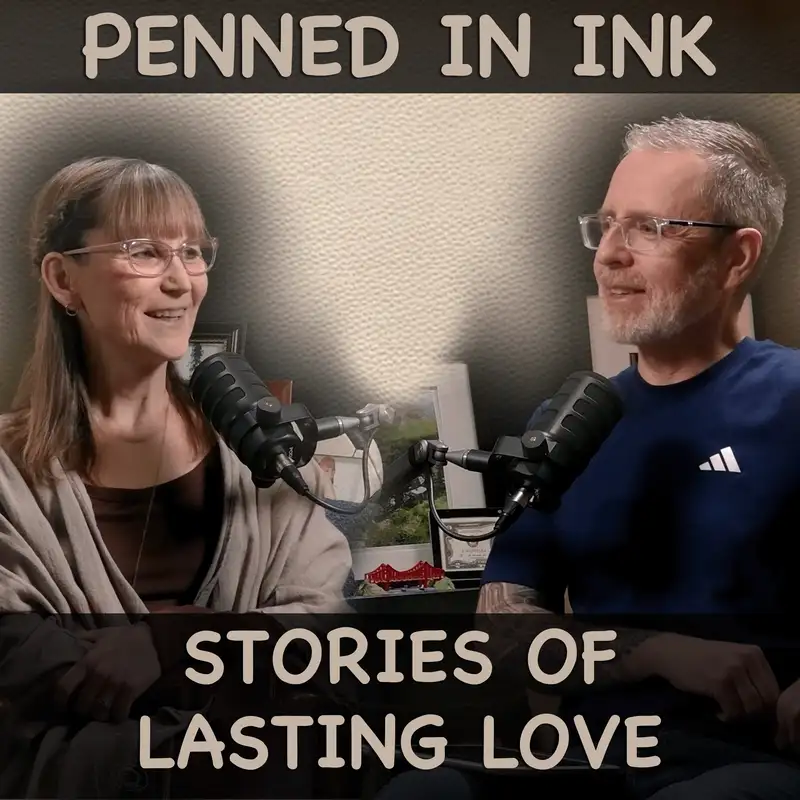
Hello, and welcome to Penned in Ink, a podcast where we discuss marriage and the power of long lasting love.
Today, we are discussing the importance of creating healthy space in your relationship around mental health.
For those of you who are joining us for the first time, I'm Michael, and I'm here with my wife, Melissa.
We've been married over 30 years.
Together, even longer than that.
So to say that we have grown up together and learned how to dig in and really embrace this important area is probably an understatement.
I think we've definitely done that.
And if this is your first time joining us, you might know, but Melissa is a mental health counselor.
So today's topic is right up her alley.
But that being said, I don't wanna put all the pressure on Melissa today, because obviously in a long lasting love, we've spent lots of time together, and we both have really gone through peaks and valleys, ebbs and flows around mental health.
So today we're gonna talk about our experiences together.
We're gonna talk about Melissa's career, as in who she sees and how she helps various people going through relationship issues.
And we're gonna dig into all topics mental health.
Sound good?
Perfect.
All right, how was that?
Did I put too much pressure on you in the buildup?
And that's okay, I can handle it.
To be determined if you can handle it or not.
That's a very good point, but you know, don't undercut me, I got this.
No, you definitely have this.
Now, if you want to know Melissa's whole background on how she chose her profession, and really who she works with, and sort of what her life's work around that is, we did a whole episode where we dug into Melissa's perspective as a counselor, and how your career has influenced our long lasting love.
So that's a good episode if you wanna check that out.
Now, when we talk about mental health, that's a pretty broad spectrum, right?
Definitely.
How would, for today's topic, how would you define mental health?
Yeah, it's more about what our daily mental load, we could say, is, and less about identified mental health disorders.
So you have, somebody could have generalized anxiety disorder, or major depression, or bipolar, all of these things.
That's not where our focus is today.
It's more about daily stressors, how you handle that, and how you handle your own mental health within your relationship.
Yeah, I think that's perfect.
I think it's really key that anytime you're dealing with mental health, you do have to sort of realize that there is true clinical mental health.
And when you're in a long lasting relationship with someone who has mental health struggles, a disorder, that is a whole entirely different beast than day to day managing your mental load, and your mental state, and your day to day activities.
Both probably equally important, but too broad to talk about in one single session.
So we're gonna start off by going through our experience and our approach to daily mental health.
And then we're gonna dig into a couple times of what we'll refer to as acute mental health struggles.
And those aren't severe clinical struggles, but those are like real world examples of when you're together with somebody for 30 years, mental health issues come up.
So we're gonna talk about that.
And then we're gonna pivot and talk about how do you help someone when they're going through that.
And we're gonna talk about how do you help yourself?
Make sure that you're in a good state and have a positive sort of outlook around mental health.
That the agenda for today?
Yeah, definitely, sounds good.
Well, let's dive right into this.
Again, if you're just joining us for the first time, the way we really like to structure these podcasts is we start by going back into our memory banks, our 30 years together, and we pull out little segments from our life and our experience of the topic, and today's mental health.
The first thing we wanna talk about is just daily life.
When we talk about mental load and managing your mental load, what is mental load in that context?
And how does that play into the concept of mental health?
Right, yeah, mental load, it's all the things that we deal with on a daily basis.
It's managing your job and your family and making sure the dog gets walked and, oh, is there food in the fridge for dinner?
And it's just everything that we, as humans, have to deal with on a daily.
And there are some days where we handle that great, right?
It's, oh, it's a normal, typical Monday or Wednesday, whatever it is.
And then there are some days where work was hard or something happened, maybe your dog's sick, or there are all these other things that can impact how we deal with our mental load.
So some of those are healthy and some of those aren't so healthy.
Yep, exactly, and I think everybody deals with their daily mental load different.
Some people are very anxious and they perseverate and they think about the laundry list while others appear to go through the day carefree and not worrying about it.
We could talk about masking and actually worrying about it below the surface and all those sort of things, but just know that there's a wide range of how people manage their daily load.
Some people are super stressed out on the daily while others just look like they're just floating right along.
Now, when we talk about managing your daily load in a healthy way, what are some characteristics of like signs that you are healthy in your mental health?
What does that look like?
Yeah, you don't suppress things.
You share them, you communicate them with those around you.
Hey, I'm having a tough day.
I need some support in this area or I need.
So there's that open communication piece, right?
And in order to be able to feel like you can openly communicate with your partner, there has to be trust.
You have to feel it's safe to do so.
And not everybody has that.
Not everybody feels they can share with their partner, with their best friend, with anybody, what they're going through on the daily.
Maybe they don't think they'll understand or maybe they think they'll be judged or laughed at.
So what are some of the things that you and I just do on the daily to make sure that we're, that each other's okay?
Because we want to focus on supporting each other and your couple.
So, I mean, for an example, we're pretty darn open about how was your day?
Did you have a rough day?
Was it good?
I think that's sort of a daily question that gets asked at the end of each day, right?
Yeah, and even before that, how did you sleep last night?
How are you doing today?
Yeah, that answer is always crappy because I didn't sleep well at all.
That's always the case.
But yes, we definitely do the end of the day, but there are other times during the day.
Hey, how's it going?
Sometimes you'll meet me in the hallway and give me a hug and I'm like, what's that for?
And you said, I thought you might be having a hard day.
There's things that we check in.
It's just kind of, I think it's something you do when you care about somebody.
Yeah, we have the luxury of being able to do that pretty frequently.
We both work at home.
So we have designated corners we go to for our daily professional lives, but we do meet in the hallway.
So we don't work at the same building.
We live at the same building.
All of the above.
Yeah, exactly.
Let's pivot a little bit.
And one of the things that will come out through the conversation is that there's lots of ways that we have worked over the years to create sort of healthy dialogue around this.
And everything will sort of come back to communication.
And there were times early on in our lives where I wasn't probably as good at this as I am now.
Well, I definitely wasn't as good at it as I am now.
And then you also, historically, would hold your emotions really tight.
And I think as you mature and you have the trust and you have that safety, and you know that you're not gonna be judged, or at least not foreverly judged.
Because we are humans, and there is judgment that comes with everything, right?
And there's vulnerability that come with all that sort of stuff.
So even after many years, there probably is still some level of hesitation to share certain things, because that's just human nature.
So the best we can, we create an environment where we can come to each other absolutely on the minimal struggles.
And I would say, for some of the examples we're gonna go into next, it probably took us a lot longer to get to openly sharing on those things, because we were in our 20s and 30s, and we didn't really know how to do it.
And now that we're not in our 20s and 30s.
Great way to put it, I love that.
We're much quicker to share when there's issues coming up.
Let's dig into two areas of acute mental health that we've sort of dealt with.
In an earlier episode, we shared that we have adult daughters who were diagnosed with a form of muscular dystrophy.
And in their very early teens, for one of our daughters, our other daughter was diagnosed a few years later.
Let's talk a little bit about the mental load that comes with a diagnosis.
And let's start with pre-diagnosis.
So take us through sort of what was our mental state when our daughter was having health issues, and we were trying to figure that out.
Let's start there.
Yeah, well, at first it was confusion.
She was an athlete, looked like all the other girls on the soccer field.
And then that changed.
There were gait issues, there were strength issues.
And so I believe the first thing was confusion.
Hey, what's going on here?
The journey to diagnosis, if it's a very quick and short one, boy, you're blessed, because that's not how it works.
It protracted most often.
It's a matter of you identifying something's going on.
Sometimes the patient identifying there's something going on.
Our daughter was very young, so she was taking influence from us.
But if you're later on in life and you're dealing with this, then you've got to recognize, oh, I need some help.
But for us, let's just say the journey from, oh, we think there's something going on, to diagnosis became sort of all-consuming.
We have to figure out what this is.
And anytime you are facing something that's unknown, you're facing something that is potentially lifelong and sort of scary.
I think the natural tendency is that you think about it a lot and it impacts a lot of the things you're supposed to be thinking about, supposed to be taking care of.
If you got a job, which we did, I did.
Yeah, you did.
I had to think of the timeline there and almost stayed at home for a little while.
But yeah, you had your job.
So you have the job of listening to other people's problems and helping them while you're dealing with your own problems, right?
Which is huge, by the way, as a therapist, when you're having your own stuff.
It's very difficult because we're not supposed to share our things because you don't want them to start feeling bad for you and try to be helping you.
It's about them.
And that's the focus.
It is extremely hard.
I've had to do it a couple of times in my life where going and trying to be there for somebody when your mind is elsewhere.
And that's a struggle.
And this was such a big thing for us that it was very much a part of our daily and that wasn't confined to after work hours.
No, and you'll find out with a lot of these sort of things that the thoughts come at the most inopportune moment, right?
You're in the middle of a meeting at work and you're presenting and you're talking on stuff and the next thing you know, oh, man, we got that doctor's appointment on Tuesday and it's like, well, no, no, I gotta focus back in.
So that becomes a very disruptive sort of, and I think that absolutely was the case for me.
And if you're not careful, that stuff bleeds over into how you're interacting with your partner, how you're interacting with your children, how you're interacting with coworkers because I think your level of emotional control starts to sort of get out of whack, right?
So you might get angry quicker, you might get distracted quicker, you might get upset and teary quicker.
So I think we dealt with that.
What are some of the minor things or ways that we sort of helped each other pre-diagnosis?
Because then we're gonna pivot real quick into post-diagnosis.
How do we help us mitigate with that?
I know what I did for you.
Oh, well, do tell.
Yeah, I mean, you mentioned a little bit earlier, but just lots more hugs and lots more time to just like stop and breathe and just realize that, okay, yeah, this has been a stressful day.
And in our daily check-ins, we ask and we talk about it.
These weren't that.
They were just like, hey, let's just take a minute.
Right.
Breathe, catch your breath.
We needed them more frequently.
Absolutely.
It was needed, definitely on my end.
I'm a feeler, I'm an empath.
I needed more emotional support during that time because like you said, it would pop up at inopportune times and all of a sudden your eyes would start to, you know, you start to feel teary and you're like, I can't cry, I'm in the middle of a session or I'm just about whatever you're about to do that's normal and this is something outside the normal.
Yep.
And I think the other way, and then you can jump in with any that you remember, is just being a little more willing to give grace.
If you snapped a little, or if I snapped a little, or if you were quiet when normally you wouldn't have been quiet, just realizing, yeah, you're probably going through something that's, you know.
So it's that concept of giving space when necessary, but also just realizing that that outburst probably wasn't aimed at what I just said.
What I said was pretty innocuous, that might've been a little stress coming through the.
Definitely, and allowing people to feel what they need to feel, not to, you know, totally project everything onto you and be mean to you and be rude and disrespectful, but okay, yeah, she snapped a little when all I asked was what was for dinner.
Right.
That wasn't really about me.
Well, and that goes back to that, creating a space that's safe and trustworthy and you have the ability to sort of be a little more authentic, be a little less guarded, be a little more raw in those things because you and I were there for each other even in those moments of stress.
Let's talk post-diagnosis.
There's no other way to describe getting a lifelong diagnosis for one of your children than saying that you're gonna go through a period of grief.
Right, you're gonna have to go through all the stages of grief.
And we think of grief as in loss of a loved one or that sort of stuff, but really what it was for us was a loss of a vision that we sort of had for what was our family kind of taking shape.
And loss means that the vision we had and we were sort of on, it just changed.
There's just no way about it now.
The requirements of how we support our daughters changed drastically.
Our daily life was gonna change with that.
And looking back, yeah, tremendously stressful, but man, the lives have turned out fantastic.
But in the moment, there's a lot of uncertainty.
There's a lot of sadness.
There's a lot of fear.
There's a lot of, well, all the stages of grief.
So you wanna talk about that a little bit?
Yeah, it's something I talk to people a lot about that have children in particular.
When we decide to have kids and then we have them, we have this vision, right?
That we obviously want their life to be easy.
We want them to be happy.
We want them to, well- I wouldn't choose the word easy, but yes.
We want them- Sorry, I didn't mean to interrupt.
No, it's quite all right.
Yeah, I know what you mean.
But we have this vision that they're gonna be happy and healthy, and that's mentally healthy, that's physically healthy.
And whenever your child, and I have quite a few clients who have children with mental health disorders as well, and that falls outside of the vision you had.
When you're pregnant or supporting somebody who's pregnant, you have, like I said, a vision, and this is what you think.
And when that's altered, it throws you off.
You never think, oh, my child might have a disability, be that either a mental health or a physical disability.
And it really- So we had this plan, and grief is the right word because that plan is now lost.
Doesn't mean you don't come up with a new reality, which is exactly what everybody I know has been able to do.
Once they work through those stages of grief, the final stage is typically acceptance.
You accept, okay, this is how it is.
Now, how do we deal with it?
And you rewrite what that vision was, and you accept what that reality is.
And it's probably not the reality you had when you were, before they were conceived, or when you were pregnant, or right when they were born.
The reality has shifted, and it's okay to grieve that.
Honestly, it's important to grieve that, to say, oh, this is not how I saw our life.
But it is what it is.
Let's move forward.
How can we make this our new reality?
Yeah, so I think that's a pretty good dive into that period.
Let's shift and, well, let's close that with one thing, which is, I think coming out of that, you learn a lot about yourself, and you learn where you're, on the mental health side, you learn maybe where some of your weaknesses are.
You learn where some of your strengths are.
And I definitely, for me, I came out of there with a lot more gratitude for where we were than when we went into it.
Going into that, I think we're just kind of rolling along, and then you don't have a whole lot of perspective of all the things that are really foundational and really solid in your life.
You go through something like that where it shakes up a lot of it, and you realize, okay, all those really core things were really solid.
So a lot of gratitude for, okay, we had a really good base coming out of that.
So even in those periods of struggle, there are sometimes really positives that come out of it.
We'll pivot to another point of sharing.
All right, this one's a little more personal for Melissa.
So I'm gonna let you share this.
Yeah, there was a time in my life when I struggled with something that went a little bit beyond mental load, and I just did a little bit of quick math, and it wasn't too much longer after the diagnosis, actually, it was within a couple years after that.
Can't help but wonder, kind of an epiphany in the moment, did that also contribute to the struggles I had?
Probably so.
I started my business.
I was working a lot.
I was working until eight or nine at night.
I was working some Saturdays, and a lot of my life had shifted during that time.
I used to, I was, before that, able to make all the girls' sporting events, all of their school activities, all of that, and I wasn't able to do that as much, and I think that played a role.
So I had the stress of starting a new business, and then my role in life had changed.
I wasn't, I was still a caregiver for my daughters, but not as central, and I think that played a role on my mentality and not in a positive way, and didn't really feel like I was in control of things, that I was just kind of trying to make life work, and sometimes when you don't feel like you're in control, you find a way, some way, some part of your life that you can get, gain back some of that control.
Makes sense, logically.
It doesn't make sense for life, which we'll find out here in a second, but it makes sense logically.
And what mine turned into was I, there were so many things I didn't feel I was in control of, by gosh, I could be in control of my exercise and my food, and that took me down a path where I was restricting food.
I didn't quite have an eating disorder.
It never got quite there, but I saw somebody about it, talked about it, worked through things, but it was definitely a journey, and one that maybe you didn't quite understand, which makes sense.
Really, if you've never had an unhealthy relationship with food, you don't really get it.
You're like, it's food, it's sustenance.
Yeah, we'll get into that.
But yeah, I mean, yeah, first, thanks for sharing.
I mean, I sort of just had to let you go through there because there was a lot of words there that you needed to get through to get to that.
So yeah, thanks for sharing that.
And part of that is because, I don't know, I'll let you all know, I felt feelings there.
This is kind of a vulnerable thing to share this with.
I mean, there's a lot of people in my life that know I struggled during this time.
Yeah, for sure.
Not out there for all day, hear or see.
Yeah, I mean, our commitment here is to be as transparent as reasonable.
Because we're not gonna be fully transparent because some things you just don't need to know.
But for the most part, we want to bring you real stories because in a long-lasting love, you're gonna have real stories that come out of that.
And it does us no good in sharing this.
It does you no good in listening if we don't sort of dig into some of these issues.
So yeah, that's a very vulnerable thing.
And I'm sure that was very uncomfortable.
But let's talk about how that, how we manage that.
And we'll talk a little bit about when your partner doesn't understand something because this is clearly an example of that.
But our goal is to hopefully, if you're going through something similar to this in your relationship, you're gonna see some similarities and some commonalities in there.
How quickly did you sort of share or how quickly did I catch on that you had issues?
Do you remember?
I really do not.
It took me a while to realize that I had issues, right?
And before we go on that, this is super common, having control issues around food, right?
Most people think eating disorders or eating issues are around food.
They're not, they're around control, right?
So you did a very intentional lead up to that of what was kind of causing that.
Food issues often come out of sense of control.
They don't come out of food.
If you're listening, this is really not a food issue.
This is a control issue.
And you were in a situation of not control.
I don't think I noticed it for a very long time because A, you have always been super athletic, have always like daily worked out more than I do.
Like that's always been part of your personality to detect that it went from a healthy to a potentially not healthy.
Took a little while to realize that.
And then we'll talk, yeah, food.
I don't even pay attention to food.
So to see what you're eating or not eating, doesn't even cross my, still doesn't to this day, unless we're really focusing on it, doesn't cross because that's not.
So do you remember when you noticed?
No, but I remember when it got to its worst.
Yeah, I mean, there was a couple, there was a couple like a crescendo there where you had lost enough weight and you were into counseling at that point.
You were seeing somebody about it and you were having, you were sharing your struggles more than you were before.
I think, I don't know if your struggles were any worse because they're probably all better at that point, getting better at that point because you were getting help.
So now I don't remember.
Like I never came to you and said, hey, you have an issue.
No.
You identified it way before I did.
Yes, and honestly, it was my medical doctor that definitely, I had it in my head.
I was like, you know, I'm in the field.
I know what's healthy.
I had an inkling that it had gone out, gone past what is okay or normal and had gotten into a place where, okay, this is not, this is not sustainable.
You can end up in the hospital if you lose enough weight.
There are all these things.
And I went in for a regular physical and my doctor commented on my weight and said, okay, this, I need you to go see a nutritionist.
And she pushed me that way.
And then I saw, and then I decided, okay, I need to get somebody.
The nutritionist helps with the physical piece, at least the first nutritionist I saw, about how much you need to be eating.
And she, actually, she did really help in that.
She told me all the bad things that can happen if I kept not nourishing myself, right?
And so she helped with the physical part, but the mental health therapist helped with the emotional part.
Why is this happening?
What is going on?
What is this control about?
What is it that you need?
What is going on?
And that's how I came.
It would have taken me probably a little bit longer if my doctor wouldn't have said something.
So I'm glad she did.
Yeah, no, that makes sense.
Let's pivot to, because we could go all over.
There's a lot of sharing about this.
And so I'm pausing just for a second because I think this is all really important stuff.
And I'm kind of thinking maybe we dig into it even further down the road of some of this, because I think there's lots of, he learned a lot of lessons from this.
And even in what you just talked about there, there was the concept of physicians knowing, but not actually practicing what they preach.
And there was the learning curve that went, like, there's so many different topics there.
And I don't want to shortchange any of those topics, but let's pivot to you and I, what sort of stress did it put on our relationship as you were going through this?
Let me put mine in there.
I think that was one of the times where we were probably, we talk about communication.
I think we were more isolated early on in that, in our communication, than probably any other area we've been because of lack of understanding on my part and lack of sharing on your part.
Is that a fair statement?
Absolutely.
I think, honestly, let's wrap up this little bit of section because I think we're going to talk in a minute about how do you get through some of that stuff when you don't understand?
Because that's a real hard topic.
So yeah, so do you want to do that?
Yes.
Anything else you want to share?
So like, those are the big things.
There's so many details we can get into on both those things and even the daily load, but I think that's a good setting the table of some of our experiences.
Now let's pivot to the practical, like how do you work through these things?
That sound good?
Absolutely.
I think it would be helpful because nobody's situation exactly the same.
And so letting people know the things we're about to talk about can go across so many different topics.
So we've shared a glimpse into some of our mental health challenges.
As always, we like to invite you to share.
This one might be a little different though, because I don't necessarily want you to spill all your mental health challenges into the comments, but if you're willing, share.
Let us know, how do you manage your daily load?
What sort of struggles?
And again, focus on your partner.
How do you and your partner work through these things?
And maybe examples of when you wish your partner was a little better.
So give us some comments.
With that, let's really deep dive into how can you support your partner when they go through this?
Now, I always like to start with the sort of high-level question of when we say support your partner, what does being a supportive partner mean?
Let's just define that.
Yeah, absolutely.
What characterizes a supportive partner?
You said one earlier, which is being available.
And that's both emotionally and physically.
Being willing to listen and also to offer a random hug here and there.
Or, hey, looks like you have pent-up energy, let's go for a walk.
Being there, being available to them.
So when they do decide they want to talk, they know they can, because you are there.
There in this context means, to your point physically, it means emotionally, it means getting off your devices and actually being present in the conversations.
If a partner's coming to you and is trying to talk to you about something, and it could be that daily load, or it could be something that's a more acute issue, get off your phone and actually listen.
I mean, it sounds silly. 10 years ago, I don't think we'd have to give that advice, but now it's like, hey, put your device down, listen to your partner.
I think one of the other bits is mental health.
Importance is not owned by either partner.
Both partners have issues that they're gonna deal with.
And I think we, as a society, have sort of gotten better at realizing that mental health is something that everybody deals with.
And we'll talk a little bit about some strategies and trends and thought processes around that, but just know that it's equally important for both partners.
No, because if you think about it, everybody has mental health needs in some way, whether that's just, wow, I have this big work trip coming up and I'm so nervous, or I have this big work trip coming up, can you go over my packing list with me before?
Everybody has something, and there's just varying degrees of that.
So it's not just one.
Even if one partner's having more, like during this eating thing, you still had your mental health that needed to be taken care of during that too, which is trying to help your spouse who you love and care about, right?
Love and care.
I mean, at that time, it was a questionable, but.
Very funny.
But anyway, right?
And that has an impact on you.
Right.
And both of our mental health during that time, it was just differing degrees and levels.
Yep, exactly.
And I think if you're really gonna be successful at managing your mental health, you have to treat it like you would other areas of your life like your physical health, like your eating, like your exercising.
Mental health has ways to be trained and be improved and all those sort of things.
We'll dig into that a little bit more, but I think those are all characteristics of what we mean by healthy mental health.
When your partner's going through a struggle and you know what it's like to go through that struggle, that changes how you can provide help.
Let's talk a little bit about how you help when you understand the issues they're going through.
What are some of the things that you can do?
To be honest, it's easier.
If you.
Much easier.
If you.
Says the guy who's gone through the not understanding part, which we'll go through in a second.
Right, but it is easier.
You can show empathy.
You can say, oh, I get that.
And it's genuine, right?
If you don't understand, how do you say that?
And it's a bit easier to deal with than it is when you don't understand because you can offer up that support and it comes from a place of understanding.
Yeah, and reminder, for today's conversation, we're talking about non-real clinical diagnosed mental disease because that, even if you understand what's going through there, that doesn't necessarily make supporting easier in that case.
We're talking less than clinical.
Yes.
This is a little reminder.
Very good, yeah.
And if it's something that you understand, you're more likely to be able to offer constructive suggestions for how they might approach it.
If you don't understand, don't wean it.
Not gonna be of much value, yeah.
Also can probably know what not to suggest.
I just relax.
That doesn't really help with your anxiety.
Calm down, don't, oh, just eat something.
Just take a deep breath and just eat something.
Ooh.
I never said that.
Let's be clear.
Of course you didn't.
I don't think you were giving an example of your case there.
No, not, oh my gosh, heck no.
You would have never.
Just eat something.
You would have never.
The number of things people, I hear these things where people will say, I don't understand, just quit being sad, get out of bed.
Really?
If you have major depression, just get out of bed.
That's great advice.
Yeah, it doesn't quite work.
Yeah, craziness.
All right, let's pivot to when you don't understand because this opens up a whole other thing.
And this is really one that I'll speak to a little bit because you alluded to it earlier with the food.
Well, with our daughter's diagnosis, we were both going through it.
We were both on a level playing surface.
We both understood about equally as well what we were going through because neither of us had experience in it.
So I think there was much more equality in the impact.
This, when we talk about the eating issues, I couldn't relate at all, which either I could just not be involved and not support, not really an option, or I had to be open to, okay, what, why?
What's going on?
And learning about it.
I think that's where when you don't understand, you have to start with a willingness to, okay, what can I understand?
Yeah, like I would come home from a therapy appointment or I'll say, oh, this is what I learned about myself, and you were willing to listen.
You paid attention to that.
Honestly, one of the major turning points for me with my issues, I saw a nutritionist that specialized in eating issues, and she just really helped me reframe my thought patterns and about food, no bad food, no.
Anyway, I would come home and I would share those things with you, and you were willing to listen.
I remember you telling me that pizza is not a bad thing, and you'd always eat pizza as being a bad thing.
Yes, yes, according to Ellen, pizza is a well-balanced meal if you get the right stuff on it, and you eat it in moderation.
And you dab the grease off the top.
Well, depending on what you get on it, maybe there isn't any grease on the top.
I've never had pizza that doesn't have grease on the top.
Veggie pizza doesn't necessarily, if you go light on the cheese.
Yeah, exactly.
All right, so in addition to being open to learn, you also need to realize you're not gonna solve this problem.
And if you're someone like me who has much more of a problem-solving focus, and you're not so much about just emotional validation and confirmation that what you're going through, that was sort of a hard thing to realize that you're gonna keep sharing and sharing and sharing, and I'm not gonna be offering up the solution to it, because that's not my role, nor was it in my wheelhouse.
So just understanding that your job isn't to solve it.
Your job is to be there as a support.
Right.
Does that sound about right?
Yeah.
Okay, what else?
What other ways can you support when you don't understand?
Ask.
It's not a weakness.
Sounds like, man, we're giving out great advice.
Ask, listen to your partner.
No, but, you know.
But these are, no, I'm being a smart ass.
These are the basics of long-lasting love, is literally, you have to ask.
Yes, and that's not offensive.
You're not expected to know.
We would, those of us that are struggling with whatever the issue is, we'd rather somebody ask than make shit up.
Can I say shit on this?
You just did twice.
No, not make things up.
Ask if there's something.
We might not always know the answer to the question you're asking, but maybe it gets us to think about stuff as well.
But having somebody ask you about what's going on, I don't know, it feels good.
It lets you know that they care.
Shows you're invested.
Yeah, and that the person's not in it alone, because that's what a lot of time happens when somebody is dealing with a heavier than normal mental load, is they feel they're alone.
And sometimes that help is, that additional help is needed.
And so when somebody asks you a question about it, oh, wow, they're interested, they want to help me.
Yeah, and one of the things you mentioned when we were doing our show prep is that the type of question you ask really matters.
Asking open-ended questions, don't ask yes, nos, just ask questions that get the person to share, because the more they are comfortable sharing in a trusted environment, a safe environment, the more insight you're gonna get to what's going on.
Might help you understand a little bit better.
Yeah, absolutely.
Yeah, definitely, closed questions aren't as, it's too simple for somebody to shut down if it's a closed question.
If you ask something that is open-ended, they have to expand on it and it gets them talking.
Right, exactly.
All right, our puppy dog is interrupting our set here real quick, but we'll just kind of give her a little pat and we'll keep moving.
You wanna go lay down someplace?
All right, I would say the last thing that I would probably say when you don't understand is you have to come from a place of being willing to have uncomfortable conversations.
Not understanding isn't a weakness, it just, you just don't relate.
So you have to be, you have to kind of embrace the discomfort of those.
Correct.
And you have to be willing to fail in your communications, right?
Because that's gonna happen and you can't go, well, I tried.
Yeah.
You gotta do it multiple times and you, and don't be afraid to come back and go, no, I really, I don't get this.
Yeah.
So I think I cycled back multiple times of like, honey, I just don't, I. Yeah, and that's okay.
Once again, would prefer honesty like that over pretending that you understand and getting it wrong.
Good.
All right, let's close this with three takeaways about how you support your partner.
Takeaway one, normalize discussion and actions around mental health in your relationship.
Don't ignore it.
Make it part of your daily.
It is every bit as important as did you exercise today?
Did you go to your doctor's, your physical doctor's appointment?
Did you do your stretching?
Did you do all those things?
It's all super important.
You don't have to understand to be supportive, but you have to be willing.
You have to be present.
You have to show up.
You have to care.
And then the last one is misunderstandings, mistakes, and discomfort are all natural parts of the process.
Definitely.
Pretty good.
I think I like that segment.
That was pretty good.
Yeah, it was a good segment.
All right, time for you to share again.
Do you and your partner support each other's mental health and well-being?
What approaches have you taken?
What works?
What doesn't work?
Let us know in the comments.
We're always, always, always interested to learn new ways that you are actively helping your partner and sort of growing in your long-lasting love because one of the things that has become very obvious to me as we've gone through these episodes is we're still getting better at this and better at this and better at this.
We're not a finished product.
So let us know in the comments.
Yep.
Brings us to our first recurring segment.
We refer to this as Inked Moments.
Unlike previous episodes where we're not necessarily sharing a whole bunch of stuff about us, we already shared a lot of memories in this particular episode, but we're gonna share one memory that's related to this topic that came up during our show prep.
So Melissa, you got a memory you wanna share?
I do, and it's around that support piece that you can be as a partner even when you don't understand.
One of the most impactful things that you said to me when I was going through this and I was telling you about my appointments and everything, and you said, I wanna be honest with you.
I really don't get it.
I can't relate.
I eat food because I know I have to or I'll die, but I don't understand the struggles that you're having right now, but I am here for you and what do you need?
I am your support.
Teach me, share with me, and if you ask something of me and it's within my power to help you with, I'm there.
And that meant so much to me.
It was like just this huge relief because once again, you feel like you're going it alone, even if you have a therapist and a nutritionist.
You still feel like, so to have somebody that you live with say, I don't understand, but I'm here for you, big, huge.
And the fact that I remember this, what, how many years later, 20 years later?
Yeah, to me, that is just, yeah.
Yep, you have to be present.
You have to show up.
You have to be willing to help even when you don't understand.
Don't underestimate the power of the words and being there and being supportive, even, or maybe especially, when you don't understand.
And you didn't just say it.
You did it because there were some things I asked you.
Well, that's true.
Yeah, that's true.
Words are only words.
Correct.
Actions actually have to back up those words.
But I had no doubt of that.
So when I did need something, when I thought of a way that you could help me, even though you didn't understand, and I asked you for that help, you gave it to me.
And I don't know, maybe it made you feel better, that you were helping me in a way.
I don't know if that had an impact on you or not.
I don't know, it wasn't about me.
So I don't know.
Very true.
That particular case, I don't think it mattered what I was going through.
It was about supporting you, so.
But remember, both partners.
Yeah, that's different.
Is it now?
Okay.
Yeah, I mean, I had my own mental health issues or things that I needed to manage.
Didn't mean I didn't have this, but I didn't have that issue.
That was, we were trying to help you through that issue.
That's different, it's acute versus sort of just general health.
Yeah.
But that's a nice pivot.
Yeah.
Let's talk about the, let's pivot here.
Yeah, thanks for sharing, that's our inked moment.
Now we're gonna pivot to a little micro segment.
We're gonna just talk a little bit about the changing perception around the importance and willingness of young men, or not so young men, to embrace their mental health.
I think 10, 15, 20 years ago, there was a lot of stigma around mental health and seeking, not just seeking professional help, but just even caring that you should monitor and pay attention, just suck it up and do it.
Like that was sort of the rub some dirt on it, get back out there, right?
Rub some dirt on it.
I think that's sort of the era that I grew up in.
And if you go before my generation, absolutely.
Like you did not, mental health was not something that men were ever gonna talk about.
And I think I despise this term, toxic masculinity.
I think it's a stupid saying, but I will pivot and say this concept of modern masculinity, I'll sort of embrace that a little bit.
But just the idea that mental health is part of being a rounded person, full stop.
And if you are not going to treat your mental health at whatever level it is, your mental load, daily mental load, all the way through severe issues, if you're not gonna manage that just like you would with your eating and your exercise and your relations with other people, you're not gonna be the best person you can be.
So I think, and I don't think I'm alone in the fact that more men are embracing the fact that they need to be aware of this.
And I think one of the things that they're really starting to do, and I get my gens all messed up, but the Gen Y, Gen Z, I think is really starting to embrace that positive mental health environment is self-optimization.
It's just like going to the gym, it's just working out.
And this might be the taking five minutes a day to just reflect and be calm.
And I don't do this personally, but I have lots of people that I know that believe in meditation or their yoga or whatever their mindfulness time is.
I do mine in my own way.
I have certain times during the day where I just reflect on the things that I'm grateful for.
And gratitude has been something that's grown massively over the last 15 years in my mindset.
I do share, I used to do it daily, every workday with my daughters, I send them a quote.
And a lot of those are around gratitude and mindfulness.
They're now mid-20s, man.
I've sent them a lot of quotes, so it gets harder.
I don't send them daily anymore.
But often I come back to just gratitude and thankfulness.
So I spend time in my, my everyday, just being a little grateful and ironically stupid.
But one of the things, we've had a cold winter.
And one of, and cold, we live in North Carolina, so when I say cold, it's not like Northeast cold, but it's been cold for us.
And I've been struck by like, every night when I go to bed and I get in bed and my blankets are warm.
It's like being really grateful for the fact of like, holy crap, I'm safe, I'm warm, it's time to go to sleep.
It's like just, that's a daily mental health practice that I think men are becoming more aware that the more of those things you can do in your daily, just the better other areas you're gonna go.
Couple other things that I want to talk about there, especially with young men, is that you have to find people in your life that you can talk to and build that trust with.
And if it's a partner, great.
If it's a best friend, that's fine.
If it's a coworker, whatever it is.
And you have to listen when your partner, when your friends talk and just be more aware that like, young dudes are going through stuff, loneliness, all these sort of things, and just have an ear out for mental health.
I think that's my five-minute sort of just first pass into dudes in mental health and young men.
Anything to add on there?
I mean, you're a therapist, so obviously you.
Right, yeah, I'm always impressed and thrilled when an 18 to 30-year-old guy comes for therapy and he did it because he wanted to, not because somebody said, my girlfriend said I needed therapy, or my mom says I'm impossible to live with.
So refreshing that that is more of a thing.
We still have a very long way to go because for every one of those stories, I have another one of, I told my so-and-so that they needed therapy, and they said, never, you'll never get me in the therapist's office.
There's still a lot of that.
We still have a long way to go, but we've come a long way, at least in the 20 years I've been a therapist.
Yeah, and I would say that professional therapy is one route for mental health, and it's absolutely important when it gets to a certain level, or if you don't have the people in your life you can talk to.
For me, I think the positive trend of more awareness about it, searching out resources, podcasting is really an area where you're getting a lot of young men or are seeking out voices.
Now, we can get down the debate of which voices are they hearing.
Hopefully, they're migrating to voices that are positive about relationships.
Our podcast, so there are definitely toxic voices in the space, just like everything, unfortunately, but the fact that they're desperate for information, they wanna make it part of just their general self-health, their self-improvement, I think those are all really good trends.
Yeah, there's a lot of way to go on that, and I think the important part or perspective for me is that if you are going to be a strong male in your relationships, romantic with your partner, or just friends and family, you have to treat your mental health and you have to, it's part of being a rounded, good, strong person.
Yep.
Not just a man, but a person, so I wanna close on that.
Now, before we get to our pen-to-paper challenge, we have one more area that we wanna talk about, and this is the concept or the topic of when and how to seek help.
When do I encourage my partner to seek help, or how do I let my partner know that I need professional help?
Let's dive into that.
What are some signs that my partner might need some professional help?
Impaired daily functioning.
If you find that they're forgetting to do things that they typically do, and you're like, what, the rent's due every month, and you're the one that pays, what happened?
The day-to-day stuff isn't being seen to, it's being overlooked.
Any anger issues or significant temperament changes.
If all of a sudden they used to laugh at your stupid jokes, and now all of a sudden they're throwing a vase at you.
When you look at me and say stupid jokes, I get offended every single time.
No.
My jokes are not stupid.
No, you have great.
Quit attacking me.
You have great jokes, honey.
But, right, if somebody goes from laughing at those to scowling or crying or whatever, you're like, whoa, whoa, what's going on?
Something significant that catches your attention.
The key is change there.
If they never laughed at them, fine.
Exactly.
If there's no difference, no, that's just who they are.
You're just annoyed they don't laugh at your jokes.
All right.
Am I derailing your list here?
It's quite all right.
No, it's fine.
I got a comment for your next one, too.
Go on.
Well, then I'm messing up, and they tell you.
Boo.
All right, go on.
Somebody tells you, hey, you know what?
I'm really struggling here.
I need help.
But I think the one you wanted me to go to, because you had a response, they stonewall you, which is they refuse to discuss it.
You bring something up, and you say, hey, I've noticed.
Nope.
And they're like, all of a sudden, they're gone.
You're like, I wanted to talk about this.
So a refusal to discuss what's going on.
Makes sense.
I wasn't even looking at your list.
I was just gonna make a smart-ass comment on whatever your next one was.
So you didn't mess up at all.
You're terrible.
You're killing me.
All right, so those are all good reasons.
If you think your partner needs help, those are signs of that.
Let's flip that.
I know that I need some assistance.
I'm gonna go seek some professional help.
I maybe have not communicated and created a safe space with my partner around this topic.
How do I go about doing that?
Yeah.
As with anything, a discussion of importance, schedule a time to do it.
Hey, there's something I wanna talk to you about.
Do you have time after dinner?
Not just walking into the room while they're in the middle of something and saying, schedule this time.
Hey, I wanna talk about it.
And then once you've done that, tell them what it is that you need and do that.
Use the I statement.
We've talked about them in other episodes.
I statements, I feel, and why.
And try to do that without blaming them.
For instance, you wouldn't say in the middle of this when you're telling them you need help, I need to go to therapy because you're terrible at communication.
Or no, I need to go to therapy because I'm struggling in our relationship or I'm struggling in my communication.
This is something that I need for myself.
So telling them that you wanna get help without putting the onus on them that that's why you need help.
Yeah, I hadn't really thought about that in context of, I was thinking, have identified something that I'm struggling with.
But yeah, what I'm struggling with can very well be you.
So if it's you, I don't wanna necessarily open the conversation by saying, I need therapy because of you.
Right.
But yeah, okay, that's a good point.
Again, I feel like we're a little bit of the captain obvious with some of our guidance.
Yeah.
But it's such, no, I mean, it's the guidance.
It's what makes sense, right?
I mean, it's- And it's the things outside of, when you are in the thick of it, these don't seem like common sense because you don't think of them.
The people on the outside looking in, it's common sense to them, but to the person in the moment, they might miss it because there's so many feelings, emotions that are getting in the way of the common sense or thinking logically.
And I know a lot of people that go to podcasts outside of their therapy sessions with me to get kind of an adjunct to what they and I am working on.
And I love that.
I'm thrilled about it.
Anyway, so that's another.
Yep, that makes sense.
Any others on that list of ways to create that safe space with your partner?
Yeah, just letting them know this is about yourself and that you're also hoping that will also help the relationship.
I'm having troubles with communication.
I wanna work on that.
And I think that will also help our relationship because then I'll hopefully communicate better with you.
Right, I think that's a good list.
So open and honest communication is just about the only way to navigate mental health in your relationship.
If you and your partner is in need of professional help, say something, take action.
Anything else on that?
No, that's great.
All right.
That brings us to our final section, Pen to Paper.
In our Pen to Paper segment, we give you a practical challenge or reflection to help you write your own lasting marriage story.
This episode has centered all around the importance of supporting each other's mental health needs.
A key to doing this in your long lasting relationship is open and honest communication.
One tool that many couples find value in is an emotional check-in.
Melissa and I have built into our relationship regular and intentional emotional check-ins and we encourage you to do the same.
Those check-ins may happen at daily frequency, they may happen weekly, they may happen monthly.
The important part is that they're intentional and that there's good structure around what you're covering.
When you are ready to implement an emotional check-in in your life, Melissa's created a guide that will help you establish best practices around your first emotional check-in.
Now, Melissa and I have been together a very long time and as you would imagine living with a mental health counselor, we've put a lot of value on this and we've become very intentional with our check-ins and our check-ins happen much more frequently than most people.
So Melissa, what's our daily check-in look like?
Yeah, every day after work, we walk the dog together and we cover, you usually start with, hey, how'd work go today?
And I could say, oh, it was rough or oh, had a great day, I felt really helpful today, whatever, well, how was your day?
And we talk about the day and that's not just the work day, it's also emotional.
Like, oh wow, I'm really tired because I didn't sleep well or I didn't sleep well because I had a nightmare or whatever it is and we use those walks or usually at least 25 or 30 minutes can go upwards of 45 to 50 and for a lot of that, I would say at least half of it, we're discussing how we're doing, what's going on and we do that daily because the dog needs to be walked daily.
And Melissa needs to share her daily.
One of the things that Michael learned very early on is that when you are in a relationship, a long-term relationship with a mental health therapist who has to listen a lot of the day, they've got a lot of words to use up at the end of the day because they've been stored up in there.
Yeah, exactly and Melissa, just for clarity, she doesn't tell me about her sessions, she tells me about how she's dealing with her sessions, was she, did she feel like she provided value today?
Did she get stuck on something?
Is she frustrated with something?
It's much more about how are you dealing with and in cases of secondary trauma, you had to deal with something, you got to vent it because therapists hold a lot of that stuff.
So yeah, we talk, so we have a daily check-in and that's not a formal thing except it's formal because we do it every darn day.
Sundays are a little different because we project to the week ahead and it's not just, hey, what's your calendar look like?
But it's like, hey, got anything coming up that you're worried about?
Anything we need to focus on?
Anything that needs extra support?
So we do that there and then we do big milestone check-ins.
We always have around birthdays or big holidays or anniversaries, we'll sort of just do a life check-in.
That's how we do ours.
Anything else to add on that?
No, that covers it.
We do it a lot but once again, I really want to stress that we've been together a long time and I don't think we used to do it on this level.
No.
We didn't and it's kind of like somebody that wants to start working out and they haven't worked out in years.
You don't say all of a sudden, I'm gonna work out daily.
How about we try for two times this week and start on the slower side?
And so the guide that I put together is more of a to kind of get you started and there's no, you don't have to, it's not called a daily emotional check-in.
It's just how do you do an emotional check-in?
Yeah, it makes sense and the benefit or the key is to start paying more attention to your mental health needs, your partner's mental health needs and to build that safe space around mental health.
Absolutely.
All right, links for that guide are in the description, in the show notes, wherever you get your podcasts, get that.
All right, I think that's our Pen to Paper segment.
Yeah.
That brings us to the end of today's podcast where we have discussed the importance of supporting your partner's mental health.
In our next episode, we'll talk about sustaining intimacy in marriage and long-lasting relationships.
We'll explore how intimacy changes over decades together, the importance of staying emotionally connected and do a PG-13 dive into physical intimacy.
And I have to stop at this point because Melissa's over there smirking and laughing.
I have no idea how that session is gonna go.
It could be very interesting.
Like I said, just worry, not worried, but it might be one we suggest our kids don't listen to.
I don't know, we'll have to see.
Well, I said PG-13.
Yeah, but do they even want a PG-13 version?
It's intimacy, it's not.
Anyway, that will be a fun episode.
With that, I wanna thank you for joining us today.
We invite you to connect with us by joining our free Penned in Ink community.
Here, we share free digital guides and occasional updates to help you build your own long-lasting love.
Check the link in the description for details.
Also, remember to share a comment, ask a question, and let us know your thoughts on today's topic.
And if you like this content, give us a like, leave a positive review, and remember to subscribe to get notified of future episodes.
Thanks, everyone. you