I thought when the girls left, we were the best we could be.
I have learned that I don't know if that's the case.
We were pretty damn good, but I think we're even better now.
So you're saying that we're more relaxed and less stressed with less pressures of having the kids around, having long-starred kids.
Like, oh, yeah.
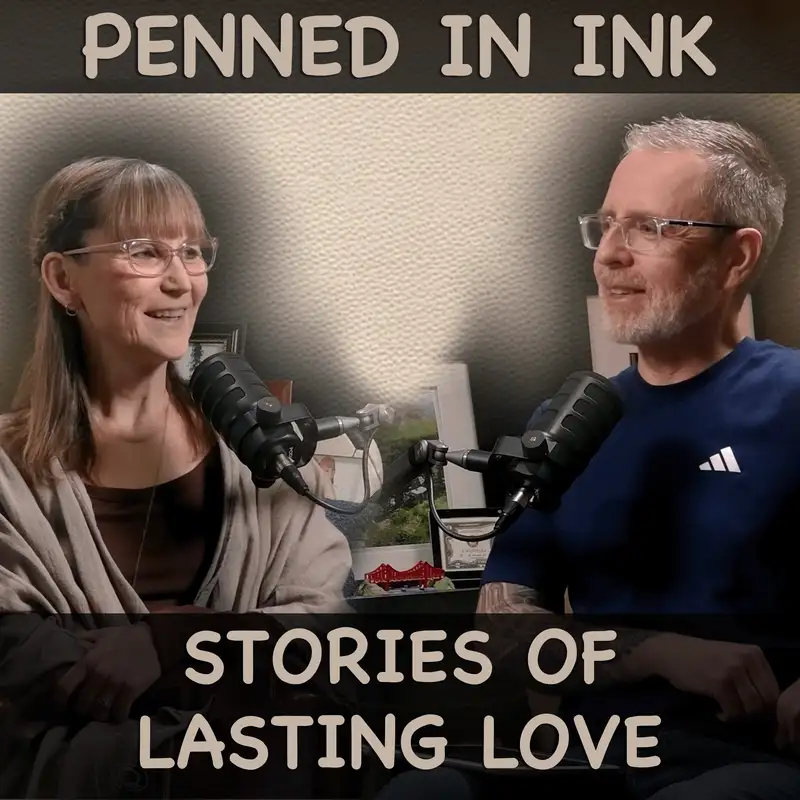
Welcome to Penned in Ink, a podcast where we discuss marriage and the power of long-lasting love.
[MUSIC PLAYING] Off we go into our first full episode of year two of Penned in Ink podcast.
What are we talking about today?
Today, we're talking about that no matter how long you're married to somebody, you're constantly learning about them.
That's part of a healthy relationship.
What we did coming out of season one is we spent a lot of time talking about and reviewing and going through all the episodes and looking at everything.
And one of the things we realized is that we actually learned quite a bit about each other over the past year, and we're 30 now, 31 years in.
And I think that's kind of a hallmark of any long-term relationship.
Excuse me, hallmark of any healthy long-term relationship is that you're learning about your partner, right?
Yeah, and I'm actually quite shocked.
We learn about each other, I think, you know, over the years.
But this past year with the podcast, it was like really concentrated.
I learned a lot of stuff in a shorter period of time than-- I think that stuff comes out over time in general.
But having done the podcast, there were just a lot of things that came out at once.
Does that make sense?
Yeah, and looking back, I think one of the things that the podcast did for us was it allowed us to reflect on how much things have changed over 30 years together.
And I think when you live in it day to day, you don't notice the change.
Everything else.
Absolutely.
You have a niece or a nephew, and you don't see them for six months, and you see them and they've grown six inches, and you're like, "Wow, you changed a lot." Well, it's because you didn't see them every day.
Whereas mom and dad are like, "Oh, I saw them grow." Like, so they're a little tone deaf to it or whatever.
Exactly.
So for us at the podcast, this past year has been two things.
We brought up a lot of things that we think are just staples of a long-term marriage, and we were talking about those.
But it also gave us a chance to think about our history through a lot of those things.
And one of the things that came out of there was, "Oh, yeah.
The way we did that in our 20s is not at all how we do it now." And there's probably even a few things in there that we sort of wanted to cycle back to.
And it's like, "Oh, yeah, we used to do it this way.
We probably should be still doing it that way.
We've gotten a little lazy in this area." So today, we're going to chat about what we learned about each other over the past year.
But the reason we're talking about that is so that you can take some time in your life to reflect a little bit about how has your relationship changed.
And then I think we're going to also look at why do we change?
What are the seasons of our life that happen?
And what are some of the things we learned about each other during each of those seasons as we reflect on them?
Just so, again, so that you're aware as you're going through those seasons in your own life, "Hey, change is happening.
And am I paying attention to it?
And am I noticing it?" Absolutely.
All right.
So it's our first fall day.
It's actually cold outside.
Anything else going on in our world?
We seem to be quite busy.
Work seems to be busy for both of us right now and soccer has spun up.
Well, actually it spun up a while ago, but we're heading toward the end of that.
Especially about to wind down.
Exactly, but there's a lot that goes on with that.
And so it seems like we're doing something on the daily that's a little bit extra.
And you've been working at one of our daughter's house.
You've been working on a project for her.
Yeah, that's taken a lot of time.
And we're just on the cusp of heading into the major holiday season.
So I think the whole world gets a little busier.
It falls a big transition for us.
And one of the things we want to do in year two, I think year one, we spent a lot of time going over what are the healthy indicators in a long-term marriage?
What are the healthy skills?
How do you resolve conflict?
How do you maintain intimacy?
How do you do X, Y, and Z?
And I think in year two, you and I have kind of talked about let's bring you, the listeners, a little bit more inside of a long-term marriage.
And as part of that, we're gonna kind of each episode, we're gonna talk a little bit about what's going on in our world.
Yeah.
Right, and show you what a long-term marriage might look like.
I think we have pictures of what it must look like or what it should look like or fears about what it might look like.
So we're gonna just bring you a little bit more into our day-to-day.
And this is a busy season for us.
Yeah, it very much is.
And I'm excited about this season.
For that reason that we're bringing people in.
And I'll tell you, as part of it is, I'm a mental health counselor and I listen to people talk all day.
And part of the ethics of being a counselor is you don't talk a lot about yourself.
You don't give people as much of a glimpse into that as you do a friend or on a podcast.
And you don't give advice.
Like, you're very hesitant to, you don't give direction.
You help them explore options, help them come to their own.
So I think a lot of times you want to express stronger opinions than you're allowed to in your profession.
So this gives you a little chance to say, "No, that's actually not right.
You shouldn't be doing this." Or, "Hey, I see this and we're gonna get into in our next episode talking about navigating the holiday season." And I know that's a big one for you personally, right?
In our lives, we've had to navigate, yeah, going from being the young family and navigating with our parents.
But then also now we're on the flip side of that.
We're the established family who got kids who are building their own traditions and that sort of stuff.
And you also deal with people who are going through grief during the holidays and all sorts of stuff, right?
And you have to sort of help them navigate through, but you don't get to necessarily share your own views and visions and advice of like, "Oh, really, you should shut that grandma down or you should not let Aunt Betty do whatever she's doing." Oh, I shouldn't use Aunt Betty.
We actually have an Aunt Betty in our family, but-- Yes, but-- That's not who I'm referring to.
Exactly.
Anybody's Aunt Betty.
Yeah, so I think season two, that's sort of what we're gonna do on that.
Let's get into our review.
So the focus of today is continually learning about your partner.
And in a healthy marriage, you absolutely need to be open to learning about your partner.
Because if you're holding on to the vision of the person you married, that's not gonna last.
And I saw a video earlier on Instagram, I should probably credit it, but I have no idea.
It's just some random, you know, Instagram.
Isn't that all of Instagram is just some random guy?
As you're listening to us, we're just some random people.
But he was talking about how marriages tend to go through, long-term marriages tend to go through at least three phases.
The first phase is that honeymoon phase.
We all sort of know that.
And that's the person you probably fell in love with because you're right in the heat of getting married and everything.
And then most relationships go through a period.
He referred to it sort of as a period of conflict.
And what he meant by it was, years two to nine, 10, somewhere in there, is when you're really learning how to live with each other, how to navigate conflict, how to maintain your intimacy, how to run your household, if you choose to have kids, how to manage your kids and everything.
And it's really a dangerous time for relationships because it's got lots of stress and lots of change.
And if you're not noticing the change and you're not noticing all this, or you're not developing your conflict resolution skills, et cetera, you never get to the third phase, which is he referred to it as a mature marriage.
And that's when you realize a lot of the things that you're having conflict about, things that are causing stress in your relationship, are nonsense and they don't matter.
And a lot of them stem around you holding on to a version of your spouse that no longer exists and that you need to sort of embrace and learn and learn to love the new partner you have because every season brings a new partner.
So he did it in 90 seconds.
I think I just did it in three minutes, but whatever.
He probably rehearsed it in a particular way and you're using his words.
Yeah, exactly.
And he shortcut it and didn't really fully go into the wise, but he basically just said, most marriages, many marriages never make it to the last phase.
They get stuck in those early phases where there's too much conflict and there's not enough connection and they lose the friendship and they lose all those sort of things.
So for us, year one was a lot of giving you how we have navigated those things.
Year two of the podcast is gonna be a little bit more into, hey, once you're in a mature relationship, mature as in, it's been there a long time, years have not.
(laughing) Well, we fit the bill for both.
Yeah, we do, but I meant more just like, mature can mean like, immature, or mature just means it's been around for a long time as well as established.
I mean, it's just been all around a long time.
And anyway, so let's jump into what we learned.
What did we learn over the year?
What are some of the things that, like where do you wanna start?
Cause we did 26 episodes, we did lots of, lots of learning, so you wanna pick one for us to start with?
Oh, that's, that's, oop.
Don't act like it's a good question.
We rehearsed this, we know what questions we're asking.
Hey, if I wanted to say-- Let me think about this, which topics?
I'm thinking through all the episodes.
No, you're not.
We got a list of ones we're gonna go through.
Just pick one.
Shh, don't tell them our secrets.
Come on now.
Actually, the one, one of the ones, because there was quite a few of them, that stuck with me was that financial piece where we talked about you being the sole earner and me being at home and not contributing financially.
And I focused a lot during that time and how I felt about that and the insecurities I had, feeling guilty for not.
Right, you talked a lot about the guilt of not bringing in money into the house and how you spent a lot of focus, like economizing our home and the couponing and doing those things or raising the kids and doing that, but you still had this struggle with, am I providing value because I'm not bringing money in?
So, go on.
Yeah.
And so I had that piece, right?
And I knew about that.
But what I didn't realize, I guess logically I realized that there was pressure on you to bring in income, but I did not realize what that pressure felt like to you until you shared it in an episode because you are an extremely confident person.
You have been since the day I met you.
Always been very confident.
Arrogant in my 20s, confident in my 50s.
Yes, yes, true.
But they felt the same on me pretty much, which is I had no doubt that you would always provide.
And so I didn't realize that there was pressure on you because I just made an assumption, oh, Michael knows he has this.
Whereas maybe there were times where you're like, oh, as you were working for startups and they were starting to have trouble.
Hey, I'm the one that brings in the money.
I can't be jobless.
I didn't realize that pressure you had until we talked about it.
Yeah, I think the stress of being a sole earner, oh, I kind of joked about this the other day when we talked about this, I think my job was to sort of not let you know about some of that in many ways, right?
Because if you're providing a, if, and this is gonna be a gender very specific, but if you're the sole earner, you're male, you feel like your role is to bring in money, it's not to bring in stress about money.
And so I think I probably didn't share much of that at the time because that wasn't the role.
My role was to bring in the money.
That was the pressure, but there are pressures there.
So I think that's, yeah, I think in that same vein, I wasn't aware how much you mentally struggled with not bringing in money, right?
So when I listened to you tell those stories and everything, it's like, oh yeah, I guess that was more of a mental load for you than I realized in that thing.
So again, yeah, I think that's a good example of something that we learned along the way.
Got another one, you want me to pop into one?
There are so many, it's up to you.
I don't mind doing another one if you'd like me to.
I'd like to give us another one.
Okay.
Another learning from the past year of, so 30 years in, we're learning about each other still, and you should still be learning about yourselves.
This, that one was quite serious.
I'm gonna go to kind of a funny one.
I really enjoy spending time with other couples.
Oh my gosh.
I do, I think it's-- I mean, I like it too.
Yes, we both do, however, I feel we should do it more, but it never comes to fruition.
And so why is that?
Is it really as important as I think it is?
Or do I just want it to be important because I enjoy it?
Yeah, so we were on vacation back in July.
Yeah, it was our holiday for our anniversary, and we're out on a hike and beautiful quiet day.
And I asked Melissa, we're very goal oriented.
We'd like to know what's coming up.
And it's part of, if you listen to our episode around our anniversary, it's definitely one of the two times a year where we really strategically think about the year ahead and what do we want to do.
And I had asked Melissa, like, okay, we've talked about this and this, what else is there?
And there's this long pause and she goes, well, I think we need to be more intentional about seeing.
And I'm like, oh no, I know where this is going.
Seeing other couples and doing stuff.
And I literally almost fell to my knees on the trail of like, not this again, because we talk about, we both enjoy it, we both like it.
But at some point, if you don't prioritize it and you don't make it part of your routine, do we actually prioritize this?
And do we want to, or are we just gonna give it lip service again for another year?
And I know you had never stated that clearly before in pointing out, hey, if this was really important to us, we would do it more.
So therefore, and I guess I hadn't thought about it like that, the counselor, me, I should have, but I didn't.
And so you point out that was something, I was like, oh, I didn't know Michael felt that level or the way he phrased that made me go, ooh, maybe that's a good point.
Right, are we living in a rut and just setting this as a goal every year and not accomplishing it?
If you're doing that, you might not prioritize it.
Really just might not be important to you.
Maybe sometimes you should be honest with yourself and go, yeah, spending time with other couples is not actually an important part of our relationship.
Doesn't mean we won't do it.
Just means it's maybe not an important part.
So stop feeling guilty when we don't do it.
It changed the language from, oh, we should get together with so-and-so to, oh, yeah, let's do that.
Just remove the guilt from the fact because maybe your relationship doesn't need that.
And I'm fond of saying in my practice, I don't like the word should.
To me, it's almost a dirty word because where is that should coming from?
Society, what you see on TV.
Oh, there's expectations.
Absolutely, and to me, the should is, I should eat healthier because I feel bad.
That's a good should, but a lot of the shoulds are just outside pressures that I don't believe are valid.
Yeah, and I guess that's an interesting point.
It makes me think of something when you talk about the should, our podcast could be perceived as, we're telling people the things you should do in a long-term relationship.
That's not actually what we're doing.
We're showing you what works for us, for inspiration, for you.
You have to set your own values on what's important and what's not.
And some people are very black and white when it comes to taking advice or not taking advice.
And they can't selectively choose what they want.
It's either they take all the advice or they take none of the advice.
I personally am a huge believer in pick and choose.
If you find things that resonate with you for you take that and implement that in your life.
And that might be around your finances, it might be around your relationships, it might be around any of your areas.
Whereas some people are like, no, you follow this doctrine, you follow this.
And so for us, I think we're not telling you these are the things, we're just saying, hey, here's a range and find something that works for you.
So we don't believe in the should, we believe in the could.
Yeah.
Ooh, that's almost a soundbite.
(laughing) I'm sure you'll find a way to use it too.
Probably not.
I think the big laugh afterwards is like, let's go lose all context.
That's true.
All right.
(laughing) Let's see, let's go with another one.
I think one of the things we recognized in this, I mentioned earlier that one of the things the podcast gave us, is giving us a chance to do is to look over the length of our relationship and recognize areas where we really have changed significantly.
And in our first, I mean, half dozen episodes, maybe 15 episodes, it almost became a running joke because one of the keys to a successful long-term marriage is communication.
And you have to communicate, you have to communicate, you have to communicate.
The, one of the things that became very obvious is the way in you and I communicate now is so far away from where we started in our communication.
And we had an episode or two where we talked about your tendency to early on to hold things close in, maybe not communicate them.
You have a little bit of conflict avoidance in your personality.
Mine was a little more hot to come to the surface, a little more flash points, a little more, I would get frustrated with things or annoyed with things that I just didn't think needed to be away.
And just for us, looking at the way you and I communicate now is, well, there's no other way to say it.
It's way healthier than it was back then.
It's more complete, it's more respectful, it's a lot more clarity to it in the moment, or I say in the moment, sometimes it's we know when to not do the communication, when to hold it, when to bring it back at the correct time.
Thoughts on that?
Yeah, you were talking about communication and it's about good communication is important in a marriage.
A lot of people communicate, it's just not always good.
And part of being good for us was figuring out how the other person communicated best and finding ways to accommodate that with each other.
And so we've always communicated, has it always been healthy, has it always been good?
Right, and I think back to that theme of learning about your partner.
We've learned cues and signals and reading each other's emotions, mood, thought process better.
One really concrete example of that is 15 years ago, 20 years ago, if I went silent, you assumed that there was something brewing or boiling or whatever under there.
And you have a much better understanding now of when I go silent.
A lot of times I'm just sort of processing, is this something I'm gonna lean into and I'm really upset about or not.
And if you just give me the time to ponder on it, we avoid a lot of conflict because I often, I still, my natural tendency is to get a little annoyed or a little short tempered or a little, not tempered, but just frustrated with like, why are we even dealing with this?
And it doesn't make sense to me.
Whereas I'm able to recognize that in myself much better now than I was in my 20s and 30s.
So I know if I just go quiet, take a moment, I'll probably settle down and realize, I don't even care about this.
What are we, like, I don't need to lean in and let that surface up.
So we just, it's, we avoid arguments in a good way.
Right.
Right?
Because not avoiding it because there's something that's unresolved that needs to be settled, but avoiding it because again, in a long-term mature relationship, some of that shit just doesn't matter.
Sure, why would I, yeah, I'm annoyed by it, but that's not your fault.
I'm annoyed by it.
So let me just settle for a minute and we'll avoid that whole conflict because it doesn't matter.
Does that make sense?
Yeah.
Subtle difference, but important.
It is a subtle difference.
And I was also thinking that kind of leads into another thing that we learned about each other.
One of the first, not one of the first, one of the more recent times where we intentionally worked on that communication.
Well, so yeah, so this is a story of sort of, there's this joke in, I don't know if it's like eating your own dog food.
It's like when you're making something or you're creating something or you're selling something, do you actually use the product?
So the story you're about to share here is an example of us.
We had preached a technique for conflict resolution that we just naturally use in our relationship.
Well, you're gonna share a story again of how we very intentionally used that.
Right, absolutely.
When we messed up.
Absolutely.
I'm gonna make a long story short.
Michael and I were on a trip and the travel day had been very stressful and he said something that didn't land well with me and I got upset and instead of just addressing it all on the plane, we both made an intentional, okay, let's rest the time.
Not the time, not the place.
Not the time, not the place.
And that was an intentional use of, and we did, we came back to it later.
Right, I apologized in the moment.
Said, hey, I realized I was across the line there, but we didn't unpack what had happened.
We let the rest of the day.
Right.
And-- We still had a long way to go in the travel day.
We did.
So it could have been a nightmare of a travel day because we still had like six hours to go in the travel day.
But that was a way of setting it aside, but knowing we were gonna come back to it.
And I think that's something that we learn about each other that we can do that and-- We can do it intentionally more so than naturally.
I think we naturally, before really thinking about it and unpacking the technique, we just sort of naturally did it.
Yes.
This was a concrete moment of no, no, we're going to actually use what we just talked about and we're not gonna do this right now.
Yeah, absolutely.
And it's, you know, that's an area that's really difficult for people.
They think if we don't address it right now, it's not gonna get resolved and it's gonna come up two years from now in an argument.
But if you intentionally, and so like you said, we were practicing a technique that we thought was important.
So then the next day we were on another hike.
We do like the hike, we like to get out.
And I approached you and said, okay, let's revisit this.
And we had a much, much cleaner conversation and a much, actually a much more useful conversation because it didn't, it wasn't spent in the conflict.
It was spent in the, what the heck happened?
Because, you know, the reactions and everything were maybe disproportional to what had happened.
And I think we find out in a lot of relationships, a lot of arguments, you're not arguing about what just fricking happened.
You're arguing about something that built up into it and led to it or some slight from earlier or some, you know, missed communication from earlier.
And you let all that just sort of explode.
And so this was a real reminder to us of like, oh yeah, these techniques actually work when you're intentional with them.
Yeah, most definitely, most definitely.
So again, learning about our, how to navigate our relationship, even 30 years in.
So the theme of the day is, I don't care if you're a year in or five years in or 10 years in, you should be learning about not just what your partner needs and likes and whatever, but what techniques can you use to communicate better and just to be a better partner.
Right, we grow as individuals.
We change a lot.
As we should.
But I think sometimes people don't realize that the relationship should be doing that as well, should.
I think that's appropriate use of should though, because we put the effort, you know, people talk about personal growth all the time, but there's also growth that takes place in the relationship and that should take place because as we're changing individually, that's also going to impact the relationship that we're in.
So the relationship needs to grow as well.
Fully agree, nothing to add.
Well, I got lots to add, but I fully agree.
(laughing) Let's share one or two more.
A learning from me or a moment that surprised me or something that I just, I didn't give the weight to in the moment, but hearing you retell the story sort of south, and you're like, oh, okay, that's an example of doing something that was, seemed appropriate, seemed natural to me in the moment, but had an outsized impact.
And you shared in one of our episodes around mental health, and you were talking about a period of time that went through that had some issues around food and control and some mental health issues you were going through there.
And you were dealing with some stuff that I just, I couldn't relate to.
There were not things that impact me at all or resonate with me or I would struggle with.
And in my attempt to sort of support you through that, at some point I had to basically just confess and come clean that like, I don't understand.
I don't get it.
I don't, I can't relate to it, but my job is to support you and I'm here for you to do what I can within my power to help you with this.
So show me what you need, tell me what you need, be open with me about this.
And to me, that seemed like the only option I had because I couldn't really, I couldn't do anything else.
And hearing you talk about how that landed with you was really important.
But it was a good bit that I just didn't realize the impact of showing up and being there had on during that time.
Yeah, it is very, I don't wanna say uncommon.
I think that's probably why it struck me because I had been working in the field, not for a super long time at that point when we were- Mental health.
Yeah.
Mental as a therapist.
Yeah, as a therapist.
And I hear all the time how people just, they just don't get it and it becomes an argument.
And very rarely do I hear people say, I don't get it, but I support you.
What do you need?
So it's something I teach now.
Yeah, that's interesting.
I guess I hadn't really thought about the fact that I said it was really the only option I had.
No, the other option I had was to just dismiss it and say- People say that to me all the time in my practice.
It's the only option I had.
And I said, no, you could have gone in the corner curled up in the fetal position and cried.
That is another option.
You chose a harder option.
So we always have options.
It's just not everybody chooses the right one or the one that's healthy and productive.
Yeah, interesting.
Yeah, I hadn't really thought about that.
It's like, of course, well, I'm the only option to support you.
No, I actually had many other options.
So did you learn something right now?
Maybe, I mean, yeah.
Realize versus learn.
Are you semantics on that?
I don't know if I learned that.
We were talking about what we've learned over the last year in the podcast.
So I don't know, just maybe that seemed a different response than you have had before that you- All right, any others you wanna hit on here?
I mean, we had one other one we talked about a little bit, which was one of the big defining moments in our life was around our daughters and their diagnosis with a form of muscular dystrophy.
And that sort of, I mean, to say it shaped our family for the last 13, 14 years would be about as much of an understatement as you can make.
And I think we, yeah, we don't talk about that at all when our sharing and re-accounting of going through that time, any learnings around that?
That's a good question.
Because there was the piece that, I don't wanna say that, I guess I should say, "I've a week, you're kind of stoic when it comes to feelings things." And that was a time where I saw you more vulnerable.
And I learned that, I don't wanna say that you evolved in that way, but even since then, I've seen you be more vulnerable than you were when, maybe this should be for our next segment, but when we were dating and when we got engaged, there were very few moments where I saw you visibly- Yeah, I'm pretty stoked.
Stokes the right word for it.
I think that's, you know- Visibly upset about something in that way.
Like in a sad or concerned kind of way.
I hadn't seen it at that level.
And to me, that was kind of a turning point, but I didn't realize it until we had talked about it more during an episode, that that was something that I noticed in you that has really carried forward, that you're more likely to, I don't wanna say you're less stoic, but you're more likely to express things that maybe you didn't in the past.
Yeah, I mean, that was definitely a turning point on a couple of different things.
And prior to that, I think I had a lot of just- assuming things were gonna be good and positive in the way they were and maybe a lack of gratitude for just how good and solid a lot of our things were.
I think that was a defining moment sort of bringing clarity in that you have you have to be really grateful of the things you have because your perception of them can change or your realities can change really quickly and I think for me there was two clarifying moments that came from that that were really sort of lifelong impactful.
One is just a better sense of gratitude because even in all that stress of the medical we had massive things to be grateful for.
You and I were relationally really strong.
Financially, we had done a lot of hard work to get ourselves in a much better position to be able to navigate medical and all the costs and things that came with that and you know, just just not losing fact that yeah, you're going through something, you know shitty but you're also a lot of things to be grateful for it.
And then the second part of that the change in there was it really clearly drove home in my mind that you really don't ever know what people are going through and so I think I became a lot less judgmental and critical of people's situations.
It doesn't mean we don't need to hold people to standards and all that sort of stuff.
I'm still a huge believer in you know, controlling what you can control and taking responsibility and all that sort of stuff.
But I'm also less likely to assume that you're Yeah less likely.
So I think that was a moment and yeah I mean it's really hard to go through something that significant life-changing without having some emotion.
I mean, I'm not yes You are not but I'm usually the one that's a bit more emotional, right?
And I believe you were in this instance Yeah, so you asked me the other day you commented the other day Like, you know why I wasn't as emotional during that time and my joke back was is because you're not as empathetic as I am Which if you know earlier is a running joke among us that I don't think I have much empathy And before the diagnosis I probably had very right a lot less empathy than I do now or the ability to show empathy So I was joking because you're heartless.
No Hardly I'm an extreme feeler.
I'm very sensitive.
I Think that makes me good at what I do.
But yeah last night's rom-com you had to you had to pause and get tissues We were only a few minutes into it.
Oh my goodness.
That was so sad If you're looking for a good rom-com voicemails from Isabella was was what we watched last night And it was it was very good for a rom-com and I don't think it was a rom-com.
It was a rom drama Okay.
Anyway, that was our movie review segment, right?
You know, and so we we did talk yesterday we said oh because I'm more empathetic than you know You were it came down to you were more educated than I was when?
Alexa started having her symptoms you had done a bunch of research and you'd share some with me But when the doctor started talking about what she thought it was you did you knew you were able to?
Look into the future.
I knew where I was going as soon as she started talking and I did not and so I became emotional later Once I did more yes, I had a delayed reaction Because I just didn't have the knowledge to understand what was happening in the moment.
Yeah, though That's why I was more stoic than you that day Makes sense.
Cool.
Well, let's transition into you said this is a good preview for our next topic.
We want to move on to We talked about you're always learning about your partner.
You're learning about your marriage.
There are times in your your Life where you're gonna go through change and we learn your we give you the heads up You're going to learn things about your partner So let's step through some of that the phase of life and these phases of life are not the point Right.
We all know the phase of life we're gonna go through But let's talk a little bit about some things we learned about each other during this time So let's just start with the obvious one dating and and through engagement What were some of the things we learned about each other during that time?
This one is a little bit harder.
I feel like you're going negative on this.
The way you're just looking at me like, I learned.
Well, this one is a little bit harder for me.
I learned, especially when the engagement happened.
The dating, we started dating when we were 14.
So I will be- Yes, we learned a lot about ourselves at our D-Day.
I am going to be honest with- Lie to them, I tell you every time, lie to them.
Our audience that there are a lot of things.
I remember some of the stuff from them, but there was a lot of stuff they didn't.
My solid memories of our relationship really started once we became engaged in the newlyweds is the bulk because teenage emotions and everything.
And you're right, I guess I'm trying to figure out how to say this because it does sound a little bit negative.
Go ahead, it's okay.
I learned how committed you can be to someone.
And maybe during some of the dating stuff, I questioned that.
Sure, okay.
And so during that phase of us getting closer toward the end of our dating, when we were getting close to the engagement.
I don't know, you became more solid in a way.
And there on my end was more trust there.
As a teenager at the time, there were jealousy things.
I'd see you talking to a girl and I would jump.
But once we got engaged, that all went away.
It's something that I learned that you are very, once you've made a commitment, bam, it is solid.
You are there.
And I don't know if I knew that prior to the late dating and engagement.
Yeah, I think that's a good example.
And I don't think that's a negative at all.
I mean, you're basically saying that I went from being a teenager, young 20s sort of experimenting and figuring out what I wanted from life to someone who decided what he wanted from life and was committed to it.
Yeah, that's kind of the change I went through.
So yeah, I hope you learned that.
Because that sounds great to me.
Right.
I mean, I don't think I'm gonna judge any 18 year old, 19 year old kid for sort of testing his boundaries and trying and seeing what he wants out of life.
You should absolutely be doing that.
True.
And if you, I'm actually a little bit more concerned if you're 17 and you're like, no, this is the path and this is what I'm doing.
It's like, son, I don't know if you've lived enough to know that that's the path.
So yeah, I think that's...
I think I had trouble saying the words because I was worried you would view it as a criticism that when you were in your teens, I didn't really know if you could, yeah, I didn't really trust you or didn't know if you could be solid and...
Well, there was reasons for that.
Like I wasn't very trustworthy on some of that stuff.
Like I was a teenager.
I know, but still, do we like to be called out on it even 40 years later?
I'm secure enough at 53 that I could listen to the, hey, you were kind of a dumb ass in your teens.
No, really?
Really?
Because it came to a positive, which is I realized how committed you can be.
Yeah, so back to you guys, if you're in your teens and you're dating and you're like us, I mean, you're way in the minority these days, it's much more likely that you're in your 20s and early 30s.
And I think knowing that where you are as a person in your that time period, it should be different when you're married and you're a couple of years in.
And if it's not, you got problems.
You marry a person that you love not with the intentions of changing them, but with the intent, with the reality of knowing they're going to change.
And so you've got to love them at each version they are.
Right, so I think that's sort of it.
I don't have a problem with that.
Then maybe I should not worry too much about how my words are gonna land.
Inside joke.
Wait, what?
What's the inside joke?
Okay, maybe not.
What was the episode when I said it?
I got a lot of shit for that.
You can't be on the other side of that.
You did get a lot of shit.
Wow, you had a lot.
That was one of our most.
We're talking about jokes.
And I was just making the case that in a relationship, sometimes it's just a joke.
And if it lands on someone and you didn't mean anything by it, but they take offense for it, it's still a funny joke.
And so yeah, okay.
You might not have the context for that, but I've caught up now.
All right, let's talk about another time in our relationship where we definitely changed and you're gonna change.
I think the topic of the discussion around are you gonna have kids or not?
If you choose to have kids or you choose not to have kids, both of those are gonna change you going forward, right?
Absolutely.
And for us, our decision was to have kids.
And to say that we learned a lot about each other raising kids, again, let's call this the episode of understatement.
But I think there are some real concrete things that were revealed in your character from my perspective during that time.
As a man, I want a wife who's going to be very loving and nurturing to my kids.
Ooh, shocking, right?
But I think to see that and to see how much the mama bear in you, the nurturer, the caregiver, again, sort of knew it was there, but to see that come out and to see that grow, yeah, awesome.
Like huge amounts of change in there.
Relationally a little hard for us to navigate at times because you love your routines, you love to be controlling.
And I think I saw a controlling side of you there that we had to navigate as well.
And part of that you could attribute to the fact that we had twins and you really had to be structured for it to work, but also a little bit of you wanting to be structured and wanting to do this.
And for me, all the positives of seeing how you raise the kids, but then also navigating the, okay, what role do I play in this?
And how do we navigate any conflict that come along with the fact that I don't do things the way you do things, right?
Any thoughts on there?
Absolutely.
You're holding?
No, I was just thinking because I had thoughts on my piece of this, what I learned about you, what really came to light during this period for us is I learned how dedicated you are to family and how you prioritize them.
I know a lot of stories about, you know what, since we're just going all out and saying what we think, dads, it's often dads, sometimes it's the moms, but I hear more of the dads are going out on their golfing.
I haven't had a time off all week, but you're gonna go spend four hours playing 18 holes.
You never did that.
You were definitely something I learned about you is that you were committed to our family and our relationship.
And you can't know that really until the moment happens.
So I thought that's the kind of guy you would be, but not until it happened.
Did I truly know?
I'm not saying I heaved a sigh of relief or anything like that because I had a feeling that was going to be the point, but to see that and to know that you would put your own stuff aside for the girls and I, that was something that I truly learned was very solid.
Yeah, so I think bringing kids in is gonna reveal what kind of character you've got.
It's gonna reveal the, are you that nurturing, loving?
Are you that prioritizing and protective?
Where are you?
And so I think that's an area of change that, you know, if you're entering and you're deciding to have kids, just know that you're entering one of the biggest changes to not only your relationship, but to your partner, right?
Because I mean, I don't know if I would have told you pre-kids that, you know, some of my greatest joy is gonna be around the family, but that's what happened, right?
So, but I don't know if I mean, yeah, to your point, I kind of knew, oh yeah, I'm gonna really enjoy this.
This is gonna become a big part of my life.
That sounds a little stupid to say, "Oh, you might have kids and that's gonna become a big part of my life." Well, yeah, of course it is.
Well, maybe not.
Not for everybody.
Right, so I think, yeah, so again, that's just another season that reveals a lot for us, let's move, let's fast forward to, I mean, this is maybe the good bookend, kids getting out of the house.
There's lots of life things that happen between having your kids and the kids being gone, but in your marriage, another huge one for us was kids leaving and this might be your first kid leaving the house and what does that change your dynamics or your last kid leaving the house, which makes you the empty nesters and changes.
For us, our first and last left at the same time, twins are only kids and they went out all at one time.
So, did you learn anything about, do we learn anything about each other during that phrase or that phase, not phrase?
I have always enjoyed you.
That's good to know.
Right.
Always.
I've always.
Always?
Okay.
Melissa doesn't like the word always.
She doesn't like the word should.
She doesn't like the word she doesn't like.
I don't like absolutes.
Never always.
They just don't really have it.
You've always liked me.
I appreciate that.
Go on.
No, really enjoyed you.
But once the girls left, what I discovered about us is I don't know.
I almost feel like our relationship is more relaxed, is funnier.
I don't know maybe because when there's kids in the house, you have to watch what you say or what, you can't say certain things because it's inappropriate just because you don't say certain things in front of your kids, right?
Certain words.
So I get told.
Certain words that you say.
And so what I learned is we had another level.
I guess I should, should I have no, should.
Maybe that is something I could have envisioned or thought, but I didn't realize.
I thought when the girls left, we were the best we could be.
I have learned that I don't know if that's the case.
We were pretty damn good.
Right.
But I think we're even better now.
Yeah, I mean, I'm just kind of chuckling over here.
So you're saying that we're more relaxed and less stressed with less pressures of having the kids around, having long-starred kids.
Oh.
Yeah, exactly.
It's sort of, I was gonna say it earlier with, you know, kids are gonna change.
It's like, yeah, it's an understatement.
But I mean, fully, that's not what happens in a lot of relationships.
A lot of times that marks the end of the relationship, right, and that you haven't done the work on your relationship during your child rearing days to be positioned to really, you know, not fall back in love with, but then all your energy is back into your relationship because you've lost the relationship during that.
You've lost the friendship.
You've lost all those sort of things.
So unfortunately, in your line of work, that's when you see a lot of going.
So I could get the expecting it not to get better that we were already good because you see that a lot.
You see a lot of deterioration.
But no, I think for us, it was great because life became more free.
And that can be freedom of expression around the house.
It could be freedom of not carrying the bills.
It could be like all sorts of freedoms that came through there.
And since we managed to keep the friendship and keep the relationship and really enjoy each other, then yeah, you have a lot more freedom for a lot of stuff.
So, yeah.
One of the things that I learned about you during that time is that you really enjoy, and I knew this from I mentioned to it a little bit with the child ring, you really love your patterns and you love your times and you love your rituals and you love your routines and you have put in a lot of work to have the freedom to set your schedule and to do what you want and watching you sort of navigate that and really benefit from literally decades of work to get there to sort of craft the day to day that you want to have.
Yeah, that's pretty cool.
And our day to days don't line up 100%.
We prioritize other stuff that we were talking earlier about.
The relationship grows, the individual grows.
I think your since you have the freedom of non the responsibilities of the kids and all that sort of stuff.
And we've done the financial work that you have the financial freedom to do a lot of things.
Your life looks wildly different.
Your days look wildly different now than they did 10 years ago.
Right.
And watching you sort of set like what's your ideal day?
Yeah, kind of cool.
Mine's a little more set.
Mine's a little more get up.
Still follow my work routines.
Yeah, you have more of a nine to five type.
You got up way before nine, but yours is a more.
Yeah, it's more structured.
Yeah, mine, I set my own schedule.
It fluctuates from day to day.
Someday I might see five people.
Someday I might see two.
Yeah, exactly.
All right.
Well, I think that's good.
I mean, I think there are other lots of other.
areas of life change and just to give it a little bit of like reiterating that you're always changing.
Yeah.
We're going to be doing this.
Actually, I think that might be good.
We're going to be doing this podcast in two years and the things that we're going to be dealing with are going to be wildly different than they are right now.
We're entering into a season where our parents are definitely aging.
My dad's had massive amounts of health scares the last two years.
Unfortunately, he's at an age and a health condition where that's not, that trend is not going to reverse.
That trend is just going to accelerate.
So we'll be going through a phase of life where parents and mortality and that sort of stuff comes in or long-term care or how does that change?
Those are areas that I know are going to change me individually.
They're going to change you individually.
They're going to change our relationship.
Yeah.
Right.
So yeah, nothing more to say there.
Exactly.
Change comes.
Change is going.
Exactly.
And there will be more because we are only 53 and 52.
There you go.
Exactly.
All right.
Had to point that out the age difference.
Did you get that?
I'm younger than you.
I actually ignored that.
That's kind of funny.
All right.
Someone's feeling saucy.
Yeah.
For a couple more months.
Yeah, exactly.
Well, let's check in on a couple things.
One of the things we want to do is bring you into our, our week to week relationship a little bit more.
And I've mentioned it earlier.
One of the things that we've really focused on is, is gratitude and just being grateful for the things that are going on in our life and that we have in our world.
So what are you grateful for this week?
What's, what's been in the queue the last couple of weeks?
It seems so silly, but I am grateful for the pumpkins in the fall season.
I am grateful for the change in the weather.
We broke several or set several heat records and we went, I believe from 89.
To like a high of 54 yesterday.
Yeah.
We had like a 35 degree change.
It was cute.
Oh, this is my favorite time of year.
I was overjoyed and still am because at least they're predicting that that's behind us at this point.
Grateful for the heat to be gone.
So grateful.
We have had a very hot summer.
Everybody can agree on that.
You're allowed to be grateful for the weather.
I mean, it's funny when I boil it down to that, I'm grateful for the weather, but okay.
Yeah, fair enough.
Anyway, what are you grateful for dear?
So this I, you mentioned earlier, I'm finishing up a project with one of my daughters helping her build a built in bookcase.
I do not have carpentry skills.
I do not have the ability to do that.
Hell, I don't even have the tools to do that, but I got a friend.
I got a friend who loves to do woodworking and I called him up and had some lunch and said, Hey, if you were doing this, how would you do it?
And he said, I'd come over to my place and do it with me.
And I'm like, I was hoping you were going to say that.
So I'm grateful for, for my buddy for stepping up and spending the last, you know, five weekends or so teaching me how to build this stuff and doing it.
And we were like 98% of the way there.
Got painting all done last week.
Yeah.
So I'm just grateful to have somebody who could teach me a new skill.
And I'm actually excited about the other things I want to build in, in that, uh, yeah, in our place.
So therefore for my buddy, so what's sitting on you?
What's, what, what are you worried about?
What's the, uh, changing from grateful to what's right.
Right.
Because reality, this isn't a, everything's good and Rosey and there's something.
And for some people, this might not be a big thing, but a month ago, our, our aging dog hurt her leg and just watching her limp around.
Oh, anyway, that has been weighing heavy.
And the fact that we don't have an appointment for, yes, we're taking her to doggy rehab to see if they can help with her getting at least a little bit better.
She doesn't have a whole lot of time left, but getting, getting better, but just watching her that really weighs on me.
I think about it a lot.
Like she's been downstairs for the last hour and a half by herself because she can't do stairs anymore.
And so she's been asleep downstairs wondering where we are, but yes, probably she used to be so right.
She normally would hang out in here with us, but he has to be carried up the stairs at the moment.
Yeah.
So the dog's health is actually weighing on because it has changed a lot about not a lot.
It has changed several things about our routine, about how she needs to be cared for.
And so there's been an adjustment there and it doesn't look like it's close to being done yet.
Fair enough.
What's going on you?
Um, you know, it's getting heavy.
Yeah, exactly.
The work has been chaotic.
There's lack of focus.
We got a bunch of different teams that are doing a bunch of stuff that I told my manager the other day.
Oh, okay.
Back up.
I'm very fortunate that I have a lot of autonomy with what I do at work.
And my manager is not a day to day manager.
He's actually really just a people manager.
So I go to him when there's, there's issues going on and stuff.
And I told him the other day that like, at this point, I really don't care where the current takes us on this.
I just wish somebody would fricking start rowing in a direction.
So it's just been very, yeah.
And finding myself, I don't know if any, I don't know if any of my colleagues listen to this.
I have to be a little bit careful, but on one hand, not giving a shit at all, which way it goes.
But on the other hand, caring passionately about it, getting done right and just navigating that.
So yeah, so we're spending kind of a pain in the ass, which is not always the case.
Sometimes it's, it's good.
It's time.
It's a little pain in the ass.
Yeah.
All right.
And then let's close this little segment with what are you looking forward to?
I mean, you already sort of gave a, I know, I know where this is going.
It's along the same vein.
This is my favorite time of year period, especially once November hits.
That is a very, because as we're recording, it's not November yet, but that's really, we have birthdays, we have holidays, we have beautiful weather in North Carolina in October, November, beautiful weather.
I am so looking forward to, you know, the next thing and coming into my favorite time of year.
Awesome.
Well, on those lines, I'm looking forward to our, we run a soccer club on the side.
It's got two weeks left.
I'm looking forward to the season being wrapped up because it's a busy time for us.
And for me, the start of the holiday season is sort of when soccer stops.
So I'm looking forward to that being done.
It's been good.
Yep.
That makes sense.
I like it.
All right.
Next episode, we are speaking the holiday season.
We're jumping into how the heck do you navigate the holidays?
How do we navigate the holidays and what are some issues?
And this is where your view of a therapist and a counselor is really going to come in because you've got lots of thoughts on how people, what struggles they have and where they go and what the holidays look like.
And for us, it's something again, with our longevity of marriage, we've been through many aspects of it.
We've done it as dating couple.
We've done it as a newlywed couple.
We've done it as a young family.
We've done it as a empty nesters.
We've done it as a family that moved 3000 miles away.
Yeah.
So we've, we've done lots of different things.
So we're going to talk to all things, navigating the holiday season.
Yeah, absolutely.
Anything else you want to close on?
No, I think that I'm, I really like where we're going with this second season season.
It feels like a seasonal, you know, we watch TV anyway, with this second year of our podcast, I'm really excited about it.
And this felt good today.
And I think this is a good format for us.
I like it a lot.
All right.
Well, thanks for joining us everyone.
And we hope that year ahead has lots of awesome stories about long-term love.
And yeah, hopefully we're still doing this in a year.
Absolutely.
All right.
Cheers all.
Take care.
Subscribe
Penned in Ink is a storytelling podcast about marriage, commitment, and the art of building a life together. Hosted by Michael and Melissa Penwell, high school sweethearts celebrating 30+ years of marriage, each ep...