What do you do if you're dating someone and you find out they have lots of debt?
Do you run for the hills?
Do you shrug it off?
Do you take a deep sigh of relief because you're carrying your own debt too?
Many people say that debt is a deal breaker, but when we got engaged, we had no assets and lots of debt.
So, 31 years later, either we got super lucky or just asking about someone's debt doesn't really tell you who they are with their money.
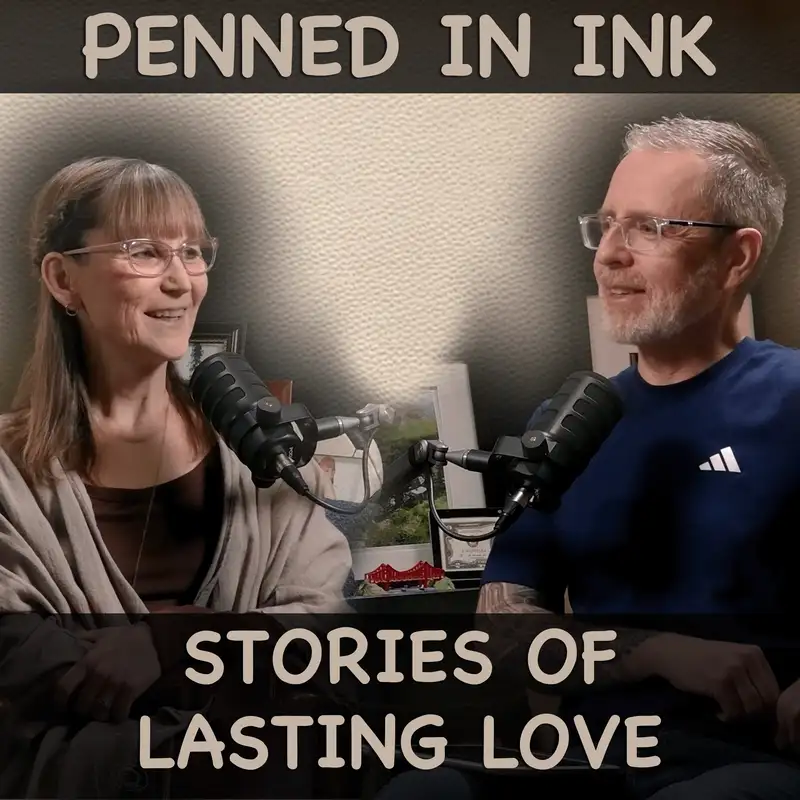
Welcome to Penned in Ink, a podcast where we discuss marriage and the power of long-lasting love.
All right, Melissa.
Today, we are talking finances, one of our personal favorite topics.
It is.
I doubt I would have said that 30 years ago.
No, probably not.
I mean, when you've got no money, it's hard to say it's one of your favorite topics in the world.
Very good point.
I guess I hadn't thought about that.
I was just thinking, you know, that it's often one that's avoided.
So, yep.
Well, today we are going to start our first of three consecutive episodes where we talk about finances.
Yes, finances is that big of a topic that it needs three whole episodes.
Actually, if we want to be honest, we've already done one episode on it.
So, this is actually episode two, but we're going to do three in a row here.
We're going to start by talking finances before commitment, before you're married, dating, maybe you're exclusive, maybe you're not, maybe you're super early on.
We're going to talk all things early finances.
Sound good?
What was that?
[Laughter] Was that a yes?
That was a yes.
All right.
Into the mics.
The people in the back can hear it next time.
[Laughter] It's been a day.
It has been a long day.
For context, it's like, what, 95 degrees outside and 85% humidity or something?
Correct, yes.
It's terrible outside.
So we're sitting here and normally we would be recording tomorrow, but Melissa's like, "It's too dang hot to go outside.
Let's just record today." Right.
You don't care.
Anyway, on to the next stuff.
If you're just joining us for the first time, let's do a quick introduction.
I'm Michael and I'm here with my wife, Melissa.
We've been married over 30 years and on this podcast we share stories from our life with the hope, vision, dream of showing you what a long-term healthy marriage looks like.
But I am also a mental health counselor, so sometimes I will share some things that I've seen in my practice, but this is not meant to be professional advice.
Perfect.
We are going to start this episode different than we start most episodes.
We're actually going to report on some surveys and some findings and some data about dating and single and attitudes toward it.
And we don't spend a lot of time on numbers typically, but it's a finance episode, so we've got to bring the numbers.
Well, no, actually we're not going to bring many numbers, so bear with us a little bit.
Right.
Ready to dive into some findings and surveys and studies?
Absolutely.
All right, well, I'm going to get my CNN or Fox News sort of host or financial news, CNBC news host on, and I'm going to go through the data on this.
There are three studies that we're going to dive into here and we're going to provide all the links and stuff in the description, show notes, so don't worry about this.
We hopefully have sourced it all.
It's all accurate data and dig into these numbers yourself.
And I would say it's exciting, kind of cool reading.
It's actually a little sad in many ways, but enough editorializing, I guess, on that.
Probably depends on what your relationship with numbers is.
Well, that's true.
Yeah, that's true.
Do you like numbers or not like numbers?
Okay, so looking at the first study, one thing jumped up to us that we actually were not expecting, and that's that the number that everybody wants to ask about is actually not a top thing.
We all think debt, what's your number?
And that actually is not necessarily the case.
So in the first study we looked at is from Northwestern Mutual, 2026 planning and progress study.
They asked Americans to pick their top three financial red flags in a relationship.
Number one on that list with 49% was excessive gambling and risk taking.
Number two, at 47% was hiding or lying about purchases.
And number three, at 41% was high credit card debt.
So the two things that beat debt are not numbers at all.
One is how you handle risk, and the other is are you willing to tell the truth?
And that's about character.
That's not about math.
No, no numbers at all in that those two issues.
Not at all.
And remember those first two, because gambling and risk taking is where we're going to go shortly.
And secrecy is where we're going to finish up.
Exactly.
Now, in that same survey, 60% of Americans say poor money habits are a deal breaker in a new relationship.
Habits, not balances.
Again, not a number, a pattern of behavior.
Right.
And you can pay off a number, but a habit is something that follows you around.
So the first two basically say, that's cool, but not maybe the number one thing in people's mind.
But let's dig into that debt number because that debt number actually has a place to play.
So this next study, and again, continuing with my CNBC survey results, a Harris Poll modern dating survey, February 2026, roughly 800 or so singles were surveyed in this.
They were asked to name their top three dating deal breakers and 34% of them picked credit card debt.
Asked separately to rate credit card debt as a red flag, beige flag or green flag, 63% called it a red flag.
I kind of find it funny, a beige flag.
I would have thought a yellow flag, but the survey was beige flag.
I was totally going to say that.
I will be honest, never my practice have I used a beige flag.
So that's the same survey with the same people, the same credit card debt, nearly double, depending on how you worded the question.
Wording mattered.
If the answer depends that much on the wording, the question probably is not measuring what people think that it's measuring.
Maybe just asking about debt isn't enough.
Maybe that's a thesis of our whole episode here, right there in that survey.
All right.
There are two more findings from this research that we wanted to pull out because they were interesting for us.
And I think they set the tone for where we want to go with some of this discussion.
The first one is that most people wait too long to talk about finances.
Earnest, debt and dating research report from February, again of 2026, they talked to more than 1,100 people surveyed.
They said, oh, from that result, 61% said they wait until after becoming exclusive to talk about debt.
On the flip side, 1% said they would do it on the first date.
Okay, I don't know who those people are.
That's a little extreme.
But 61% reported that they would wait until they're exclusive to have any sort of financial discussions.
All right.
And without tossing out all the numbers, another finding from that same survey was that those with the most extreme debt levels would wait the longest to discuss.
All right.
You know what got me about that?
That 75% of the people in that same survey rated themselves as very or completely transparent about money.
So I got this right.
Three quarters of the people think that they are an open book.
Most of them are waiting until they're exclusive to discuss money.
And the ones with the most extreme debt are waiting until there's a ring involved.
Yeah.
And that's all fine if you're good at communication and you're going to be honest.
But what often happens is that conversation never happens.
Yeah, unfortunately, that is true.
And I was listening to something the other day and I was dumbfounded.
Couples that had been married 10, 15 years and having money problems.
And they're like, we never talked about this before marriage.
I'm like, and you wonder why you're having problems.
Right?
It's crazy.
All right.
The last finding that we want to share and trust me, there were many.
We kind of cherry picked and pulled out the ones that we were most like, oh, yeah.
Okay.
So the one last one we want to share is we're going to go back to that same Harris poll.
The number one dating red flag among singles was wanting to merge finances early.
67% of singles reported that as a major red flag.
75% of women.
It was not the debt.
It was not spending.
It was somebody wanting to move too fast on my money.
And we agree completely.
Do not do not combine finances with somebody that you're dating.
In our next episode, we're going to argue that the day that you get married, you combine finances and that's not the norm anymore.
That's the minority.
It'll be a fun episode.
Yes.
We'll get lots of comments on that episode.
I'm sure we are definitely old school on that, but that is a topic for next time.
Thank you for bearing with us because that's the world.
You are dating in.
I'm sure you know most of those things because you're living it.
Risk and secrecy rank above the numbers habits, beat balances, and almost nobody talks about it before they're exclusive, which raises a fair question about us.
How did we handle this?
Let's answer that question in our Inked Moments segment.
One of the things we always do in our episodes is we like to start the episode early on, sharing a very concrete memory from our past that helps set the framework for where we're going with this.
And this sharing is going to be a little different because the logical sharing would be, how did we talk about money and what was our financial talk and what was our money talk back in our day?
But what's our confession?
I was just going to say we need to confess.
We never really, we didn't have it.
I was going to try to circle code it.
No, we didn't have it.
We had very little money and we had lots of debt and mainly in the form of school loans and basically no jobs.
We just had minimum wage type thing.
And that's not where many of the people that are watching are living right now.
So let's set a little bit more for those of you who maybe haven't joined us on previous podcasts, let's set a little background of why we didn't have that.
You had all the things like, well, we didn't have any money, so why talk about it?
And in transparency, you might be in an incredibly different situation.
You might be in your late 20s, early 30s, you've been working for a while.
You might have lots of assets.
That's not Melissa and I's story.
We met in high school before high school, dated in high school, continued to date through college, got serious toward commitment and engagement.
When I was just about graduating, you were a year or so to go still in school.
And so at the time we didn't have money.
We didn't have, you know, it wasn't a big deal, but we have a little bit of an advantage there where we grew up together.
And so there was some shared values that we knew we absolutely had around money.
Yeah, we each had jobs and we saw that.
I saw the jobs that you worked and you saw what I was doing.
And so we knew that the work ethic was there and I was a saver.
And I think you saw that, that that's something that I just did.
So we do have that history that not everybody does.
Yeah, Melissa, she glossed over it a little bit there, but what were some of your first jobs when we were in high school and stuff?
Okay, the very first job couldn't have been more than 10.
I think I was a strawberry picking.
We lived in.
And you might think I didn't know her at 10, but I think I met you right around 10.
So yeah, so go on.
Yes.
So rural, rural community and.
We're having a podcast full of hard words.
You, you pick strawberries for the, whoever was the field manager and you would give them and they'd give you 10 cents per pound for what you picked.
So, you know, I'd, I'd pick for a couple hours with my siblings and mom would pick us up and I'd pick up my pocket because they paid you right there.
Yep.
Then you worked for the Iris farm in high school, right?
Before that, I did a lot of babysitting.
That was kind of the thing that teenage girls did.
Sure.
Nannying today, but yeah.
Yeah.
Back into the, into the 1980s.
Right.
I, I babysat and then, yeah, worked at an Iris farm.
Did that for a while.
And then in college you did work, study and that sort of stuff.
For me, I lived with just my dad.
We lived in an apartment, didn't have a whole lot of money, had everything covered, but really spent a lot of time.
If I wanted extra money, I had to work as well.
So in high school, I spent my nights working at cleaning floors at grocery stores and stuff.
So work has always been something we did and we got into college and really became serious.
We were going through academics and we were making sure we were getting our degrees and we sort of knew where our careers were trajectory, what direction it was heading.
So we were already aligned in the fact that we knew we wanted careers.
We knew we were both going to work for a good bit of time.
We had financial goals that were beyond just survival.
And I think that sort of meant we didn't have to have really concrete money discussions because we sort of grew up together around our money discussions.
Yes.
All right.
So not to belabor that, but we really, our inked moment today is just really saying we never did a money talk.
And so some of the topics we're going to talk about here are really going to focus on if we were looking, well, we are looking back, looking back, what should we have been talking about?
And if we were not as aligned in our backgrounds, how do you navigate that?
And then one more thing for those of you who don't know us, we have two adult daughters.
And so some of the stuff we're going to talk about, we've absolutely leaned in and shared with them and sort of put on to their mindset as they've been evaluating and going through the dating stuff.
Yep.
All right.
We've done, we've confessed our lack of a long talk on this.
And we're making the case that just asking about someone's debt level doesn't tell you enough.
What does tell you enough?
I think we're going to make the case that there are signals, there are things about someone's debt that will help you understand much more than just the number.
So the first question that most people want to ask is what's the number?
Right.
Well, great.
That tells you one thing.
Right.
What they ask next.
What, not next, what should they ask?
What should they ask is what type of debt is it?
Is it payday loan debt?
Is it credit card debt?
Is it student loan debt?
Because those are different types of debt.
Yeah, absolutely.
So we might not have had a story or a talk about this, but we were aligned on how we were using debt.
We both had student loan debt.
And we didn't have credit card debt.
Neither of our families really used a whole lot of, carried a lot of credit card debt.
So that wasn't something we did.
And we never did payday loans.
We were very good about living within our means.
Another thing that in addition to type that I think is important is direction.
Is that debt amount going up or is that debt amount coming down?
And if you are digging a hole further and further and further, that's a signal to me that you use debt a certain way or you do something.
We might have still been digging when we were committing because I think we were still digging student loans.
We were, yeah, even after our marriage, you were almost, you were done with school, but I wasn't done with school.
So we were still doing that.
So a signal at that time was the type was something that we were comfortable with.
It was aspirational.
It was educational.
We were maybe still digging.
Maybe that tells us another signal that, oh, we weren't fully thinking about what we were doing there.
I think another is what else?
Yeah.
Give me another signal.
I think there's a couple of other signals we were talking about.
How your partner views debt?
Do they view it as a tool?
Do they think it's a necessary evil?
Do they avoid it at all costs?
What is their view on how debt should be used?
Yeah.
And I think that's really important because you're going to find people have all sorts of different philosophies about leverage and using debt.
And in your twenties, early twenties, you probably aren't using debt nearly as much as you are, maybe in your late twenties and early thirties.
There's, there's, you're just, you've established your credit.
You've established your patterns.
Those established patterns and credits will tell you a lot about what that person's operating system is, what they're going to do.
And as we were kind of thinking about this topic and as we've taught our daughters about this, there's a, there's an area, a signal that opened up that wasn't really something in our time that might've caused me some problems.
Right.
Want to share that?
Yeah.
That's risk appetite.
You know, what kind of like crypto, crypto wasn't around when you and I were, you know, is that something that you, you would get into or somebody might get into that.
How do you feel about that?
Is that risky?
Is it not risky?
Yeah.
And the other one that's in that same vein is online sports betting.
Yes.
So I was a huge sports fan still.
I'm a huge sports fan.
I also do like to gamble or did like to gamble a lot.
I love the poker game.
I loved, you know, uh, I mean, we used to go to the grayhound.
I was going to ask you if you remember that.
Yeah, we used to do grayhound.
I mean, we'd drop like 20 bucks.
So it wasn't like, it was, it was a pretty cheap date because, you know, you, you lay a dollar on each, each race and, um, but yeah, we would go to the, to the grayhound races.
We would do that.
I used to love gambling.
And if there had been sports gambling online at that time, that probably would have been something that I would have been much more involved in.
And I think that would have given you another signal about how I view money.
And cause I mean, I liked, I'm into tech.
I love crypto.
I love those sort of things.
And I always want to dabble in those.
But in addition to the type of things you want to do, how are you doing it?
So one thing that I always did with my gambling was it was out of a budget.
Like we had a date night budget or I had a poker game budget and I, you know, I knew I had 50 bucks to go play poker or I had 25 bucks to go play poker.
It wasn't a, oh, I'm going to keep gambling until I win it back sort of deal.
And, you know, sometimes those activities can be social activities.
You're part of an investment club or you're part of any of those sort of things.
There's a couple other categories that those things fall into as well.
I know some people that use it as a wealth strategy and I will tell you that that would be way too risky.
I'm never saving my money.
I'm just going to put it all in crypto and let it ride.
Right.
Exactly.
You know, and so we have to pay attention to that.
Is that something that gives somebody a high?
Do they like that?
Right.
And then, I mean, I think the other one too is some people use it as, you know, you heard the term like retail therapy.
Some people use gambling or they use this high risk as sort of an escapism.
It's a lever for them.
Or as we say in counseling, an unhealthy coping skill for maybe life stressors.
Yeah.
So all four of those are signals about risk appetite.
The first two are probably neutral, right?
If it's a social, it's within my budget.
Cool.
The second one is probably, let's call it a morals or an ethical lineup.
Is this something that you like a strategy lineup?
Are we in alignment?
The last one, the escapism one gets a little bit into areas that are a little questionable.
And then obviously, if we're going to talk gambling and stuff, there's a whole case, which is like addiction and gambling that that's beyond what we're talking about here.
Those are things.
And this is where we walk that fine line between your therapy background and not those things are beyond any sort of podcast.
I mean, those are things you actually need help with.
But the signal there is that risk appetite.
Right.
So I think if we look at those five signals, that's the week, like the number is the weakest of those signals.
That tells you the least about how someone interacts with money, whereas those others give you a much better picture of their finances.
Right.
I think it's pretty interesting because looking back for those, I would have been cool on.
Yeah.
One of those, I don't know where it would have landed.
Yeah.
It could have been interesting.
Flip of the coin.
Is it good or is it bad?
Yeah.
So how do you uncover that?
Ask questions.
And we think that there are some specific questions that you can ask.
Such as what does abundance look like to you?
What does scarcity look like to you?
Okay.
Why those questions?
What are those questions?
Why is that better than a debt?
Then tell me your number.
Because to understand where they're coming from, what to define those things lets you know, okay, maybe they have this much debt because of this reason.
It's an explanation so that maybe you can go, oh, okay.
Let's see how we can get aligned on this now that I know why.
What abundance means to you and what does not having enough money mean to you?
Cool.
Go back 30 years when we were having our limited conversation around this.
Did we have a sense of what did the abundance mean to you back then?
Do you remember?
Oh, it was, you know, having saved enough for my side job, the jobs, they're not even side jobs.
They were the jobs that I had.
Right.
You were a student and you had side jobs.
Right.
Exactly.
Having the extra past food and shelter and all that stuff, what can I do?
Are there certain goals, things that I'm trying to reach?
When I was younger, it was I wanted to go to horse camp.
So I was saving up Monday.
I had an abundance so I could go to horse camp.
You followed?
I worked out a safe for that.
No, in high school.
That was moving out horse camp.
But I feel that was like where I started.
That's how I valued abundance.
In college, it was, you know, do I have enough money to go with Angela to the movies?
Right.
It was what it's scarcity look like then.
Scarcity was, oh, that's a really good question.
I guess making, especially when I got my first apartment, moved off campus, that was it was making sure I had enough money for my share of the rent, enough money for groceries.
And sometimes it was tight, right?
Right.
Yeah, we're not having steak this month because there and it was just the it was more of the bare minimum.
Okay, I have I have food for every meal.
I've got clothes.
I have fuel for my car.
Yeah.
So.
I mean, thanks for sharing.
I mean, I knew all the answers to all those sort of things.
Right, you did, you did.
So one of the things, we might not have had clear money talks, but I knew what your view of abundance was, and I knew what your view of scarcity was.
And reality transparency, we lived in a lot of scarcity at that time.
We were right on the edge on a lot of things.
So for me, abundance, kind of like you were saying, well, if I got everything covered and I got any money left, that's abundance.
And that's fine.
And that's where we were for a very long time.
And I think the, for me, my dad and I lived in an apartment through high school.
It was just him and I.
And he worked a lot, made good money.
We had everything we sort of needed and everything there.
We didn't have a whole lot of abundance in there.
And I think there were times where, when we did have a little bit of abundance, the spending maybe was a little more than I was comfortable with.
Not that I should be comfortable with my dad's spending when I'm in high school, but we would go from abundance to like just enough to cover stuff.
So that sort of scarred me to be a little bit more of a conservative with my money.
Like I've never been one who throws money around, especially that era, because I wanted a little bit more in savings because I knew what scarcity was.
We share that because that reveals a lot more about somebody than just asking them their number.
It shows them sort of where their thoughts around there come from.
Got another question that will reveal sort of like that.
Abundance, scarcity, what else?
Yeah, I think we can all say that we've had a purchase that we regret.
Oh, this is a good one.
I think so asking your partner, hey, is there anything, a purchase that you look back on and you go, oh man, that was stupid.
We don't have any of those.
I was just gonna say, Michael, why don't you lead us off?
What purchase comes to mind when I say purchases were in regret?
Well, I'll go with my purchase because I have a much bigger regret about the one you'll probably share.
Although I have that one, but I won't take your thunder.
Cars, so if you've listened to a couple of our previous episodes, I do not value cars.
I do not like cars.
I don't like the process of buying cars.
I don't like any of that sort of stuff.
And this story might unravel a little why.
I don't like that very much.
We did, and this was not when we were getting engaged or anything, this is a little later on, but we bought when the girls were born, we have twin daughters.
When they were born, we did the stereotypical, we had a smaller car.
It was something that probably would have been just fine for a few years, and instead we went out and bought the big Ford Expedition that was big and safe and all this sort of stuff.
And we took a loan out for it.
I think we had traded it a vehicle for it.
So we rolled some negative equity and all the typical things, you just not a good financial decision.
Not to mention it wasn't a very practical one because my 5'2" wife is trying to lift car seats up into a big, too high for her, damn, you're throwing her back out.
And it's not like today where you were telling me a story last week or whatever that they've innovated to where now the whole seat will rotate and you can easily take them out.
This is back in the day where you had to climb up and throw it over and toss it on there.
So I would say I've got a couple of vehicle purchases that I look at and go, "Oh man, that was not good." Right, yeah.
What's your spending regret?
Yeah, it served me in the end, but still.
Your regret would be the wrong word for it.
No, I think regret because anyway, I'm just gonna say I chose two private schools for my post high school education.
The first one you went there.
And so that kind of played a role.
Sure, but your alternate school was a private school as well.
So don't blame me for your bad financial decision.
You weren't ever considering a state school.
No, no, I'll tell you what it is.
I know exactly what it was.
No, no, wait.
I feel that I'm smart.
I was a good student, but it didn't come easy to me.
I had to study, I had to listen to the teacher, I had to take notes.
And I thought private school would afford me a smaller class size and it did.
Oh, you bought the myth, go on.
I did.
Yeah, we've all bought that myth.
I thought for sure that I needed, because we went to a very small high school and I felt I needed that small in order to succeed.
Those small class sizes.
And I felt that the private school is what was gonna give me that.
So I did it for undergraduate.
I don't really regret that one as much, but the graduate school, I totally, because I did the exact same thing.
I chose a private school for my master's degree and I could have gone to a state school and cut that portion, which was the bulk of my, because I had scholarships for undergrad, but there's not as much of that for graduate school.
And so my graduate school two years cost, I think, more than my four year undergrad.
If I would have gone to state school, I think it would have cut that half.
Yeah, that's a whopper of one.
That is.
This is not the school choice episode, but school choice is a huge, huge financial thing.
So that's a tens of thousand dollar type of mistake.
So those are a couple questions that we think are better than what's your debt number, right?
But to bring around full circle to what we're talking about with risk appetite, a question for that could be, what is the most money you've ever had riding on something that was uncertain?
And how did that make you feel while you were waiting on that uncertainty?
So not only the sense of dollar amounts you've bet or dollar amounts you've invested on a risky thing or dollar amounts you've thrown into crypto, but what was the psychology behind it?
If you were waiting for, I think that's actually more important than the dollar amount, right?
Correct.
So if I'm someone who gets that high off that gambling and I don't, the risk gets me excited and whatever, that's a different signal than if I'm nervous about it and was worried about losing it or whatever, right?
So even within a high risk activity, the actual signal is not the activity itself sometimes.
It's the.
How they're responding to.
Yeah.
Are you using your psychology on me there?
Are you trying to get the question underneath the question that shows a psychological response rather than just an action?
Yeah.
So the psychology behind some of these questions is really important.
And that's just a handful of the questions.
I mean, there's just search online for questions, financial questions to ask.
And there are tons of these little things that'll reveal these.
But I think it's important to find a mix of like two types of questions, some questions that tell you how did you get to where you are?
And then some questions that give you a little bit of insight into where might they go with this.
I think that risk tolerance question and the emotions behind it give you that little glimpse of where they're going.
There's a little bit of historical forensic and a little bit of future forecasting.
Yeah.
That's what relationships are, right?
Yeah, they are.
So we've covered how do you ask questions about someone's debt that actually reveals more about the type of debt and why it actually matters and direction and all those sort of things.
And then we've talked a little bit about questions that you should be asking that help reveal character.
Let's pivot just a little bit and talk about what we think really is a deal breaker and something that you actually need to be very aware of.
And that's the concept of secrecy.
There will come a time when you're in your relationship that the numbers matter.
We would absolutely agree early on, early dating, numbers don't matter, details don't matter.
But at some point numbers and details matter.
And if you're going to commit to someone long term, specially married, long term, there comes a point where you have to have those numbers talks.
And it's less about the numbers and it's more about the transparency and the accuracy.
But there are some reasons why people are hesitant to talk.
Yeah, most definitely.
There are legitimate reasons.
One of them is they're ashamed of their numbers.
Either they don't make enough or their debt to income ratio is really high.
Look at you throwing financial terms.
I know.
Look out.
That's not condescending.
I just love the fact that when you speak debt to income ratio to me, I don't know.
I get a little tingly.
I like it.
And the other thing is not everybody's like super on top of.
Oh, yeah.
Back in the day, we kept a checkbook and we, you know, we tallied everything and we wrote things down and we did all the things.
There are some people today that don't have any idea what their numbers are.
Oh, I think it's not some.
I think it's most people.
Is it?
Most people don't have a grasp of what their numbers are.
Yeah.
I mean, I think, yes, it being digital, it being apps and all this sort of stuff, it's frictionless.
So we don't have to manage it as much.
So yeah, transactionally, like we're very old school and how detailed we are on ours.
Now, I'm not saying we're the only ones that do that, but I think the majority of people are much less aware.
And I think the number of times people are like, oh, I didn't realize I had this much debt or I didn't realize I had that.
Like I think that is I mean, another one is like online subscriptions.
And it's all whole services that will go out there and clean your subscriptions because people end up with 20 unknown subscriptions.
Like I know every subscription we have because I see it every month.
So like the level.
So for sure.
Yeah, I could see how that might not want to admit that I don't know what my numbers are.
So they avoid the conversation.
And another one would be a fear of how their partner might react to whatever their numbers are.
Hi, low, whatever that looks like.
They might be.
Unsure of how that will go over if they share those actual numbers.
Well, yeah, and I think that one's an interesting one too, because I mean, there's a whole trend right now or not trend aware, but.
Incomes used to be very uneven in relationships.
And I think that is shifted a lot as more women have prioritized career.
And if you're dating someone in your 20s and you're neither of you are established, that's one thing.
But if you're dating in your late 20s or early 30s and you both have had careers, you might have huge earning discrepancies.
Yeah, and I think that it creates a really.
for some men, why am I dancing around this?
Some men cannot handle it when the woman makes a lot more money than they do.
And that might be a reason why women are hesitant to share, especially if they're high earners.
I think that goes the other way.
And I think there is, I don't think, I know there is, there's a lot of talk about why would I ever get married on the men's side because then I have to share half my wealth and half, so those are legitimate questions.
So there's, yeah, so how you react either way is definitely an area.
Absolutely, so those are legitimate.
The red flag that you should be concerned about is an unwillingness to like share their number.
So if you ask your partner, so what's your debt or how much do you make or any of those questions and they refuse to answer.
Yeah, that's a problem.
Ooh, I mean, that just screams, almost run the other way.
Yeah, if you don't have a willingness to share your numbers with someone that you plan on being married to living long-term, that's the first step to financial infidelity.
Like if you're gonna hide it during your relationships or you're unwilling to talk about it, there's a high probability that's gonna continue on into your relationship.
You're not all of a sudden gonna start opening up about money.
So that would be absolutely one that would be in that red flag sort of deal.
Absolutely, and the other part of that is an unwillingness to discuss a vision for how you want to manage your finances together.
Oh, that's good, so yeah, we're not talking just the numbers themselves, but I don't even wanna talk about how we're gonna manage money.
Well, that's a good lead-in.
I mean, in the next episode, we're gonna talk about how you manage your money, right?
If you have a partner who doesn't wanna talk about how you're gonna manage your money as a married couple, that would be a red flag.
Yes, yeah, pretty big, pretty big red flag.
So when you get to the point in your relationship where you're having these conversations or you want to have these conversations about the numbers, if the numbers don't align or the conversation gets avoided, that's just information.
It's not the verdict, right?
That doesn't mean you've hit your dead end.
Really, the question then becomes whether your partner is willing to move toward alignment or not.
Misalignment, you both see, is perfectly workable, but misalignment one person refuses to discuss, that's the actual deal breaker.
All right, let's bring this into our final segment of today.
This is our Pen to Paper segment.
In our Pen to Paper segment, we give you a practical challenge or reflection to help you write your own lasting marriage story.
Our message for today has been all about going beyond the numbers and exploring how your partner's money views may impact your financial future together.
So today's challenge is a simple way to begin learning about your partner's money character.
Ask your partner this direct question.
How was money handled in your family as you grew up?
Well, we didn't have to ask each other that question because we lived it growing up together, but let's share on how money was handled in our thing.
Did we talk about money in my family?
Asking myself a question, you like that interviewer asking his own question?
Nice.
Money was relatively open in my family.
Like my dad, I kind of knew what our situation was.
We didn't talk dollars and cents, we didn't talk pennies, but I knew when we were tight, when we were not tight, I saw some overspending in certain times, holiday giving and that sort of stuff.
And I say overspending, that's my judgment on his spending.
He would probably defend it differently than that.
But money was something we had transparency about in my family, about yours.
Yeah, we didn't talk about money a whole lot other than we were told we were gonna work if we wanted extras like horse camp, we were going to need to earn that.
But we didn't spend a lot of time talking about, and we definitely didn't talk about numbers.
So who handled money in your family?
Now, obviously, well, I shouldn't say obviously, it's just my dad and I living together.
My dad managed the finances in my house because it was just him.
But with your mom and dad, who ran the house, what'd that look like?
Right, my dad worked outside the home, and my mom was a stay at home mom until I was like 12 or 13.
So she managed it, dad brought in the paycheck and mom managed that and did all the budgeting and all that.
I know we had input, but who I saw dealing with the money was mom.
And then she went back to work.
By then I was close to my teens.
I really wasn't paying attention.
I checked out on that.
I did.
Yeah, but this is an important question because what you see in the house sort of lays the groundwork for how you're going to manage your money.
And we talked earlier that both of us had jobs and work ethic was in there.
So we sort of understood the concept of earning money really early on there, and that was ingrained in us.
Not every family has that you must work sort of mentality.
It depends on where they are, what their finances, and how they manage it.
And some families do lavish trips and all that sort of stuff.
Others never maybe have been on an airplane, right?
Those early fundamentals on what you see growing up with money is a great predictor of how you're going to manage money.
I was listening to an episode of a podcast the other day and it was a little sad, but it was this guy who was in his sixties and he was talking to his wife who was in her fifties and they were having massive money, misalignment, and she was having to do all the work.
And it was just a mess.
Well, they got talking about his background and turns out he was a military guy from the age of 18.
So he went straight from being in mom and dad's house, not having to do much with money, to being in the military, which is insanely regimented and detailed.
And so he never had to learn how to manage his own money or pay for his own bills or doing it because he was a career military guy for 20 some years.
That has a foundation of you.
So if you are, hopefully you know a lot about your partner by this point, but it's probably like brothers and sisters and aunts and uncles and family and things, but have you had the, hey, what was money like in your house?
I think you get the point.
That's our Pen to Paper segment.
Wow, I think that wraps us up for today.
In our next episode, we'll dive into maybe the most highly debated question around money and marriage.
Do you combine finances or not?
That's gonna be a fun one.
All right, with that, we wanna thank you for joining us and we invite you to connect with us by joining our free pinned in ink community.
Here we share free digital guides and occasional updates to help you build your own long lasting love.
Click the link in the description to join now.
Also remember to share a comment, ask a question and let us know your thoughts on today's topic.
And if you like this content, give us a like, leave a positive review and remember to subscribe to get notified of future episodes.
Thanks all.
Thank you.
(upbeat music)
Subscribe
Penned in Ink is a storytelling podcast about marriage, commitment, and the art of building a life together. Hosted by Michael and Melissa Penwell, high school sweethearts celebrating 30+ years of marriage, each ep...