How do you talk to somebody, especially when you're experiencing intense emotions, anger, sadness, disappointment?
It's really hard to talk to somebody.
I didn't have a way to articulate what it is I was feeling.
I just know this happened.
It makes me feel bad here in my chest.
I have a higher appreciation for you that would not exist if I wasn't a counselor working with adults.
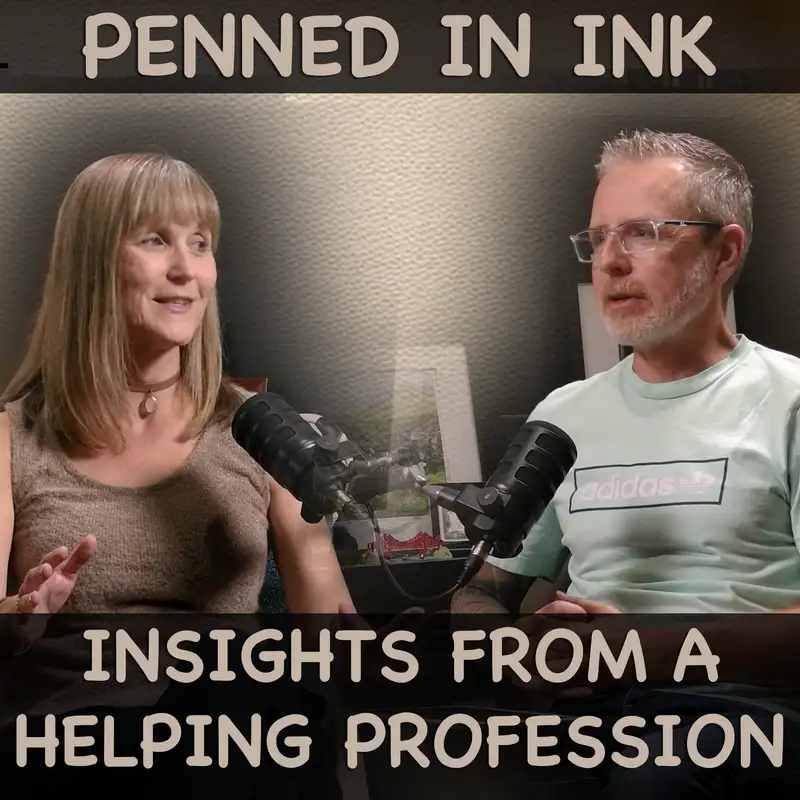
Welcome to Penned in Ink., a podcast where we discuss marriage and the power of long-lasting love.
Today, we're going to focus on Melissa's profession.
We're going to discuss her insights into the human condition and how those are continually shaping her view on relationships.
For those of you who are joining us for the first time, I'm Michael.
This is my wife, Melissa.
We've been married 30 years, and on this podcast, we discuss the power of marriage and relationships.
There you go.
How are you doing today?
Great, and you?
Great.
Good.
You ready to talk all about yourself today?
Sure, why not?
Pretty good at it.
You spend all day, every day talking about yourself.
This should be right in your wheelhouse, yes?
No, I don't.
All right.
So, we're going to treat today a little bit like an interview, and we're going to discuss Melissa's profession, the clientele she works with, lessons she's learned in her, I don't know, we'll find out 15, 20, 25, I dare not go higher, number of years of working in the profession.
And so, let's start off with the 30-second elevator pitch.
What is your profession?
I am a licensed clinical mental health counselor in private practice.
Started out 20-plus years ago working exclusively with children.
I now work almost exclusively with adults and really love what I do.
And so, hopefully, that comes through in our interview today.
Awesome.
Let's start off with, counseling is a highly variable field.
There's lots of different types of counselors.
What type of counselor are you?
Through training, mainly cognitive behavioral therapy.
So, it's talk therapy where I help people.
They tell me about their feelings and their behaviors, and we talk about how those feelings affect their behaviors.
And usually, it's behaviors they don't want.
And so, they want to change those.
But in order to change the behaviors, you also need to change the thinking around that.
And that is one of the top three mental health counseling approaches.
I found as my career has evolved over the last 20 years, I use a lot of humanistic counseling, which is, I have a belief that the people that come to me, they have it in them, what they need to do in order to change.
They have the self-worth.
They're good people.
They just maybe are misguided or weren't taught certain skills, but they have it within them with some guidance and assistance.
And that's what I do, is to get where they want to be, which is usually, you know, relatively healthy, however they define that.
And it's, yeah, it's just, it's a great job, and I really enjoy it.
These days, work with adults.
Started off working with kids.
Loads of fun, but very tiring.
So, after about a decade, I went, okay, let's make a shift.
And what's it like to work with adults?
Very different and also similar, but loved both of them.
Work with a lot of people where I kind of focus the majority of my clients, mood disorders, depression, anxiety.
I also have some neurodevelopmentally diverse clients.
I have, you know, multiple with ADHD, with autism spectrum disorder, along those lines.
And it's people that come to me either weekly, bi-weekly, or once a month, or some people just want to come for a tune-up a few times a year.
And we talk about what's going on in their life.
And with a little assistance and guidance, hopefully, they go away from their sessions feeling better about themselves.
Nice.
So, you threw a bunch of psychological terms in the beginning there.
You defined most of them, which I appreciate because it's been a long time.
So, my minor is in psychology.
So, I understood most of the phrases you threw out there.
So, cognitive behavioral therapies, that's your primary.
Explain what that is really quick to me.
Yeah.
Sometimes somebody will say, you know, I don't know why my husband said something and I just went off on him.
And I don't know why that behavior happened.
Why did that behavior happen?
Gotcha.
Okay.
So, you help them process the thought process behind behaviors.
Okay, good.
And then you mentioned humanistic.
So, what is humanistic again?
Give me a definition of that again.
You believe that people have the innate ability to correct whatever the situation is.
Yes.
And all people have self-worth.
They don't always come to me with that.
I have a question in my first session that I do, an assessment, and it is, what are you good at?
What are your positive qualities?
And we usually do that right after we've done, what are you struggling with?
Why are you here?
Because it's my way of pointing out, it's a strength-based model of, you do have skills.
And there are some people that look at me and say, I got nothing.
They don't know what their skills are to start with.
They don't.
They don't.
And so, that's also.
And so, humanistic is that relationship you build.
So, why did you choose this line of work?
I mean, unlike my career, which we'll talk about in a future episode, you were very intentional with choosing this career path.
And you've already said multiple times how much you enjoy it, but what drove you to this profession?
Well, you said intentional, and I've been thinking about that.
Ooh, was it not as intentional as I thought it was?
And I've told the majority of my clients this, so if they happen to find our podcast, they should not be surprised.
And I usually tell them ahead of time, maybe you don't want to hear this, but there is an element that I kind of fell into it.
I started my freshman year in college wanting to be a physician's assistant.
Oh, I remember this.
Bio major.
Yeah, I remember this.
So, the first, and then in my second year after being a bio major, I took chemistry.
And math is not my strongest suit, and I just didn't like it.
And I knew I was going to have to take more advanced chemistry.
And then it made me think, or there are other things.
I love anatomy and physiology.
I think I really intrigued, I love those classes.
However, the rest of being a physician's assistant, other than helping people, didn't really fit in with my strengths and my desires.
Gotcha.
And so, to be honest, I went to my advisor at college and said, okay, I think I need to make a switch.
This isn't working for me.
What else do I have credits in?
She said, well, it looks like you've taken quite a few psychology courses.
And I paused and went, I have, because I really like them.
Bang.
And there it was.
So, I switched.
I ended up being a psychology major.
Did get the bio minor, because I'd already taken enough classes.
And then, do you need me to pause at all?
Do you have any questions there?
Because I'm going to launch into the next piece, which is.
Well, this is funny.
I didn't realize that you have the psychology major and a bio minor.
I have a BS in psychology.
That's the same degree I have.
I love that.
I didn't realize that we had to end up with the same degree.
We did.
Interesting.
I got mine in a very similar path, but not the exact same path.
But for some reason, I didn't realize your undergrad, I didn't realize you had the minor in bio.
I did.
Yeah.
I only needed to take one more course after I switched to psych.
So, I'm like, well, why not?
That's funny.
Yeah.
That's too funny.
You didn't know that.
We'll get into it in the episode we feature on my career, but I ended up with a minor in bio simply because I didn't want to write the thesis.
So, that's how I ended up with a psychology degree, because they said no thesis.
I said, sold.
So, anyway, all right.
Okay.
And so, I get to my, what was going to be my last year, and I started thinking, what does one do with a bachelor's in psychology?
So, I started researching, and the answer is not a whole lot, or there are things you can do, nothing that interested me.
So, I went back to my advisor, at that point, I'd been given a psychology, Alison Burns.
That's who I thought it was.
Yeah.
Yeah.
Alison Burns.
And I said, well, what?
And she said, she reeled off a few things, and she had counseling.
I was like, oh.
And so, then I did a couple hours worth of research, and I was like, that's what I want to do, which means there's graduate school.
So, then after college got my BS, then I went on to graduate school and got a master's in counseling psychology, with an emphasis in child and family, and loved grad school.
Every class was about, and I just knew, I found it.
And it was like a sense of relief.
I know some people struggle to find what it is they want to do.
And so, just to know, and I knew within minutes of starting grad school, great, I chose the right thing, and haven't looked back once.
Well, let's pivot to the work, then.
So, that was how you found the passion, which is great, because you alluded to this, but lots of people don't find the passion, or they come to a career because of other reasons, quality of doing it, necessity, all sorts of things.
And we'll talk about in a future episode, how I found my career.
It was not a passion.
It was a proficiency.
I was really good at what I did.
And so, I built a career around being really good at something, whereas you've built yours about being passionate about it, and really good.
So, that's a good combination.
So, let's talk about the work of it.
And we often joke between us that there's a big gap in our levels of empathy.
You truly have the ability to feel what your clients are going through, to experience it in a secondhand nature, and to really empathize with them.
Me, not so much.
That's not really in my wheelhouse as much.
But we've had debates about this, and how our daughters differ, or are similar to you and I in this area.
But let's talk a little bit about the process of being a counselor, and how your ability to share the feelings, understanding the feelings of the others, how does that play a role in helping others?
How does empathy play a role?
And what's the counseling process look like?
Absolutely.
You cannot have a good therapeutic relationship with somebody if you don't have rapport.
And, you know, not to toot my own horn, but I'm going to, which is, I like talking to people, and I'm animated, and I really want to hear what they have to say, and they feel that.
And I've had people say that, even after first session, because I always give people the option at the end of a first session, hey, if you don't feel you mesh with me, because you really have to find the right counselor.
If you didn't feel you meshed with me, you know, maybe I sound like your Aunt Edna, and you can't stand Aunt Edna, or for any other reason, I will not take offense.
I'm a professional, and I will help you find a new counselor.
And toot my own horn, I've never had anybody.
A couple clients haven't worked out after a few sessions.
We decided that we weren't a good fit, but in general, people like working with me.
And this is really hard for me to brag about myself.
It's good.
But I'm really good at rapport, because I do.
I listen well.
I can understand.
I can, even if I've never experienced what they do, I still feel it with them.
I've cried in sessions before.
I try not to do that too frequently, because the sessions aren't about me.
They're about them.
Right, right.
So, if anybody's ever been to a social gathering with you, none of that is surprising, right?
The joke in our family is that, so with two daughters, we mentioned them earlier, Alexa and Taylor, adult daughters.
If the four of us, when we're growing up, would go someplace, we could be riding a short little shuttle bus to the airport, and Melissa would know the life history of the guy she sat next to and the things.
So, very, very social rapportability.
That doesn't surprise me at all.
So, that ability to make that connection and to feel the struggles they're going through, obviously, is the key to the type of counseling work you do.
One of the things, so we go on a daily walk with the dog, and you're talking about the debriefing or decompression of what you felt, what you've experienced.
We talk a lot about the things you see over and over again, the traumas you see, the relationship issues you see.
So, one of the questions I have for you is, and this will help us pivot to how your work impacts our relationship and relationships in general.
Can you give me three things that you see as reoccurring themes sort of across your clients?
And if you can focus sort of on relationship topics, that'd be great because I know you see people who are dealing with a wide range of issues, but I think you see some commonalities or consistencies.
Absolutely.
The main one is miscommunication.
People miscommunicate a lot.
And it's, so having strong communication skills, it's something that I teach a lot of because it's, for some people, it's not super easy.
How do you talk to somebody, especially when you're experiencing intense emotions, anger, sadness, disappointment?
It's really hard to talk to somebody.
And when you're really connected to somebody, so like a significant other, it's very difficult to keep those emotions in check so that you can express yourself without being mean or without name-calling, which are all, you would think, common sense-wise, not productive.
But in the moment, you don't always know that or feel that or be able to express yourself.
So, communication issues are very high up there.
Second one is, I would think, respect.
And especially respect for differences.
So, for instance, in what we're talking about with the communication style, somebody, if they get really upset, might need a moment alone to gather their thoughts, to not go into the name-calling or bringing up past ancient history that is still a sore spot, things that shouldn't be included in an argument about something that happened today.
And so, and I've known, I hear it, I hear it probably weekly where somebody says, I said I needed a minute.
I tried to go to my room to take a break, to collect myself, and I was followed.
This happens with parents and children.
This happens with significant others.
It happens between siblings, right?
A lot of times, people, if their desire, some people like to process things right away, and they want to work it out.
And then other people, they might need that time to figure out what they want to say in a productive way instead of, you know, like I said, name-calling or, you know.
So, respect for differences, especially.
I'm loving this conversation because I'm sitting here processing.
I'm going, oh, which one is Melissa?
Actually, I know which one Melissa is.
You sometimes need a little moment to collect your thoughts and to go back at something.
So, yeah, interesting.
And it's not unusual because we're different people, and couples are different people.
So, for instance, you're pretty good at thinking on your feet and knowing what you want to say.
I bet you, this is a guess, having known you for so very long, that you rarely go away from conversation thinking, oh, I wish I would have said that.
Whereas, that is something that's common with me.
Oh, I wish I would have said, you know.
Yeah.
No, yeah.
Probably a lot.
Not often.
I mean, of course, sometimes.
Yeah.
There are definitely times where I was like, oh, I could have said that better or, oh, I should have made this point.
So, that definitely happens.
And I think in moments of conflict, we all have that, right?
It's like, oh, I could have said this better.
But probably, yeah, there's people who struggle with that way more than I do.
But yeah, I see what you're saying there.
Yeah.
And also respect for differences in, not just in communication, but like hobbies.
You don't expect me to go to every sporting event that you want to go to.
Or- Oh, I do.
And I get really upset when you don't.
You do not.
You just ask somebody else to go with you.
You know, or whatever, you know, or if somebody's in a car.
So, it's issues of respect of how you handle conflict, but just in boundaries in general.
So, that's what's the third.
I asked you for a list of three.
I know.
And now all of a sudden, even though you gave me, you suggested that we come up with three, now I'm blanking because it's because those two are so, it just happens so much.
And everything else kind of stems from that.
Because the other one I see that has a lot is, okay, maybe another struggle that I see a lot when it comes to relationships is disproportionate division of child-rearing or even work for that matter, you know.
Inequities in the balance.
Exactly.
Interesting.
That's another one.
And being willing to discuss those instead of becoming resentful, because that's what will happen.
Okay.
I'm, yeah, my wife's only working 10 hours a week and I wish she was working more, but I, and then I ask, have you talked about that?
Well, no.
You know, and then eventually it gets to, oh, yeah, I'm working so hard and she's not doing, you know.
And so, I think that's another one.
I see a huge, where there's one parent that is the primary caregiver and sometimes the other, and the other, the non-primary caregiver, I don't want to say helps out, but parents on a different level, and some that are just totally absent.
They live there, but, you know, the baby cries, and one person's doing all the changing of the diapers or doing all the baths or doing all the, and so it's that, I guess the, yeah, I think you hit it, the inequity that can happen in a relationship and comes back to communication.
You have to talk about it.
If you're feeling that you would like more assistance in earning money and caring for the kids and doing the yard work and doing the housework, you have to say that.
And a lot of people are hesitant, either because of history, either with their significant other or how they were growing up.
You know, when we, we learn a lot.
They're called the formative years for a reason, you know, from birth to, you know, until, until we're out there, we learn a lot.
And if every time you tried bringing up your feelings, you were shot down, eventually you give up, you stop, you don't even try.
And so sometimes people get to the point of marriage or relationship and they still do that because early on that wasn't respected.
So I would say those are the.
Yeah.
I mean, those are, those are, I mean, I can't tell you if those are great or not.
Those are the three you see.
So, so clearly those are great.
But just to recap, it was communication and struggles around communication.
It was respect, respect and how you respond to things, giving people respect, but also, you know, claiming back your, your respect and how you want to treat or deal with things.
And then the third was sort of, how do you deal with inequities and imbalances in, in, in their relationships?
And not surprising, those are all topics we'll cover.
We'll talk about all those things because all of those are human issues.
Those are all things we deal with.
Relationships with a significant other, with a child, with a parent, you, you mentioned all those, those sorts of things.
And I think one of the, the trends I see in our conversation that you didn't hit, I was curious if it was going to be in your top three, is you see a lot of people who either really are or have the perception that they're stuck.
That the way that they're dealing with whatever the situation is right now is the way it will always be.
And I think one of the, the things you talk about a lot is how you're helping them to have the confidence or skills or tools or bravery or whatever to make changes.
And I think we'll talk about that a bit in our relationship and how we try not to get stuck.
We, we try to never let something that's not right, just be the way it's going to be.
We're going to work on it to fix it.
But that's one of the things I hear you talk about.
You got a lot of people who are just stuck what they're doing.
Absolutely.
And on the extreme of that is something called learned helplessness is if every time you try to get ahead, you've been knocked down and it's, it's rarely every time, but it might feel like that, you know, just as you're about to get ahead on the bills, the car breaks down or just about, you know, that you, you started working out cause you want to take better care of yourself and then you get injured or you get sick.
And if you get derailed a lot, you can get to the point where why even try, it's never going to change.
And so you stop trying and that's learned helplessness.
And I think, you know, maybe in certain areas of everyone's life, they have a little bit of that.
A lot of times people come to counseling because they're trying to get, like you said, unstuck.
They keep doing flip side of that too is change is hard.
You might know you need to do the thing to change, to feel better, to have better relationships, to behave in a manner that you're, you feel good about, but making those changes, especially if you've been doing something, I mentioned, I work with adults now, you know, I have adults in their sixties.
They might've been doing, having a pattern of behavior for, you know, 30, 40, 50 years.
And I think it's a good term, you know, it's not a professional term, but stuck that you just, yeah, you don't know how to move past that.
Did you just throw shade on me calling that stuck is not being a professional.
I think you just, I think you just knowledge shamed me and you didn't want to use your jargon.
No such thing.
You absolutely did.
I heard it.
That was a microaggression.
There's a, there's a good term for you, isn't it?
All right.
We could go further into discussion of what your, the role of a counselor is and, and your day-to-day.
And honestly, there's some, some awesome stories in there that probably will come out over time, but I think this is a good, good time to pivot to one of our reoccurring themes, which is Inked Moments.
This is where we, we talk about a memory you have, or, or I have this related to today's topic.
And since you're today's topic, let's talk about some milestones in your career.
You know, what are, what are some big milestones you've hit in your career?
Absolutely.
Well, it was, it felt great to get the master's degree because that was the, the end of the formal schooling.
I'm required to do quite a bit still.
Yes.
Continuing it.
I hear about it all the time.
Yes, I do have to, but the formal schooling, I was done and that was exciting.
And then I got my first job and started using those skills.
And then, and then we had kids.
And so then I took a few years off, but then getting back into it.
Right.
And so, and I just totally lost the question.
Career milestones.
Thank you.
All right.
So the master's degree, master's first job.
And I got that first job before, well, the last year of the master's degree passed the licensure exam, which you need, um, you don't have to, you don't need it to get the master's, but you need it to, in order to practice to work.
Yeah.
And so past that in my last year, spring of my last year, and, and then the first job and then, and then going back to it after taking a break, that was a big deal.
And when you went back, so your first job was, that was the one at the boys home.
Yeah.
At the boys home, um, at risk youth.
And it was a in, in patient.
Yeah.
I, right.
I worked in the day treatment.
They had a residential program, but they also had a day treatment program.
So that was primarily children.
When you went back, you were doing some intensive in care in home care, right?
Is that the, yeah, I did that while I was working on my license.
So you get the, you get the degree, you take the exam, but then you need a certain number of hours and supervision to get the license.
And the license allows you to practice independently.
So in order to get the lines, I had to, the license I had to work at agencies.
So I worked for several and once again, worked exclusively with kids.
I did community counseling.
So went into people's homes, um, learned so much from that.
It's fascinating.
You can see so much more when you're working with a child, you're trying to figure out like, sometimes I don't know why somebody is exhibiting a specific behavior, but then you see their sibling do something in the home or their parent or their grandpa.
And you want, I get it.
It's so much, I learned so much, but it was very hard.
And the intensive in home, it were like two hour sessions.
I'd go into somebody's home or take them to the community.
We'd go to a park, shoot baskets and play soccer.
And, uh, we had a grand time, but they were two hour appointments and that's a really long, if you've ever done therapy and to be a child and do two hours.
And those were once or twice a week.
And so very intense, very intense.
And, but my goal had always been, I wanted to be in private practice.
I wanted to have my own practice where people came to me and, and I was in charge of everything.
And so that is where I was heading always with the agency work with the license was someday I want to hang my shingle out.
And so that was a big deal.
And I think it was 2010, I got my license.
And then, uh, 2011, October, 2011, I started my own practice and it's just, the rest is history.
We're going on what?
So what is that?
14 years, almost 15 years in a couple of weeks.
Yeah, no, that's exciting.
And then so your private practice in-person COVID hit translated into remote.
Now you do primarily virtual licensed in North Carolina.
Correct.
Primarily he means a hundred percent.
Yes.
So, so yes, COVID was hard.
I know it was for everybody, but especially people with mental health issues that first year.
Wow.
Was I busy first year and a half, two years actually.
And you know, people that had seen me in the past, but had graduated or had decided they didn't need therapy anymore, came back.
I was seeing, and the, one of the benefits of virtual counseling or telehealth in general is a fewer people cancel or don't show up if they're not feeling well and they didn't want to drive to my apartment, they'd cancel or my apartment, excuse me, my office, they would cancel, or they forgot about the appointment.
And I would reach out to them a couple minutes after the hour.
And they couldn't get to me in time in order to have a beneficial, because I do usually schedule back-to-back clients.
So if you're late to your appointment, you still, you get cut off at the same time.
Well, and so, so not only did people need counseling more during the beginning of the pandemic, they also showed up more because it was easier to do so.
So that was, yeah, that was huge.
And I, I love working from home.
I have a space that's private and it's just, and the vast majority of my clients like it as well.
There were a couple that have reached out in the last year.
And I said, I only do, I don't do in-person and they chose to go elsewhere.
Totally respect it.
But a lot of my people love it.
And I also have a lot of people with physical health issues, you know, fibromyalgia, you can't- Hard to make appointments.
Right.
To get out of the house and make it, you know, the drive and then come, you know, take the elevator to my, my office.
And it was a lot.
We can debate for hours and hours and hours, the pros and cons of, of lockdown and COVID and that sort of stuff.
But I think universally, most people will say that the telehealth access has been a real positive.
And we'll get into this.
One of our daughters has some mobility challenges.
And so the curbside pickup, the remote telehealth, there's, there's some things that came out of that, that we would have gotten to eventually that we got to a lot quicker.
I think access to therapy online is one of those that we would have gotten to eventually, but we got to it a lot quicker and it's been very beneficial.
Well, let's pivot to the meat of why does any of this matter when you talk relationships and long-lasting love?
That is the focus of our, our podcast and our talk and everything.
So let's, let's pivot to that.
And let's talk about how counseling principles have helped you personally strengthen your relationships or just how they help people in general.
So what are some of the skills you have as a counselor that are helpful in building positive relationships?
Yeah, it kind of goes back to the three things we identified that were, I will be honest, and Michael will attest to, at the end of a work day, I'm not always the best listener because I've been listening all day.
And so we'll, sometimes we go on these walks, Michael hardly gets a word in edgewise.
I am yammering.
I, you know, because I just, I want to be able to say things because in counseling, I, I don't say everything.
You listen a tremendous amount.
I listen a lot.
I, I also provide a ton of, my clients like feedback and I ask them about that, their first session, do you want feedback or you want me to listen and validate?
Both very beneficial.
The vast majority of mine want at least a little bit of feedback on, okay, well, what are my options?
Guy, is there something I'm doing wrong?
Do you have suggestions?
I don't tell people what to do.
Occasionally I get somebody say, what should I do?
I cannot answer that.
So anyway, so I listen a lot.
And so I get to the end of the day and I think I talk a lot.
And I wonder if- I will confirm you talk a lot on our walks.
And I wonder if that's exhausting for you.
So that, it's, it's something I'm thinking about.
So- Well, it's an interesting thing.
So there's, there's this, I don't know if it's a trend on social medias or if it's just, so I heard this term the other day that I thought was really good.
So social media is what we refer to all these platforms are, right?
People sharing ideas and thoughts and everything.
And I heard this new term called interest media.
And it's really how the algorithms have changed to where you're not getting everything.
You're getting things that you're just interested in.
And it's as the fine-tuning is sort of this new term for interest media.
So I don't know how popular it is out there, but at least in my algorithms, I'm seeing a lot of comments about guys who go and see their friends or they have their work day or they do whatever the thing is.
And they gain pretty much no knowledge to share with their wives when they go back about how their friends' lives are doing or, or whatever.
So you'll, you'll, so let's say I go and I go to a soccer game with a buddy of mine.
We watched the game for two hours.
Maybe he just had a kid, maybe he's married, maybe all those sorts of details.
And for example, I would come back and you'd say, Oh, how's Tim?
And I would be like, Tim's good.
Well, how's the baby?
I have no idea.
How's the, like, I don't know.
I didn't ask.
What'd you guys do for two hours?
We watched the game and talk like, so this is the thing.
And I'm not saying those are all made up.
That's not an issue I have, but that's sort of the thing going on there is that men tend to not share on those sorts of things or care.
So it's funny, you mentioned your concern that you talk a lot on those walks and that maybe, you know, well, I think my concern on those walks is do I not share enough?
Cause you asked me how my day is and I'm like, it's fine.
How was work?
Oh, it was good.
So sometimes I try to make sure even if you don't really care about the stuff that I try to have stuff to tell you about, because I think that's one of the differences or imbalances between the way we communicate in those.
You always have lots of stuff to talk about.
And I'd say four out of five walks, I'm like, yeah, work was fine.
So I try to at least once a week tell you a little bit more about whatever's going on at work.
So.
Absolutely.
You asked how it helped me.
I went into how it kind of detracts from a relationship instead.
Yeah.
I mean, I asked about the skills that you have, but I mean, but communication skills and acknowledge of the acknowledgement of, yeah, you went to the next thing, which is, which was the next question we're going to get to, which is, but yeah.
So, so back up then.
So what are some of the skills?
So obviously listening, you just hit that.
Obviously communication, you just hit that.
What are some of the other skills as a counselor that help in relationships?
Yeah.
Honestly, knowing what not to do, you, you know, it's just sometimes I will have a client that says something, I was like, and they say, oh, that did not go over well, or it was take, somebody took offense at that or whatever.
I was like, and in my head, I went, oh no, I just did that the other day.
And so sometimes I learn what not, you know, I know that it's important to express appreciation in relationships.
That's something that I hear doesn't happen all the time in other relationships.
So that we are very good at, and it's something I learned in school and, you know, positive reinforcement.
I learned it in school.
I see it with my clients, but for instance, actually you do this, but it's something I do as well.
Oh, I'll use my example for a second.
You mow the lawn because I'm very much allergic to grass.
You mow the lawn.
I say, Michael, thanks for mowing the lawn.
It looks great.
Pretty much every time you do it.
Do I need, it's your job.
Do I need to say that?
Not necessarily, but I really do appreciate it.
Yeah.
I mean, people like that.
It feels good to be appreciated.
Yeah.
Showing gratitude.
And so, yeah, the, again, trying to tie this into the skills you have as a counselor, that might not be a skill, but it's definitely an observation you make.
You see the relationships where they do that or where they don't do that and showing gratitude for the things you're supposed to do.
It still takes effort to do whatever those things are, right?
So even though it's your job or my job or your assignment or my assignment, you should always show gratitude for it being done, right?
So that's, yeah, that's a good example.
So what are some things that counselors do in their course of their profession that you struggle with when you're in your own relationships?
What are some things that you see in your clientele or you help your clients get better at that you are still working on personally?
This is the Get to Know Melissa 101 segment.
Vulnerability.
What are you going to tell that you, you already mentioned the over-talking, but that's not really, that's just, that's a by-product of you listen a lot.
So you, you got to get your 10,000 words out in the day.
You know that, right?
There's a study that in general, women speak about 10,000 words a day.
Men is much, much fewer.
And so if you only spend 3,000 at work, you got 7,000 to bestow on me in the evenings.
It's science.
I'm not making those numbers up.
So anyway, I'm moving on.
The, the, the main one that comes to mind is I teach or I help people with conflict management.
It is not a strong, I am definitely conflict-averse.
That is not, if I, I, yeah, I do not like arguing.
It doesn't feel good.
So how do you problem solve then?
Or how do you, how do you affect change if you don't like conflict?
I push myself to do it.
Okay.
Yeah.
Yeah.
I, it gets to a point, sometimes I'm quiet for a couple of days, but then eventually I practice what you preach and you need to say something.
This is something that's bothering you.
You need to speak it because it will just continue to bother you.
And I know that up here, but here, you know, I get a little bit nervous when I'm, there's criticism or I'm sharing, you know, maybe an unpopular belief or, and so I, I would say I'm not the best, but I do it anyway.
Yeah.
We had an example of that just a month or two ago, we were talking some administrative changes, some regulation changes that are going on at the federal level.
We'll keep it nice and generic.
We won't talk about which ones or which things.
And I had asked you several pointed questions about it and you would sort of slow rolled giving your answers on those.
Yes.
And I kind of didn't let you slow roll.
Cause I wanted to hear what your answers were on those.
And you eventually opened up and kind of answered the question at hand.
And then I revisited it like 15 minutes after we were done with our walk and everything.
I'm like, why did it take you so long to answer that question?
I think you gave me an answer that some, some, there was something along the lines of, I knew we didn't agree on this topic.
And so I didn't want to really go into it, but I don't think it was because you were worried of, well, well, why didn't you want to go into it?
If you remember, I'm trying to think why you didn't want to go into it.
Well, I think you said something about my opinion of your views on it.
Yeah.
You, we talked about it at the beginning of the episode.
You were somebody that thinks well on your feet.
Sure.
And so sometimes you ask questions that I, sometimes I do a lot of research these days, especially with all the false news and all.
Sure.
We've all had to become better judges of like what's true or not.
But sometimes you ask a question and I do a lot with feelings.
You know, I hear somebody is, I'm a feeler.
And so I hear if somebody's being oppressed or I hear that somebody was being oppressed and, but I went and did the research and then found out there.
Anyway, I feel you ask questions sometimes that maybe I haven't thought through all the way, but I still feel strongly.
It's not changing my opinion, but I feel, I don't know, uncomfortable, I guess that people like to know things.
Right.
And so when I hadn't thought about that piece of my opinion, kind of embarrassed, I guess, that I hadn't thought it all the way through, or I didn't have a way to articulate what it is I was feeling.
I just know, I feel this happened.
It makes me feel bad here in my, in my chest.
And so sometimes that's enough for me to.
Yes.
This actually is interesting.
So this goes back to the, the respect thing, right?
The, the, we process things differently.
You need a time to process on those things.
In my defense, it was a topic we had talked about multiple times.
So you would have plenty of time to, to go back and do some more digging on there.
It's been good.
I kind of, kind of learned a little bit more about why you're, why you're still rolling though.
So conflict.
That's, yeah, that's something you struggle with that you help a lot of people with.
Anything else come to mind?
Sometimes, and this was more earlier in my career, feeling too much, like I would get embarrassed if I got teary, like even with you, you know, while we're talking.
And cause I would cry when I was angry, I'd cry when I was disappointed, I'd cry when I was sad.
As I've, I've learned how to come, hardened yourself, learned how to compartmentalize.
Cause I can't feel everything my clients feel and be good at my job.
Because then all we would do is cry during the session and we wouldn't get anything done.
And, and then they start, I start worrying that they're worrying that I'm crying.
Oh my gosh, I made my therapist cry.
No, no.
So anyway.
And so, yes, I've learned to compartmentalize.
I don't get, I hear some terrible things in, in counseling, in therapy sessions.
And I, I don't let them get to me.
Sometimes though, in my personal life, and sometimes I'm embarrassed if I'm crying about something that doesn't seem like it needs tears.
Sure.
You know, the dog dies.
I'm not embarrassed about crying when the dog dies.
I was going to say, I've shared tears when the dog died.
What are you talking about?
But sometimes, yeah.
One of the only few times I've seen you cry, but sometimes, you know, there's those, I'm like, I don't want to talk about it now cause I don't want to cry.
And I know I'll cry if I'm, and so sometimes it would be nice to be able to be detached from my feelings a little bit in my personal life.
Like I can do in my professional life.
Interesting.
Which is harder.
Yeah.
It probably doesn't help that one of your daughter's rails on you when you cry, cause you are pretty emotional and she's not.
And so every time you cry about stuff, she sort of probably jabs you a little bit about it.
Yeah.
That's okay.
Yeah.
So before we move on to our final segment, what are some of the skills or things that you see people struggling with, or you observe over and over and over again that we don't struggle with that you're really thankful for?
You mentioned communication.
We're pretty open on that.
Yeah.
You mentioned conflict.
We don't have a ton of conflict.
The conflict we do have, we've sort of learned each other's patterns.
We sort of know when, when, when it happens, your signal is tears.
Tears happen.
I know something.
We, we, we had a conflict.
We hit on something.
I tend to go quiet.
Yes.
I'd rather not say anything than something I'm, you know, going to regret sort of.
Right.
So what, so what are, what are some areas that, I know one of the things you do often is, dang, I'm glad we do this, this good.
Right.
Right.
Oh gosh.
There's, there's a lot of things and I'm not saying we're perfect.
I'm not.
You don't have to say that every episode.
Oh, good point.
Or before I say, well, yeah, good point.
We're not perfect.
We've established that.
We're, we're not, but I have a higher appreciation for you than I think I would, that would not exist if I wasn't a counselor working with adults.
Let me explain.
How many times, how many times have I come in after work and given you a hug and you're like, what's that for?
And I'm like, you're just wonderful.
And it's because I've heard something where somebody didn't treat somebody well.
And, and, and I realized you don't do those, you treat people very well.
And, and, and sometimes you kind of lose that.
It's an expectation now of you that I have of you because that's just who you are.
And, but sometimes it's rammed home in a workday that, wow, Michael loves his family.
He's, he's a good provider.
He's, he's, he's caring without being, you know, fully emotional.
It makes good, all those things.
You would never.
Yeah.
Yeah.
Oh, absolutely.
I think that a lot.
Right.
Of course, I don't say that to anybody because you don't kick somebody while they're down.
Sure.
Oh yeah, your spouse is, yeah, that your spouse is unacceptable, you know, but, or my spouse would never do that.
I've never said that once, you know, in a session, but in my head I do sometimes.
And, and so I think that's something that I probably would not understand how huge that is, that, that you're good at those things.
And so, and that we work at our marriage.
Yeah, that's great.
I mean, it's good.
It makes me, it makes me sound good.
So I like that.
Not perfect, but good.
Right, right.
Yeah.
No, that's, that's, that's good.
And I think our closing segment will, we'll get into something about how someone can take some of these counseling skills and apply them to, to their relationship to, to help better.
So with that, you want to move to our closing segment?
Sure thing.
All right.
Pen to paper.
So this is where we want to give you some guidance.
We want to give you something to maybe work on in your, your relationship, something to think about, something active.
And today's focus has all been about Melissa's counseling profession, the skills that she uses in her life professionally that she brings into her relationships.
So we're going to, we're going to continue on to that thought.
So we've discussed your career as a clinical mental health counselor and how those skills give you unique insight into how people navigate relationships.
Let's talk about the concept of active listening.
I think this is one of the therapeutic skills.
So can you start by just telling us what is active listening?
All right.
Active listening is, there's actually two types of listening skills.
The more basic one is active listening.
That's making eye contact.
That's asking a question if you want to really hearing a person as they speak, occasionally saying, wow, that sounds hard.
One step further than that, which is what I think.
So start with that, you know, in communication, really listening to the other person, letting them say they're, that would be great.
No interruptions, right?
Listen to them all the way through and then ask if they're done.
And then, oh, this is another one that comes up in counseling a lot.
Asking them if they want feedback, because some people just want to vent.
They don't want you to solve their problem or to, maybe they just need to get off their chest that, you know, Colleen at work, you know, did X, Y, and Z. So that's active listening.
Being present, paying attention.
Reflective listening is kind of a mirroring, mirroring back to them what they've said to really show that you understand.
And it gives the other person an opportunity to clarify because that's where the miscommunication.
I think I hear you say something, but if I don't say, so Michael, you know, it sounds like your day at work was really rough, which is why you came home and did X, whatever it was.
And that gives you the opportunity to say, no, that's not why I did it.
Or yeah, that's exactly right.
You know?
And so reflective listening is a step up from active listening, which is where I think the goal should be is to truly, active listening is about the what.
And reflective listening is more about the why and the how.
So it's, why are they feeling this way today?
As they telling me these things, why?
What's going on?
And it's more advanced, I guess, is the way to say it.
So I think that's, start with active listening, which is just being there in the moment.
You know, do you want to talk about it more?
Ask what you could do?
That's active.
Reflective is actually hearing, saying some of the things back to them that you heard them say, giving them an option to clarify really cuts down on miscommunication.
Yeah.
So you said it's advanced.
It's probably a ton more effective as well.
Yes.
Yes.
But if you really don't have the active listener, you're going to get the reflective wrong because you're going to be mirroring back the wrong things.
You really weren't, you were busy cooking dinner or you were, and that's another thing, you know, about time and place.
Say, asking, I see you're making dinner.
I want to talk to you about something.
Can you, can you listen and do that same time?
No, sorry.
This is a complicated recipe.
Whatever.
Right.
And that there's a better time and that that's part of it as well.
Finding that out before you start a conversation.
Is this a good time?
Yeah.
Well, it's good.
So I think our pen to paper segment is to encourage you to start by active listening.
Once you've actually heard what the person said, move on to reflective listening, which is when you actually communicate back what you've heard, give them your partner a chance to clarify, to enhance, to confirm, and then that will hopefully help your communication.
That's a good pen to paper.
Absolutely.
Before we close, let's cycle back on a topic.
You've discussed a lot about your role as a therapist.
You've talked a lot about what that is, your career, how it impacts relationship.
Let's talk specifically about the role of you as a counselor in this podcast.
Are you giving, are you giving clinical advice here?
I am definitely a lot that this is, this is you and I talking about a relationship and yeah, there's psychological aspects to it and it would be impossible for me not to throw in my clinical knowledge in some way, shape, or form, but I am not.
There is a particular area of counseling called licensed marriage and family therapist.
If you are struggling in your relationship to the point that, you know, you can't even get to active listening, you know, maybe that's something that you seek out and that is not, that's not, that's not my training.
They take specific classes and this is more of just you and yes, it's informed a bit by my profession, but this is not me giving, I'm not going to give you a list of things to do and yes, do the, no, that's not, that's not the point here.
This is us being real, showing you that love can be long lasting and it can work and it can work for you and be a full force multiplier and all of the things that we discussed in the first couple of episodes.
Thank you very much.
So yes, this is not clinical advice that you are receiving on Penned in Ink.
I mean, I knew the answer to that, but we want to make sure everybody else knew the answer to that.
Yeah.
So we are just sharing our experience informed by your knowledge and your profession.
In a future episode, we'll go into my profession and, and our different careers and stuff.
You'll find out that my profession does not inform our relationship, hardly at all.
Anything else you want to share about being a counselor and all that stuff?
So you, you hit on a few good themes throughout all that.
One of the things that I've sort of taken a lot of, you know, pride in for you is watching you really, A, build your, your private practice.
That was something that was very much front of your, your sort of goals and your vision was, was having a private practice.
You joke a lot when we schedule vacations or we, we schedule plans or stuff that you don't, you don't answer to anybody.
You set your own agenda, you set your own schedule.
That is awesome.
That's, that's good.
So that's been very fun to watch and see all that go.
You, we've joked off and on about empathy and all those sort of differences between us.
And I mentioned this, I think in one of our first episodes, you, you mentioned that you, you sort of care for people and, and, and I, I chided you for underselling that you care tremendously about people.
You spend a lot of time helping a lot of people and you, you do great work.
So I think one of my, my things that you maybe don't hear often enough is that I, I take a lot of pride in watching you be awesome at your job.
So there's, there's my nice closing, closing.
Well, you said something nice about me earlier in the podcast.
I felt like I had to respond.
Thanks.
We use a lot of joking and sarcasm in our relationship.
Does that diminish it at all that I just made a joke about it?
For some people, me knowing you and our history, absolutely not.
Right.
But for people that maybe don't know us as well, they'll be like, well, that was kind of.
Yeah.
I think that's one of the things that hopefully over the course of this podcast, you'll start to see more of our sense of humor.
We've been a little cautious with it in the first few, because to your point, when you've been married 30 years together, we understand each other's humor and mine is very biting and very sarcastic and.
Don't worry, folks.
I can handle it.
Very much so.
So that's good.
But no, that's, that's, that's awesome.
Anything else?
I think we're clear.
All right.
I think we're good.
So as always, we want to thank you for joining us today.
We invite you to connect with us, share your stories.
If you happen to be a counselor or working in relationships and any of this resonated with you, let us know if you've got anything you want to add on to there.
Maybe you've been in therapy and you've, you've practiced some of these things and you've had your relationship positively impacted.
Or maybe you think therapy is a crock.
I think that's out there too.
Oh, just feel free to engage with us.
Let us know your thoughts and share and help us along with this community.
If you do like these episodes, this content, please give us a like, give us a thumbs up, share a review, subscribe for a future episode.
I can't remember what the topic of the next episode is.
We'll have to see.
You'll find out with us.
Thanks all.
Thank you.