So we were sitting at the steakhouse.
You know the kind.
No prices on the menu.
If you have to ask, you cannot afford it.
And we could not afford it.
We could not.
The whole night, Melissa sitting there memorizing the room.
How long did the hostess take?
Were the servers on time?
Was the food prepared correctly?
Were our drinks filled?
Were the restrooms clean?
I had homework.
She had homework because she was going to spend the rest of the night filling out surveys about our anniversary dinner because that's how we paid for it.
31 anniversaries and no one else in the room.
Just us.
No friends, no family, no big parties.
And when people hear that, they assume it's because we're private people.
That's not really it.
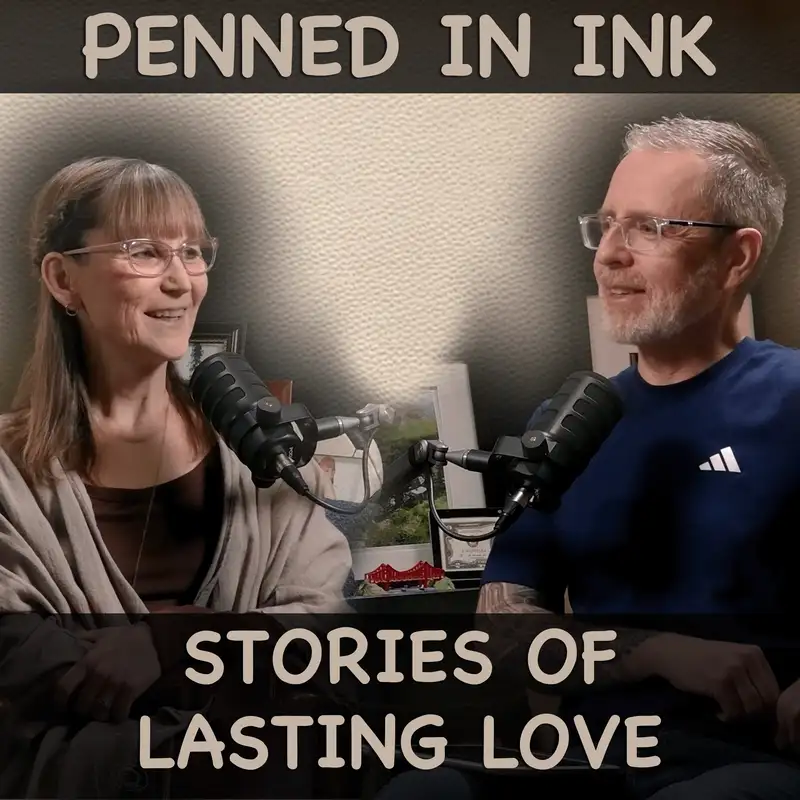
Welcome to Penned in Ink, a podcast where we discuss marriage and the power of long lasting love.
[Music] Today we're talking anniversaries.
And if you've been following along on our journey and watching us on YouTube, you know we are not at our home office.
That's because we are celebrating an anniversary.
So what better topic to talk about on our podcast today?
But an anniversary.
How are you doing?
Doing great.
It's been a nice day.
It's been a crappy rainy day, but we made the best out of it by going an hour away and getting a hike in.
We went outside the rain zone to find something to do.
Exactly.
Our morning was spent trying to find dry hiking trails.
And our afternoon was spent on said dry hiking trail.
Correct.
Yep.
All right.
For those of you who might not normally watch us and are joining us for the first time, I'm Michael.
This is my wife, Melissa.
We've been married 31 years as of yesterday.
And on this podcast, we share stories from our long lasting marriage with the intent, hope, dream, vision of inspiring you and showing you what a healthy marriage looks like.
Not all healthy marriages, but a healthy marriage.
Correct.
And for context, we always have to disclaimer on this.
Melissa is a mental health therapist, but this is not counseling.
This is not therapy.
This is just two old married people sharing stories of long lasting love.
Perfect.
Wow.
I think you did it better than I do it.
I did it quicker than you do it.
You go like four minutes long on that.
I have to edit it down every single episode.
All right.
We'd said anniversaries are just about the two of us being together.
It's because we hate a party, right?
No, we love a good party.
We love throwing a good party as well.
We do it very seldomly, but when we do it, they are very memorable.
The last big party we threw was my 50th birthday.
I hate saying that still.
And I'm almost three years past it and I still hate saying that.
Just going to say that that was almost three years ago.
But yeah, that was a stellar party.
We had so much fun.
So we're not private people, but our anniversary is a private celebration.
Now, if we are being honest, I love throwing parties, but I actually don't like going out and going to dinners and going to meals and sort of doing that.
I'm not a foodie, I'm not a person who likes meals.
So I have a preference for home cooking and a nice quiet meal for our anniversaries.
And luckily I like to cook, so it works out for us.
Works out pretty well.
So we've had many anniversary celebrations, especially early on, where that's exactly what it was, a home cooked meal and a nice quiet conversation.
But if we're being honest, I actually prefer to lie to you during our podcast, but apparently I have to be honest.
Although it's a personal preference, we actually had to do that for a very long time because well, life and money and kids and all that sort of stuff kind of put a constraint on what we could do.
So I think there was a period of time there where the dinner at home was really the only way we were gonna be celebrating.
So I guess that brings the question of if we're gonna pitch a time together and private celebration and maybe even a quiet meal, is it because we prefer that or because we had to do that?
Very interesting.
A lot of times the things that you have to do can turn into a preference.
And I think that probably is part of it.
So I think it's actually a little bit of both.
We actually really enjoyed the private, but we had to do it.
And in the process of doing it, we learned something that I don't think we would have learned otherwise, that the private celebration brings something that the public and out in dinners and with a bunch of other people doesn't bring.
Very true.
But we'll tell you what that is later.
Exactly.
How's that for a tease?
(laughing) Well, let's do our ink moment, which is where we really set the stage by telling a very concrete story from our past that's on the theme.
And we teased it at the open, which was the fancy steakhouse.
And let's go to where we were in life when and how we ended up in a steakhouse with you having homework.
I think that's a great place to start.
Every anniversary should have homework in it.
Right, yeah, absolutely.
I believe it was our eighth anniversary.
We had moved out to North Carolina, so we didn't have any family.
We hadn't had babysitters, so we hadn't been going out much.
Yeah, girls were only probably five years old and our support system was super, super basic at that point.
Yeah, definitely.
And at the time, I was staying at home with the girls.
You were the sole provider at that time.
And I was doing all the frugal things that you can do.
I was a major, I wouldn't call it, they have a term for those coupons.
Coupon queen?
Something.
That is an acceptable term.
I wasn't that extreme, but I was cutting coupons.
I was finding any discounts for, even for the girls for activities that they wanted to do.
Whatever it was, I was finding discounts.
Just, you know, it also feels good to save money.
And one of the things that I used to do was mystery shopping.
Some of them were really simple at fast food places.
What's a mystery shop?
A mystery shop.
For those youngins out there who might not know what a, I mean, they still do mystery shopping.
All right, so tell me what mystery shopping is.
A mystery shopping is where you anonymous.
Ooh, anonymously, that's a good word.
A mystery shop is where you anonymously go into an establishment or there is some type of service that you're going into and you have to evaluate a lot of things.
And the more the mystery shop pays, usually the more things that are required of you.
Cool, all right, so you were doing mystery shopping.
I was.
Our anniversary might've been around the corner.
We were being frugal with our money, because, well, we had a lot of debt and we're working through a lot of stuff.
So all right, good picture there.
Yeah.
Continue.
Absolutely.
The way they would send out the options for a mystery shop were emails and you often had to reply really quickly because it was a first come, first serve, but also they had to evaluate you.
Sometimes you had to write a little blurb.
Yeah, you'd be qualified to do that.
You had to be qualified to do it, right?
And so I saw this one for Steakhouse, happened to be in the month of our anniversary.
I said, "Oh, that would be so cool." If I could get a Steakhouse dinner paid for, for us, for our anniversary.
So I applied and I got it, woo-hoo.
I remember coming home and you telling me this that I thought it was the batshit craziest thing in the world, but I'm like, "All right, this is okay, let's roll with it." Right, yeah.
So fast forward to this really fancy dinner and the homework that was involved in this.
Like, what did you have to do at the mystery shop?
Yeah, there are a lot.
This was a laundry list.
It was very much, because if you think about it, Steakhouse dinner, what, upwards of 200 bucks back then?
Keep in mind, that was 25 years ago or 20 years ago.
So it was, yeah, it was a couple hundred bucks probably.
Right.
Now you're talking much more, but yeah.
Right, so it's from the instant you walk in the door.
Were you greeted?
Did they have your table available for you at your reservation time?
If I recall, I had to go in ahead of you and order a drink from the bar to evaluate the bar.
Forgot about that.
So we couldn't even arrive at our anniversary dinner together, well, you could have gone to the bar and done it, but you don't drink.
So I went to the bar, I sacrificed to get my cocktail, so I went up early, had a drink, and then met you.
I was like, "I'm waiting for my wife, she'll be here." Correct, and then you get seated, but you have to do timings on all this, right?
And you're not supposed to be writing stuff down, where they can see you, right?
You can't go in with your note pad and take it in.
No, you can't, but sometimes they made it a little bit more general, like, were you seated within five minutes of your reservation?
So I didn't have to know exactly.
Anyway, but then, how fast did your server make it to the table, were you told the specials?
Were you asked if you wanted appetizer?
And we had, and we'll kind of go through this, because it really was hundreds of things you had to do.
But I think we also had, like, you needed to order an appetizer, and then you each had to order an entree, and then you had to order a dessert to split.
So like, it was sort of like, you have to follow these things, what'd you order?
This is a running joke to this day, still with us, when we go to a nicer dinner or a steakhouse in particular, it just gets me, what'd you order?
Chicken.
You can have chickens freaking anywhere, and every time we go out, you order chicken.
That's actually not true.
We went to a steakhouse a few years back, and I think you got the kebab, so you at least got beef.
But yes.
I am not a big red meat person.
Was it good chicken?
It was good chicken, you know?
Still chicken, all right.
Pay that much for a chicken entree.
It's pretty tasty.
Yeah, all right.
And there were a lot of things, and I didn't tell the mystery shop people this, but you helped me with that.
Of course.
I couldn't do it all, so I gave you some assignments.
I shouldn't say, of course.
So this wasn't like I was just a passenger in this.
We sort of embraced this and said, "Hey, let's do this as our anniversary activity," and embraced the shop.
So yeah, I helped you with a lot of those things.
You did.
Question for you.
So you were on the clock the entire night?
Or do you just go and let that go?
Because now I'm thinking, you know, if I'm listening to this story, I'm like, you had a working anniversary dinner.
It's like, yeah, we sort of did have a working anniversary.
Was it all work?
It was not.
And pretty much once you ordered your meal, things calmed down a bit.
It's just that first 10 minutes.
But once you order your meal, I remember it.
I went to the bathroom and I had paper in my purse.
And I was writing down everything up until then because I had written the things, the timings that I needed.
Because that's what I was worried about missing was the timings.
Because there was a lot of them.
But once I had written out everything, the rest of it was, how long did your entree take?
I can remember eight minutes, right?
But once we had our food and we're eating, I don't feel that I was still working, doing homework at that time.
We were just eating and talking.
Yeah, I think this is probably as close we ever got to being spies and trying to actually stay covert and do whatever.
Odds are we probably would suck at it.
And they probably pegged us as being mystery shoppers pretty quickly on there.
But from my point to my question to your answer was I think once we got through all of that sort of stuff, it really was nice because we were able to just have a really nice dinner.
And then I think about service at a steakhouse like that is it's just really special service.
And they passed the mystery shop awesomely.
It was a very good.
And it gave us the private time to sort of actually be in the moment of our anniversary.
But I guess I do have the question of, did it feel like an anniversary?
Or did it feel like an anniversary?
It did.
And I think the reason it did is because of that time when we were actually eating, which if you think about it, that's when you're eating, you're talking, you're talking about life stuff.
I felt that there was substance there.
And it wasn't about, once again, I think really it helped that I went and wrote things down in the bathroom.
So I didn't have to think about it.
I mean, I could just concentrate on us celebrating our anniversary.
Yeah, I think for me, it was a nice treat.
And we embraced it as something just kind of, I don't know, silly and whatever.
And an opportunity that we wouldn't have been able to do otherwise.
And I think that was okay.
I think part of me would have been like, oh, I would have loved to be able to drop several hundred dollars on the meal and had a good meal.
But the other part of us was like, well, that's not where we were in life.
So it was fine.
And I don't think it, ironically, as we started thinking about our anniversaries, it's one of the more memorable early ones because it was crazy or whatever.
Yeah, and there's something about what I didn't say earlier about the couponing and stuff.
I love saving money.
I really, really do.
So after we left, right, or it was probably after I submitted my report, I was just like, I just had a really nice dinner with my husband and I didn't have to pay.
We didn't have to pay for it.
I didn't count.
Yes, maybe I should have counted my time as, but in general, no, we didn't, not a dime came out of our pocket.
So that was a good night and that was your eight.
And now we're celebrating year 31.
And when people hear that, they say, "Congratulations, it's so funny." It is.
And I actually had a coworker the other day who has the same anniversary year as us.
And I said, "Oh, we're gonna go away for a little while, celebrating our 31st anniversary." She says, "Oh, we're celebrating our 31st anniversary." My first words were, "Congratulations." And I don't actually know anything about her marriage.
It's because it seems like we just celebrate longevity.
What does that say about a relationship that you've been married for 31 years?
Right, we celebrate the year, not how healthy is your marriage?
And now this is a coworker, I'm not gonna ask her, well, were they a good 30 years?
Or were they awful?
But as we're thinking about this, I think society has taught us that the big number is something of awesomeness, celebration.
And the number doesn't represent, were they good years or bad years?
And I think we all know people who have been married a very long time.
And I mean, in your work, you see people who, what do they, they stay together?
For the children, or they're like, "Oh, you know what, I've been a stay-at-home mom for so long, I don't know how to go back into the workforce." And so there's a lot of people that will just, just because they've been married for 20, 30 years, doesn't mean it's a healthy, happy marriage.
That's endurance, and we don't celebrate endurance.
We take a different view of this.
For us, yes, we're mentioning numbers, and it's ironic that we're running a podcast where we sort of, the basis is, "Hey, we've been married 30 years, and I hope if you listen to us, we're not telling you stories of endurance, we're telling you stories of growth and love and things that happen." And so when we look at our anniversary, for us, it's just a date on the calendar that reminds us to intentionally be in the moment and to check in, to go to the steakhouse dinner, to have something and to take a time for a private celebration.
And what we didn't really dig into in the steakhouse story is that life was really messy around the steakhouse year and the steakhouse year.
That's funny, what we refer to that year is the steakhouse year.
That sounded funny as it was coming out of my mouth.
But life was busy.
We had moved across the country.
The girls were three when we moved across.
We had spent roughly 24 months trying to figure out what's our community look like, who can watch the kids.
And we had been, quote unquote, forced into those private moments, those private dinners at home because we just didn't have the support network and you were home economics and doing that sort of stuff.
But you were like 24 seven taking care of the kids and I was working and life was very stressful.
I wouldn't say it was a bad marriage year.
It just wasn't a rosy year.
But it counts the same as two years ago, which might've been one of our best years because life has changed.
But they all count as one on the score sheet, which I think is a little funny.
Yeah, it is.
No, I agree.
And yeah, we can definitely remember the years that were a little bit more rough and then the ones that were a little bit smoother sailing.
Yeah, so let's share another anniversary story because it's a amazing year for us that was inside of a very rough year for, well, pretty much everybody.
And it kind of delayed some stuff.
So our 25th anniversary, again, just a number, was, I don't know, 2020.
What was going on in 2020?
Anything important, anything major, anything that wrecked everybody's effing life?
Right, yes, that would be COVID, wasn't it?
Yeah, COVID.
So before COVID became a thing, Melissa and I had all these visions for what our 25th anniversary was gonna be.
And it was gonna be the first time we took a significant trip.
And we were gonna do this big grand trip to Scotland as a post-kids sort of time.
Our kids were in college and we were coming into the phase of almost empty nesters.
We were partial empty nesters because the girls were away at college, but we weren't full because they weren't launched yet.
And so we did this goal of, hey, we're gonna save and we're gonna go on this big trip.
And we were all set to do that.
And then, bam, COVID hit right before our 25th anniversary.
So did we take the 25th anniversary trip that year?
That year, no, we did not.
Did we take it the next year?
We did not.
Not about the next year.
Nope.
Did life finally open the third year after that?
It did.
Yeah, so we took our 25th anniversary, probably closer to our 29th anniversary.
Yes.
So I think for us though, the trip was a celebration of where we were in life around our 25th anniversary.
The fact that it took us several years to actually do the trip in our minds, it was still our 25th anniversary.
Correct.
Just another way of saying, the number's just the number.
Where are you in your space?
And for us, those had been some very hard life years, but very good family years and very good relational years.
You know, when you're launching your kids into college, and we're very fortunate they got into schools and were doing very well with their academics, and we were good with our jobs and our careers, and we had sort of started coming into empty nester phase and we're back together and kind of, we had already moved through a rough phase where we were very now intentional with how we were relating with each other.
Like, we were good.
And the trip was just to sort of celebrate and commemorate that.
Very, very hard time for a lot of people, but it actually gave us a couple things that actually really help us now, which is we work remote.
Yes.
And really changed a lot of those things.
Yeah.
Yeah, interesting time.
Yeah, it very much was.
Now, we've alluded to in a lot of these things that private celebrations, private anniversaries create something that public don't.
And I think we probably should dig into that before we lose people who are hanging out here.
Let's get into our third anniversary story.
And ironically, it happened on year three.
So Melissa and I got married, and when we got married, we took a very minimal honeymoon.
We went a local drive to a nice little secluded area and had a very small intimate, well intimate, it's gonna be just the two of us on a honeymoon, so I hope it'd be.
(laughing) But it wasn't a big trip or anything.
So in year three, we had this great grand idea of let's take our first big trip.
We just mentioned our trip we did at 25.
That was our first big trip post kids.
This was our first big trip as a married couple.
So what do we go?
What do we do?
How do we do it?
We went to...
The Virgin Islands, we went to St.
John's, spent a week, maybe 10 days there.
Like that, and we lived in Oregon.
So a little crazy, I don't know why we didn't go to Hawaii.
It's probably closer, probably was more expensive, would probably be part of it.
Maybe so.
But we had never been to the Caribbean.
So we said, let's do this as a big trip.
And we very intentionally said, let's not do gifts for a while, let's be very diligent.
And we spent probably from midway of year two, all the way to the third year, socking away a little bit of money to take this trip.
Absolutely.
And yeah, so that was our first big trip.
And let's talk about that trip.
I think it actually changed how we celebrated anniversaries.
It really did.
It was a great trip.
I very much enjoyed that.
It was a good, you found a fabulous place.
And we had a lot of good adventures, there was lots of beaches there.
But the, I remember one day in particular, where we'd spent the day hop around beaches and just driving around sightseeing, right?
I think the entire island is a state park or national.
It's a, that's a good point.
I don't know if it's national or state park, but it's not the whole, but it's like 95% of the island is natural park, natural forest.
And so yeah, we'd spend our days literally going to the beach.
And our place did not have a pool, but it overlooked.
It had, it has spa.
Had a spa.
I feel like it, yes, I feel like it was, yeah, spa.
And then white sand beaches.
It was pretty much what you think the Caribbean is going to be and you hope is going to be.
As our days were lounging around.
And on one particular day, we went to the north side of the island, which the island is very small.
The roads are crap and driving is really difficult.
So a 10 miles the other side of the island is a day trip.
It was a day trip.
And I remember we stopped at some little place for lunch and then we went and did more sightseeing.
And then we found a place for dinner.
All the typical things that a tourist on an island would sort of do in there, minus the fact that I almost got us killed by driving on the wrong side of the road.
So, you just- Well, I thought you were going to tell the donkey story.
Well, we'll get to the donkey story.
There are two stories.
Anytime you're in a foreign place doing crazy things, it's windy, blind corners, et cetera.
And coming out of that meal where we stopped for lunch, I just pulled out of the wrong side of the road, went around the first blind corner and went, "Oh, I am absolutely on the wrong side of the road," and pivoted over.
But then we went down into the little Harbor area and came back around the other side and went up to the big hills.
And we got the big hills.
We saw a wild donkey standing right in the middle of the road.
Right, yeah.
And we're like, "What the hell is a wild donkey?" Or, "Well, you know it's a wild donkey.
What the heck is a donkey doing in the middle of the road?" Later, a little bit of research, not internet, because it's pre-internet.
A little bit of talking to locals.
They're like, "Oh yeah, we got wild donkeys all over the island." And I'm like, "Who knew?" Right.
Or you're like-- Would've been nice if the rental car place would've told us that.
Watch out for a donkey.
Yeah, stay on the right side of the road and watch out for donkeys.
Yeah, that would've been good advice.
Right.
All right, probably not the point of our story, but-- Point of our story.
We're at dinner, right?
And prior to that dinner, like before we came, went on this trip, we had talked on and off for a few months about when we were gonna have children, because I had just finished up grad school and we were talking about what that looked like.
And at dinner, can't remember, I'm guessing it was me that brought it up.
Almost for sure you.
Because I was the one that was thinking, okay, got the marriage, we got married, we'd been in it for a few years, got the grad degree, and what comes next, right?
Most people would say maybe you work for a few years.
I'm glad you said it, because you're telling this story, I'm like, "Go to work and pay for your student loans." Right, yeah, that would've been good.
And I did do that for a while.
We don't need to say how-- All right, bring it back home.
Sorry, bring it back home.
So anyway, so we brought it up, and it ended up being a very in-depth conversation about what our plans were regarding having children.
Yeah, we actually put a lot of meat on that of like what is actually gonna happen.
And to your point, we had talked about kids off and on for months probably, but this thing called life and routine and your grad school and my work and all those sort of things kept those conversations at sort of this level.
We didn't actually get to go really down into those and say, "Let's make some decisions." But when you're on day two, three, four, five, whatever of being on holiday where you've been very fortunate to sort of just decompress and be away from stuff, and you've talked about damn near everything you can think of to talk about, it gave space for this to come there.
And I think there's kind of a term for this, and it's pattern interruption.
When you take yourself out of your normal surroundings and you put yourself into something different, that gives you a space to have conversations or to do things that are a little different.
And that was the first time in it, especially for sure in an anniversary setting, I think that was the first time where it really dawned on us that being private and intentional with this honeymoon, or this not honeymoon, this vacation, this anniversary, actually brought something that kind of going out to just a meal or doing whatever didn't bring, it brought us time to have a conversation and to really connect, if we will.
So obviously we decided to have kids, we went forward, had two kids, probably pretty quickly after that.
I think the timing wise was, a couple of years later we had our kids probably, third year?
No.
Oh, was it one year later?
Was it nine months later?
Less than 18 months.
Okay, yeah, so that was sort of a pivotal decision that actually had some real impact on our lives.
Right.
But the other thing it did is it created something we've done every single year, twice a year since then, which is what, what have we come out of that with?
We've come out of that with, we have an intentional discussion on our anniversary day, and you've mentioned two times a year.
We also, we, lucky, I guess, that our anniversary falls about six months before the end of the year.
And so around the holidays and around the first of the year, we also have another discussion.
But that talk is about, the anniversary one in particular is about, okay, what's going on in the past year?
What was good?
What was, what maybe could have been better?
And we, so we talk about the past and then we talk, and we also talk about the future.
And then we talk about us and our relationship during that anniversary time alone, because we're alone and we can do that.
Yeah, and it's, I don't know, it sounds, the way you just listed it out there, it sounds like, again, it's homework, and we've brought a homework assignment into our anniversaries.
And that's not really what this is.
This isn't something we do kind of as a performance, it as a checklist and a check item.
It's more important than that.
It's a very intentional, whatever shape our anniversary is going to take, it's going to have a time where we just sort of sit in the moment and we discuss things that are important to us.
And you already kind of mentioned the framework there, but it always has a reflection piece.
And it's a very clear reflection.
What did this last year bring for us?
And it's not always just the good things.
I mean, it's the bad things, because there's bad things that happened in this year.
And it's not a time to argue about them or to disagree about them.
It's just a time to acknowledge them and sit with them for a little while.
And then we move into a, what do we think is coming this next year?
And some of those things are, things we know are going to happen.
But some of those are vision things, things we want to have happen and things that we hope to come into our lives in the year ahead.
And they're not necessarily let's make plans.
They're just, hey, what's on our radar?
And are we synced and aligned?
And is there anything that you think's going to happen this year that I'm maybe not aware of or things that I want to have happen this year that you're not aware of?
And we don't have to plan them, but we have to sound them bored and make sure we're aligned on those.
And it started kind of because, well, heck, if we can have this really good, positive conversation around having kids, let's do that more frequently.
And then the end of the year one is really just a status check-in.
I kind of make the analogy to, if you live in corporate America and have ever done corporate stuff, you have your annual review, but then you have your quarterly check-ins and that sort of stuff.
This is exactly what that is.
And we kind of skipped over it a little bit, but there's also some things that we make sure we don't bring into this conversation.
We don't come with a set agenda.
We don't hold something waiting for the anniversary discussion on.
Just bring it on your partner.
Right, there should be no surprises.
There should be nothing big.
It's sort of like, again, back to the corporate world, if you're being surprised in your annual review, then your manager's not very good.
There should be no surprises.
You should be talking about things.
So we don't come in with an agenda.
We don't come in and we never have on this.
This has always been sort of a good intentions and vision setting sort of thing.
I think it's probably worth saying that the setting for that conversation has changed significantly and has taken many different forms over the years.
And we'll get into that in a little while.
But what has not changed is that we make space for a conversation that helps us align and connect and set a path.
Now you might be, I don't know, year three, four or five, you've never had something like this in your relationship, but you might be like, well, what does that look like and how do you start that?
So let's just spend a minute giving you just a thought of what a very first basic one of these would look like if you're at year five.
So what would you do?
I think you just start with an honest reflection of the past year.
That's the positives and negatives, but don't spend a lot of time.
I had, you're not hashing those out.
You're not arguing.
It's just, Hey, what went on?
Okay.
Yeah, that did.
Oh yeah.
I forgot about that.
Yeah.
That's the thing.
Yeah.
Don't don't sit in the, don't sit in the bad very long and don't sit in the, the joy ones and be Pollyanna or not Pollyanna.
What is the term for that?
Well, everything's Rosie and sunshine.
Pollyanna.
Yeah.
You did great.
So, so yeah, start with that honest reflection of what happened.
And then just list a few things that you are excited for in the coming year.
Something that you're looking forward to.
So keep it simple.
That first one, especially if you've, yeah, if you've never done this before and you're early on in your relationship or marriage, then I think about the vision part of it or the forward looking is it gives you a chance to see if you're aligned or not.
I think if you are at year five and you just want to baby test it, keep it positive as in don't bring the confrontation in.
Don't try to solve stuff.
Don't try to make decisions.
Just do an honest reflection.
And then if you can actually see if you're aligned or not and get a sense of that, then that's a successful first one.
Now over the years, the shape of it will take your own shape and it'll change and it'll develop.
So don't try to do too much.
Don't try to do everything that you think.
Needs to be done in this check-in just do something to start and see if it works for you.
Yeah as you might be able to imagine when you're on anniversary 31 and you started a tradition when you were at anniversary 3 that you're always gonna create space for That private time that private connection that how you create that space over the arc of three decades.
God that sounds old Over three we are a little bit.
That's okay.
That's not okay Sorry, it gets distracted.
I was sometimes you know, I'm old today apparently.
Okay The shape of it changes.
So let's go over just in big moments how our anniversary celebrations have changed.
So I'll start with the first one.
First couple of years, I think it was the traditional what you see in the movie and what everybody thinks your anniversary should be.
I would buy you flowers, maybe chocolate, probably chocolate, maybe that was more Valentine's day.
I don't know, but probably some gift that went along with it.
Oh, definitely a gift that went along with it.
Man, we are so far removed from-- Doing traditional gifting.
I'm like, oh wait, yeah, there would have been a gift involved.
We did gifts in the early years.
Yeah, so early anniversaries were dinner out at whatever was considered a nice restaurant for us at the time, it was not steak houses.
It was the flowers, it was the gift for each other.
Very traditional, year three.
That was the Virgin Islands trip, yeah.
So we already covered that one in depth.
That was our big first sort of trip together.
And I think an important part there was that's when we started pivoting from the gift to the experience.
And we didn't know it yet, but that shifting from doing a gift to an experience really directionally changed how we celebrated anniversaries for the next 28 years.
So if you're embracing this new sort of trend of like, let's go experiences over things, we love it, do that, at least around your anniversary celebration, do that because it's served us well.
Yeah, and think about that.
You have birthdays, you have holidays, you have other times when people get, so it's really, I think it's just a neat concept to just do.
Yep, then we had these little beautiful daughters that were time consuming and everything.
And then we made this, I don't know, crazy decision to move them 3,000 miles from our family and support.
So we went through, we'll call them lean years as far as time, lean years as far as money, lean years as far as just flexibility in our schedules.
And so the whole anniversaries took a much different shape and they were the private dinner at home after the kids had gone to bed and you would cook a very nice meal.
And it was usually something that was either a favorite of ours or it was something that was maybe a splurge meal.
I think we were very much in the, just home economics mode and everything.
But the point was those dinners would happen after the kids went to bed and they wouldn't happen in front of the TV.
They wouldn't happen at the breakfast table.
They would happen in the dining room.
Yes, we have those formal houses that has a dining room in the breakfast area.
So it had a little difference to it.
Then what came after those.
Then the steakhouse that we talked about in our eighth moment, that was one.
And that was because we finally had babysitters.
We actually just went through the, our good friends were neighbors and we just went through each of their kids as they aged out.
All three of their kids had watched the girls over the course of.
Yeah, we got a nice couple in our neighborhood.
That's just a little bit ahead of the development of family life than ours.
And so yeah, that's true.
Yeah, the youngest one didn't babysit too terribly much because by the time he was old enough, our girls were almost old enough to stay by themselves.
But the point there was as the constraint of, we didn't have support, sort of was lifted.
We could do the dinner out again, if we could find a way to pay for it.
Right.
We found a way to pay for it.
And then we got into now, was kind of skip over some blocks of years there that where the girls were in high school and college and that sort of stuff.
Now we're sort of in this mode of where we work remotely and we have a little bit more finances than we did back in the day.
So now we try to do a trip of some sort.
Our calendar sort of July is a time where we can try to get away.
And we already mentioned the Scotland trip, which was a very big one.
We haven't done those sort of trips since then.
But last year we live on the East Coast.
We popped down to Miami and we spent, it was a week.
Yeah, it's been a week beachfront with lots of sun and fun.
Miami is an experience if you get to do it.
Miami Beach.
Miami Beach, yeah, exactly.
So that was very fun and that was a lot of time.
And then this year we're doing a trip that's a drive from home to the mountains and we're doing a little work retreat, which is a little different for us.
This one is quite a bit different actually.
So every one of those anniversaries that we just went through there took a different form, took a different level of out or in or away or travel.
And they were all sized to the moment we were living in.
If we couldn't afford to go out, we did the private dinner.
If we didn't have the babysitter, we did the stay at home.
As it's freed up, we started to do more things.
But the thing that has stayed the same, whether it's dinner or where it's dinner out or where it's a trip or where it's a steakhouse, there's time for the conversation.
The conversation is the consistent piece that stayed.
Yeah, absolutely.
Now, real quick, let's settle this because we brought this up a little earlier, which was we're defending the private time and the quiet dinner as really something valuable.
Let's go back to the restaurant versus that.
What is your preference?
If we have our way, do you prefer the restaurant or do you prefer the private dinner or the dinner at home?
You know, that's, I don't know.
There's too many variables there because I do really like the home because I do like to cook.
I would say though, as we've been working, we both work from home.
And so we're doing meals together, just the two of us.
Can we safely say almost every single night?
Yes.
Right?
At home.
So I would say over the last three or four years, I have leaned more toward wanting to go out because we spend so many dinners at home.
Yeah, fair enough.
I'm not a big restaurant person, so I always prefer the at home, but that's okay because special occasions need it as long as they have time for the conversation.
Correct.
Now, let's talk about this, where we are right now on this couch in our working anniversary trip this time.
How did it come about?
What are we doing?
Is it working?
Is it not working?
Yeah, this is brand new.
We've never done this before.
We've talked about it for a while, but anyway, since we work remote, both of us, we and our schedules, there was just too much going on that we really couldn't take off time from work.
Yeah, work is too busy.
Travel dates were not opening up and the anniversary date is a date on the calendar that we intentionally identify and we needed to create some space for it, so.
We did, and so we found a place that had good wifi and-- We're a little bit worried about it because it's on Starlink because, again, trying to create space, we're up on a mountain in the middle of nowhere.
Yeah.
I can tell you where, but-- 30 minutes to the nearest town and takes you five minutes to get down the driveway.
So we created lots of space.
Internet has been good.
Yes.
How has the working been?
So we came on the weekend, we had a nice couple days where we could sort of settle in, be here, not work.
And then Monday morning came and I started to work nice and early Monday morning and you started seeing clients Monday afternoon.
I did.
How's that been?
It's been okay.
It's very different.
Obviously, I would love to not work this week.
That would be ideal.
But since we needed to, it's fine.
It's just very different.
Yeah, it's a little weird going from, let's go take a hike and let's go do something that's time away and everything.
But I'll go wait a minute, I gotta finish this call first.
I gotta do that.
So it's been fine, it's been good.
It's different.
I think the nice thing is that we've been able to very quickly switch between the two.
Which we can't quite do at home.
You're still in that routine at home.
You still got other temptations you would take care of.
Whatever the things are around the house.
The dog maybe.
The dog, yeah.
Thank you girls for watching the dog.
So I think the ability to switch is much easier when you're remote.
So the pattern interruption is there, which was the key part.
But it's been a little odd.
Yeah, just not bad at all.
I can very much say we still have a couple days left that it's been good, I'm glad we did it.
So this podcast and doing this podcast has challenged us in ways that make our check-in that was a little different this year.
This year I feel like our very intentional check-in part didn't need as much detail in it.
Because we've been doing tons of detailed check-ins in the course of the last year as we've been developing the podcast.
We are trying to be very intentional.
If we're gonna share something with you and recommend that you do something, we make sure that we are actually doing things we preach.
If we're telling you stories about things that have worked for us, by golly, we gotta make sure there are actually things that work for us.
So we've been very intentional and really good relationally this year, I think, on just being open to this stuff.
And some of the stuff that we might have addressed and talked about and needed to catch up on, we've already caught up on.
And having a three hour car drive helped us catch up on some of that stuff.
So we did do our reflective discussion.
We did do our forward leaking.
We did forward looking.
We did it on our hike yesterday, in between swatting gnats and bugs and flies.
And the bugs were a little hard on that hike.
But we did do that.
We created a moment for it.
But we also have done something different on this trip that we don't normally do.
So we're a Saturday to Saturday house rental.
And I made the, for better or worse, recommendation suggestion that like, hey, let's just every day take a question that we toss to each other and we ponder on through the day.
And then we have a discussion over dinner about the topic.
So what was, give us an example of one you tossed at us.
Three positive characteristics of the other.
And then one thing that makes us pause.
Yeah, the makes us pause one was a little bit of, how do I define this?
Do I go, I don't know, you need to change this?
I don't need to change this.
Or is it just something that like, yeah.
We created space to share three positives and something that we maybe wanna work on.
I think the next one or another one we have done is, oh, this is the one I gave, I forgot about this one.
Name a task or responsibility or obligation or something that you have ownership of that your partner, it would be nice if they helped you or leaned in or provided more support in.
So this gave each other an opportunity to think about, is there an area where we think, we're either carrying an uneven load or it just would be nice if I had support in this area.
We left it wide open.
It could be a chore, it could be a task, it could be whatever.
One little, maybe you noticed or not in here, but a couple of those topics have room for maybe uncomfort and discomfort.
And we had a little discomfort, I think, in yesterday's conversation because that's what happens when you give honest answers to something that, yeah, so just be, if you're in year five, I might not try this.
Correct.
But if you're later on and you want a little, something different, maybe try something like that.
And in full disclosure, we're in the middle of it.
We've got a few more days to go.
So we'll report in a later episode if it really bombed out and ended up being a stupid, stupid, stupid idea.
But for the moment, it's been pretty good, I think.
I think so, yeah, most definitely.
All right, let's bring this home.
Let's move into our Pen to Paper segment.
Our Pen to Paper segment is where we try to wrap this all up and give you something that you can put into practice in your relationship today.
We already talked about if you're at year three, four, five, what a starter anniversary conversation or a vision-setting conversation might look like.
Let's hang some more structure on that.
Let's dig into that a little bit.
Our intention, our goal, our hope is that you actually embrace this concept of a anniversary discussion and make it your own.
But it's often hard to know where to start.
All right, so take us through a scaled-down anniversary conversation.
Yeah, absolutely.
And don't worry about writing this down or forgetting it because we have made a handout for this and it'll be in the session description and you can download it from there.
So a scaled-down anniversary conversation if you've never done this before.
Set aside some time.
Usually takes about 30 minutes.
And then ask each other these three questions.
What was the best week of this year for us and why?
I like that.
So we do a whole year in review.
This actually focuses on just pick a week, a little easier topic.
The second question is what did we let slide that maybe we shouldn't have?
A little bit of tough love or a little bit of like, okay, acknowledging that not everything was rosy and good.
I like that too.
Okay, and then what do we want to be true a year from now that is not true today?
The forward vision.
Always gotta have the forward vision.
Yeah, absolutely.
And in order to get this done, there are two things that you really need to do, which is pick a day and time and stick to it.
If you don't stick to it, it's not gonna happen.
You'll just keep saying.
What if my anniversary is not till?
You know what?
If your anniversary is far away, pick a time in the near future.
You could do it biannually like we do, and then do the other one on your anniversary.
There is no rule that it has to be an anniversary.
Again, it's about creating space.
We do ours twice a year to give us a chance.
Anniversary should be one of them.
Yeah, and the second instruction is interrupt your pattern.
If you usually do your talking over the dinner table, find a new place to do it.
Go for a drive, find a quiet space at the local library, interrupt your pattern.
Just take a break from your normal pattern in order to have this conversation.
Nice.
So that's today's Pen to Paper.
So let's bring this to a close.
For us, year three was a pivotal one.
We traveled wildly across the country, created space that we didn't know we needed to have a conversation we had been sort of around the edges of, gave us an opportunity to move and go really deep into it.
To year 31, a different rented house, isolated, a working vacation, but with some hikes thrown in between obligations.
Different constraints, same goal.
Create the space, create the connection.
31 years, not just a number, but 31 years of intentional decisions to create space and connection in our marriage.
And with that, we wanna thank you for joining us today.
And we invite you to join our free Penned in Ink community.
Here we share free digital guides and occasional updates to help you build your own long-lasting love.
Click the link in the description to join now.
Also, remember to share a comment, ask a question, and let us know your thoughts on today's topic.
If you like this content, give us a like, leave a positive review, and remember to subscribe to get notified of future episodes.
Thanks everyone.
Thanks.
(upbeat music)
Subscribe
Penned in Ink is a storytelling podcast about marriage, commitment, and the art of building a life together. Hosted by Michael and Melissa Penwell, high school sweethearts celebrating 30+ years of marriage, each ep...