Why did you choose commitment?
Well, you know, I'm fond of joking because you asked me.
That's true.
I am a hundred percent believer that marriage is not just for religious people.
There's a clarity of where marriage fits in if you're religious.
There's almost always guidelines there.
But if you're not religious, what's marriage?
What's the role of marriage?
If you're gonna be a strong partner, you have to be a strong individual.
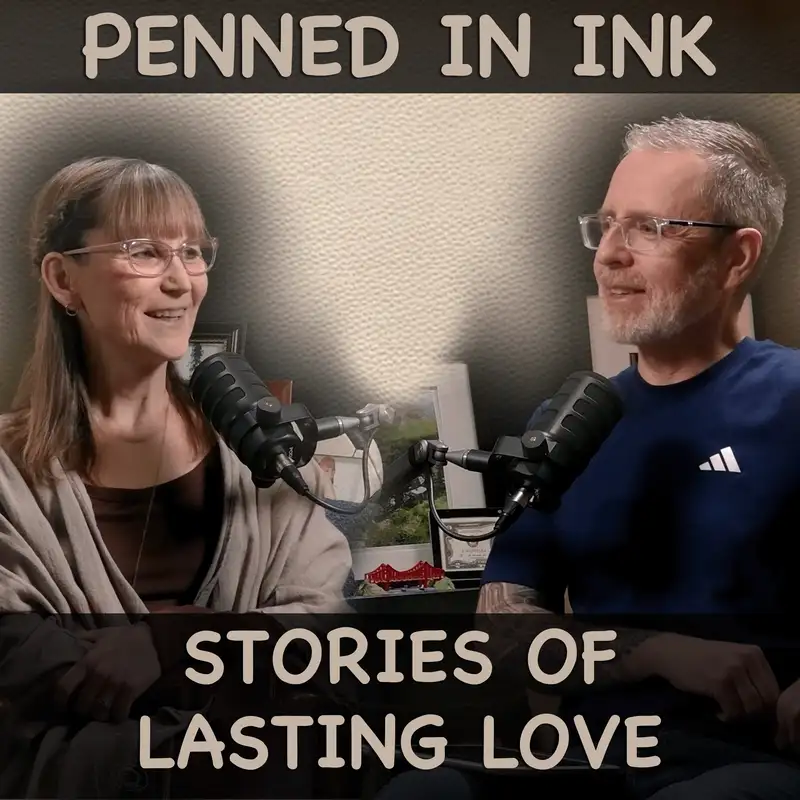
Welcome to Penned in Ink, a podcast where we discuss marriage and the power of long-lasting love.
Today, we are gonna talk about why we chose commitment.
Why was marriage the right choice for us over 30 years ago?
How have the bonds of marriage helped us over those 30 years?
And why do we continue to choose commitment year after year after year after year?
Let's kick this off with why did we decide to get married?
Well, no, hold on.
How are you doing today?
Thanks for asking.
I'm good, good.
I like Saturday.
Saturday's a good day.
Just gonna steamroll right through that.
Not say hello, nothing.
Oh, and for those of you who are just joining us, Michael, Melissa, today we are talking commitment.
We've been married over 30 years.
Why did we choose this?
Where are we going?
So now let's back up 30 years.
Why did you choose commitment?
Well, you know, I'm fond of joking because you asked me.
That's true, that's true.
Was I the only one who asked you?
Or did I just have first mover status?
Oh my gosh, I was 20, I would hope so.
Yeah, yes, yes, yeah, that's true.
All right, now that that's out of the way, why did you choose to get married?
I guess I just always thought I would.
It was, they say girls dream about their wedding and yada, I never did that.
But I just, I had seen marriage.
I thought it was, you know, it just felt right to have somebody that you come home at the end of the day and you can, the good, the bad, the ugly.
So I think that's part of it, that having that stability, it feels good.
And we'd been together long enough at that point when you'd asked me that I was, yeah, yeah, that sounds right, this is the person I want to spend the rest of my life with.
And I really had no doubts about that.
So I think that was part of it as well.
And so I'd always planned on getting married.
I loved you, we'd been, you know, through some good and some bad.
And I felt we were ready for it, even though we were young.
And it's what I wanted.
When you asked, like I said, no qualms.
It was just, well, absolutely.
It wasn't what took you so long, because we were so young.
But it was one of those things.
It didn't take that long.
To me, that was the trajectory of our relationship, was heading that direction.
I had never considered not, I guess, getting married.
I never saw myself as like a lifelong single person.
That's just outside, for me.
You grew up in a house that was married?
Absolutely.
You know, and that was, you know, showed to me.
And my parents actually got married earlier than we did.
And so to see them go through 20, 30, 40 years of marriage, and it looked good to me.
You know, they weren't perfect, no marriages, but it showed me that it could be a good thing.
And I actually hadn't seen a lot of non-marriage relationships, I guess.
Oh, you hadn't met me.
That's a very good point.
Yeah, my grandparents were married till they passed away.
So all the way through, my dad has a very large family, and the majority of them are married.
So you came from a line of long-term marriage.
Absolutely.
So marriage was sort of always on your path of where you were going.
Okay, I mean, that makes sense.
So I hinted at it a little bit.
That's not my story.
I didn't come from successful marriages.
I don't know, I have to really think on it.
I think the only long-term successful marriage that I probably saw was my grandpa, Matt.
That's my mom's dad.
He was married to Rita all the way from when they were super young, all the way through World War II, all the way through careers till she passed away.
And so like, and then he never remarried after that because they'd been married 50 years or whatever, but that's the only marriage.
So I won't shed dirty laundry on the rest of my family, but there was not many stable marriages.
So I didn't come from marriage being what you do.
So my reasons were probably more individual and related to you less than, hey, this is just sort of what we do.
So mine was, you'd mentioned wanting a partner.
I think that was a big, big deal for me.
So my home life was not stable.
Lots of, you know, my dad's been married multiple times.
Mom's been married, dated multiple times.
So lots of changes.
So I think for me, one of the big things of marriage was, all right, I got a partner for like the long time.
Why marriage over just a long-term cohabitation?
How's that?
That's a good word, cohabitation.
It was nonjudgmental almost, almost.
Almost.
I'm not judgmental.
I'm joking.
Go on.
Well, I had always been told that that's what you do.
I come from a religious background and to be blunt, that's living in sin, is the message that I was, not only through my parents, but through the church and it just wasn't done.
So that didn't even cross my mind because I was a rule follower and what mom and dad wanted of me, especially early on, is what I did.
So you grew up in the church and the church obviously had very clear teachings around this.
Yes.
Yeah, very.
Yeah.
It's just, I don't even know if it was discussed much.
It was definitely never considered an option.
Right.
You know, the, yeah, it just wasn't an option.
So living together for us was not an option because your parents and that sort of stuff.
Yeah.
That makes sense.
And to me, once again, the marriage, I don't know, there was just something about the commitment that was shown to me that, I don't know, to me, cohabitation seems a little bit that it could be transitory and not really a permanent thing.
Right.
For some people it is.
Don't get me, now that I'm quite a bit older.
It was 30 years ago.
You can say you're quite a bit older.
Right.
It's okay.
I can see that for some people it does work and it works well.
And I have nothing, obviously my worldview is a lot larger than it was when I was a child.
Right.
You know, because my parents were the same religion.
My grandparents were the same, you know, all the, all my dad's brothers and sisters, everybody, same religion, right?
And so, yeah, there was nobody in the family.
Now that I'm thinking about that, that's weird that nobody cohabitated.
Yeah.
And I guarantee you that's not the case anymore in the family.
So that's what 30, that's 30 years ago, what people did.
That's true.
Before it was much less common, much less in your face.
Yeah.
So we'll talk about religion and the role that played.
Let's pivot a little bit and talk about the non-religious aspects of it.
So we chose commitment.
You'd mentioned we'd been dating for a long time.
If you want to hear our origin story, check out our first episode.
It goes into how we met and sort of our journey to get to marriage.
But at this point we had known each other and had been dating for many years and we had a ton of shared goals, right?
We had sort of a vision of where we wanted to be in five, 10, 15 years, maybe a little bit more so than a 22-year-old, 23-year-old today might have.
And I think we grew up, we didn't have to grow up as fast as your parents probably did, but we had to grow up a lot faster than today's 20-somethings have to grow up.
And we grew up in a different environment.
I think marriage was something everybody around our cohort was doing.
We talked last episode that your parents got married in their late teens, very early 20s.
We got married in our early 20s.
By today's standards, that's very young.
Back then, I don't think it was.
A lot of our friends were getting married.
So we were in the marriage season in our early 20s.
So I think that was part of it too, is like our cohorts were doing it.
And so it made sense for us to take that as our next step.
And we had been together long enough.
We knew we were going to commit to each other and move forward.
It was very general of how we chose commitment, why we got there.
You had seen it, modeled it, had some religious influence.
We'd been together very long.
It was a natural next step.
I hadn't seen it, didn't really know exactly what it was, but I knew that you were who I was going to commit to.
So it made sense to me.
And I didn't have it modeled.
As we'll talk about in other episodes, there's lots of things I didn't have modeled in my life that we sort of built together and had more foundation.
I think a big picture for me was I wanted stability.
And we tested that relationship a lot before we committed to marriage.
I tested it a lot.
Okay.
Yeah, I wasn't going to say anything.
It'll come out at some point.
What's this we?
Yeah, it'll come out at some point.
I tested it a lot.
It had been pressure tested, let's put it that way.
So I think we were both ready.
And I had done enough things to convince myself that I was, yes, this was the right choice.
So I think in the moment, not great, but in the fact that it got me to a point where, yes, this is the right choice for me.
Let's go into one of our first reoccurring segments.
This is a segment we like to call Inked Moments.
Here's where we share a memory from our story that is related to today's topic.
So commitment, why did we choose to get married versus cohabitation?
I thought, talking about my proposal.
How did you get asked to marry?
That'd be a good place to start.
I guess I probably should tell the story since I was the one.
I'm thinking so.
It's very traditional.
I did the asking.
It's none of this modern stuff of you asking me.
Modern stuff.
I don't know.
Gonna get some hate on that one, you know it.
No, no, no.
There's some funny stories of some, we're big soccer fans.
So I follow these footballers and there's some good stories of girlfriends asking their footballers to get married right after they make it big.
And so, yeah, I think that's what made me laugh about as I was thinking about that one particular story.
Anyway, that's not our story.
My brother got married.
We grew up in Portland, Oregon area, down South, closer to Salem.
But Pacific Northwest, for those of you who are familiar with the West Coast, beautiful area.
Portland area is right on the edge of the Cascade Mountains.
And the downtown Portland area, historically has been gorgeous.
We haven't been there in 10 years.
So I don't know what it is now, but when we were growing up, it was very idyllic Mount Hood off in the distance, gorgeous area.
And my brother and his wife, who have also been married 30 years.
So that broke the chain of, they broke the chain as well.
They got married at this place called the Oregon Rose Gardens.
And about a year before I asked you to get married, that was just a beautiful, it's a rose garden.
This is up in the hills of Portland.
It's got a great view of Mount Hood and everything.
So we spent the day golfing.
This is back when we had building shared interests at the time, golfing was one of those.
And this was like country golf.
This was nine holes in a very small, rural golf course, nothing serious.
Spent the day golfing, went out to dinner in Portland.
And then I asked you to marry me up in the rose garden.
And I think you remember what I said more than I remember what I said.
What's your recollection of that day?
Everything you've said.
Oh good, we were there together?
Yes, I remember the golfing.
I'm athletic, but golfing's hard, but we enjoyed it.
It was just fun.
We laughed, you know, slice here.
That was a period of our life.
It was a fun shared activity.
We don't do it anymore, but it was very fun.
No, yeah, that was a good time.
And so, yeah, it was a beautiful day.
If I remember, I'm pretty sure it was in August of 94.
I definitely know it was 94, but I'm pretty sure it was in August.
It was right before school started, college.
Side note, if you're ever gonna visit Oregon, early August is absolutely the time to do it because it rains a lot in Oregon, but it hardly ever rains in late July and early August.
And so the weather is fantastic, and it's all green because you've had rain for 10 months.
Anyway, there's a side note for you.
There's your travel tip of the day.
Exactly.
And yeah, after we went golfing, I know we went out to dinner in Portland, could not tell you where we went, name of the restaurant, what we ate, no idea, but I do know we did that.
And then you made a comment about, hey, let's go up to the, we don't have to go back to the dorms yet.
Hey, why don't we go to the- Oh, we were in college.
Mm-hmm.
Yeah, makes sense.
Yeah, I don't think classes had started quite yet.
So we must've just, you were doing RA training, I think, or you had to be there early for being a resident assistant.
And so I think you actually skipped a team building thing but they had all gone to the something.
How dare I?
Exactly, you rebel.
And so anyway, so before we went back to campus, she said, hey, let's go up to the Rose Garden.
You know, I betcha it's beautiful today.
And so we went up there and I believe we were standing in a gazebo, not positive.
And I feel like we were looking down over the- We were definitely looking down over the Rose Gardens.
Yeah.
At the Mount Hood off in the distance.
And so I don't remember your exact words, but it was something to the effect that my brother and his wife found a beautiful place to start their life together, to have their wedding.
And I hope we, something effective, I hope we could find something.
And then it led into the proposal.
That kind of implied that I would say yes.
So I'm pretty sure you said if we were two.
So now that I'm thinking about that a little more.
I'm pretty confident, I probably didn't hedge my bets.
Okay, maybe not.
That's a very good point.
So anyway, yes.
Up at the Rose Garden, you asked, I said yes, obviously.
So yeah, and then after that, I don't remember.
I'm assuming we went back to campus, got ready for classes.
Probably something along those lines.
Oh, I bet you I showed my best friends and stuff at college and whatnot.
Oh yeah, I guess I would have given you a ring at that point.
Yes.
Yeah, that makes sense.
So I asked you in preparation for this, did you know the proposal was coming and you gave me a sly non-answer?
Okay.
Did you know the proposal was coming?
I knew it was coming at some point.
How did you know it was coming?
Who ratted me out?
You checked my bank account?
What were you doing?
No way.
You had gone to an RA meeting.
Oh my gosh.
Or you had done something and you had left your checkbook out on your desk.
I feel violated.
I know, that's why I never told you because I'm embarrassed that I was a snoop.
What the hell?
This is none of my business.
This is not the digital intimacy and the personal space episode.
Yes.
I feel violated.
It just said ring.
It didn't say like a jewel or it didn't, it just said ring.
And I was like, so I wasn't a hundred percent positive because usually in a checkbook register, right?
You write down.
For those kids listening, a register is a piece of paper that you used to write down your transactions in your account before you had a phone to hold.
Okay, go on.
Oh gosh, yes.
Sometimes, yeah.
Check register.
Half the audience has no idea what you're talking about, a check register.
So cute.
Anyway, you spent money, you wrote it down so you could keep track of it.
Anyway, instead of putting wherever the jewel was, you put ring.
I was like, and I really could not figure out what, and so that crossed my mind, but it wasn't, so I wasn't a hundred percent sure, but yes, I had snooped in your stuff.
I am so sorry.
I apologize.
You held that for 30 plus years.
I have.
Wow.
I haven't told anybody that.
Like nobody.
You just told whoever is gonna watch this that.
Yep, I just did.
Wow, that's honesty.
Yeah.
That's funny.
Yeah, so like I said, in our first episode, I said, you know, there might be some things, but we know so much about each other, there probably won't be many.
I don't know.
We're off to a good start.
I didn't know that.
But that one, that's something I've definitely held on to.
You feel better now.
Is that cathartic?
No, actually.
Now, I don't know.
You feel guilty.
It doesn't, exactly.
It doesn't feel as cathartic as I thought it would be.
Now, I'm waiting for, you know, some judgment or something, maybe.
I don't know.
We already covered this.
I don't judge.
No, we did not cover that.
I don't judge all the time.
So, I'm glad you dropped the first, I didn't know, then, rather me.
Yeah.
I'm sure they'll have some.
Good day.
Turned out pretty well.
It was a good day.
It turned out pretty well.
Yes, it did.
Yes, it did.
Let's move on to another topic you alluded to a little earlier that we wanna spend some time on.
One of our big goals for this podcast is, obviously, we're advocating for the power of a good marriage and what it can do for your life.
And one of the topics we have talked about a lot, or if you go and you're looking for podcasts where they're discussing marriage and commitment and such, you're gonna come across a bunch of religious couples, couples who their marriage is built upon faith.
And there's some fantastic podcasts out there.
But I think one of the missing areas is marriage from the non-religious.
So, we're gonna talk a little bit about the role religion played in our decision to get married.
And we're gonna talk about religion in our current, what we do and how it's guided our life and that sort of stuff.
And just discuss that because I am 100% believer that marriage is not just for religious people.
And I think there is a misconception or there's a clarity, let me use that, there's a clarity where religion, or where marriage fits in if you're religious.
There's almost always guidelines there.
But if you're not religious, what's marriage?
What's the role of marriage and everything?
And just as a foreshadowing of this conversation, I did not grow up in a religious family.
My mom is spiritual and attended many different churches, but was very much all over the place and not in a single denomination.
Is that the right word?
Never, same church, that sort of stuff.
My dad was not, I would classify him as anti-church for a lot of his life.
He did have a period where he attended church regularly, but that's not part of his, he grew up with church being a part of his life.
So, I think his was maybe a little rebellion from church.
But I didn't grow up with religion as a core tenet of my upbringing.
You already mentioned you grew up with religion being a very core tenet.
So, let's talk a little bit about the role religion played for us in our decision to get married.
And before we continue much further in this, I already, I need to apologize to mom and dad, to John and Anita.
Religion did not play a single bit in my decision to get married.
So.
It's okay.
Oh, I'm okay with it.
Right, right.
Honesty is good.
Yeah, exactly.
And I don't think that's a surprise to them.
No, there is no surprise in that at all.
But when you state it out for the public, for people to understand, I just want to acknowledge that they probably would have been happier if it had a religious backing to it.
And if we were religious in our relationship.
And I respect that.
I do too.
We just made the decision that was right for us.
So, what role did religion play in getting married, choosing to get married though?
Well, you said earlier that part of the next step to move forward was you needed to be married because of your upbringing.
So, it wasn't part of your decision-making.
So, I'm challenging you on that.
No, because I don't remember ever talking about just living together.
And so, it wasn't.
Right, so the religion part was the, you won't cohabitate, you won't live together, but it was never part of the decision of getting married.
Interesting, okay.
Yeah, because you never asked me.
You never said, hey, when you graduate next year, do you want to get an apartment together?
You didn't ask that.
Right, we took marriage as the next step.
Correct.
Yeah, I wonder if that's partially because I knew that was going to be the next step that was necessary for your parents.
That's exactly what I was just thinking, was it might be that you never suggested that because you knew that that wouldn't go over well, and maybe you didn't want to put me in that position.
I don't know.
Interesting.
So, without religion as the foundation of our marriage, what's the foundation of our marriage?
I know my answer.
I'm curious what your answer is.
Ah.
Nah, spoiler, sneak attack question.
Yeah, I need a little more.
So, we prep many of these things.
We have kind of sort of a show flow that we want to talk about and things, but we do our best to coordinate, but not schedule what we're going to talk about.
But every once in a while, there's got to be questions that sort of change the focus.
So, that's mine.
I don't know if that's fair.
Anyway, can you repeat the question, please?
No, I forgot the question.
What was the question?
No, seriously, what was the question?
Was it, what is the, what do I think the basis is?
That's a good question, yeah.
Since we didn't use religion and a belief in God and scripture to build our relationship, what's the foundation of our marriage?
Well, one might say a belief in each other.
I like that, it's a good start.
Tell me more.
Tell me more.
Wow, who's the counselor today?
I'm an interviewer, not a counselor.
Yeah, that's still, trust me, it's a counselor question.
That's true.
Tell me more, it's the same as, and how does that make you feel?
Yeah.
It's along that.
Melissa's profession is counselor.
We talk a lot about that in our first episode, just to give you some context, and we will dive into that in our next episode in depth.
But Melissa's a counselor, so.
Yeah.
I'm playing counselor back on her.
Right, so the foundation is, I have, that one's hard to wrap my mind around because I don't know, it's just, well, one, you know, we're thinking back 30 years.
I can tell you what it is now.
You know, we have, we are very similar in our beliefs about many things.
Finances, you know, the thing, extracurricular, we're both sports, but, you know, we mesh on so many things.
But that was how it was then as well.
I guess that's probably, you know, did we discuss that in the first episode?
Part of how, well, we know, we talked about the soccer connection, but other sports.
We like going to sporting events together.
We like, you know, so those shared interests.
And once again, I'm forgetting what the question was.
Well, I'll bail you out here.
I'll let you flail long enough on that.
No, that's exactly what I would answer.
So our foundation has been a shared goal vision for how we see our life going.
And we don't have the context of, in this area of, you know, following a doctrine or following a religious belief or doing it as service of, or in, it's just not in that paradigm.
I think what we've built as the foundation of our marriage has been, yes, shared interests has been good.
Although we have many interests that don't overlap at all, but enough shared interests.
Definitely a shared vision of what we wanted out of our family.
Stability, honesty with each other, support with each other, transparency with each other.
The goal to build family, to have children.
We were aligned on those things.
And over time, those priorities and how they've manifested this change, but the foundational elements have not changed.
I think that has been, that's been our foundation and part of our commitment to each other, which is gonna lead into our next, which is what were our vows and everything, really reflect the shared foundation or the shared goals.
And I think that was our foundation was we had a vision for where we wanted to be.
Individually was being developed, but I think as a couple, we had a really good sense of, yeah, this is something that we're gonna put a lot of energy behind, and the two of us are gonna build something together.
And that something had enough of a scaffolding around it of what we envisioned our life together being, that that was our foundation.
So I think I would argue that religion is one scaffold you can hang marriage on.
I would say shared goals or a shared vision or a shared passion is another.
And I think that's what we've built ours on.
And definitely we get aligned to, and point to what are our shared goals now.
I think we had enough of those 30 years ago, that that was a good foundation.
Absolutely.
Let's talk a little bit about our vows and what sort of vows did we make to each other and how have we used those vows, maybe in times of struggle over the past 30 years?
There have been some struggles in there, like every marriage has.
I think there's been some ebb and flows in there.
We are very blessed that we don't relationally struggle as much as some of our cohort does, but we have times of struggle.
So let's talk a little bit about our vows and how they've helped us.
What were our vows in big generals?
Big generals.
We definitely went a bit more traditional with ours.
We left out the obey piece, I don't know if any, but having to hold the sickness and health through good times and bad, because I think there's a reason we always have stood the test of time, because they're important, you know?
And the obey one, that kind of went out when feminism, you know, rightfully so.
Rightfully so.
But the other ones, though, the fact that the other ones are still used, there's a reason for that, because they're solid.
They're solid.
And so I really wish, though, one thing, if I could go back, this is superficial, but I wish I would have kept our vows.
I don't think we did.
I know now, like, our daughter got married last year, and they had a book, and I'm pretty sure they're keeping those, and they will always have those.
I don't think we have those.
Yeah, the ability to actually go back and really look at your vows and to look at your partner's vows that they made, I think that would be a very nice thing.
Yeah.
Beyond a keepsake, that would be a very good thing to sort of ground yourself back to that, what's your foundation?
The vows are your foundation.
And ours were very traditional.
We did write our own vows that were in there, but the service vows were the very traditional vows.
When I think about struggle and how the vows have helped us, if you take your vows seriously, then it gives you, you have to take responsibility to put those into action.
They have to become your, I don't like this term necessarily, but your essence, your core.
They have to be things that you live by.
And so for us, you and I have been very healthy.
That's been good.
So the sickness part has, physical health has been good, but we've struggled a bit with emotional health, mental health, those sort of things.
And so we've had periods of life where we've had to support each other through air quotes of illness, right?
However you want to define illness.
I think our vows have given us that foundation of, no, I'm in this.
And I might not understand what you're going through, or you might not understand what I'm going through, but you're in this to help me.
So I think the vows for me, since we try to embody those vows, we try to live by those vows, has helped me be a better partner because I took those vows.
I think if you cohabitate and you don't have that structure, do you maybe not weather those times where it gets rough?
Yeah.
Thoughts on that?
Anything else?
No, that's very true.
I was just, just what I had been thinking about earlier, which is, I don't think about our vows much because they're at this point, and I think pretty early on, maybe not, you know, maybe I had to think about them a lot.
Maybe not, probably not a lot, but a little bit in the beginning.
Now they're just second nature.
You've had a bad day, I'm there.
What do you need?
You know, do you need a hug?
Do you need an ear?
Do you need, you know, what do you need?
Do you need to be alone?
It's second nature.
I don't even think about them anymore, but they're there.
So like for this, when we're thinking, okay, what were our vows?
You know, they're just a part of who we are, so.
Yeah, there's this, we've talked about this in our show prep, that there's things in our life that we do, there are actions and actions we take, and then there are things in our life that just become part of us.
And I think living by our vows has just become part of us.
The in sickness and health, rich or poor, our puppy dog just walked into the camera here.
We introduced her in the first episode and we thought we probably should give you a little better view of her.
So there is a shot for those of you who are watching on YouTube of our puppy.
And again, she'll hopefully just sort of hang out and be quiet and not knock anything over, but that's Ginger.
So there's your little intermission break to say hello to Ginger.
All right, another area of our vows was sickness and health, rich or poor.
I think one of the areas we have really been intentional on that came sort of later in our marriage was the financial side of it.
And that whole, we started with no money, decided to go pretty negative in money by going to school, right?
So we were living okay, but we had a ton of debt from school.
We had a little bit of consumer debt, not a tremendous amount, but a little bit cars and things like that.
And I think the supportive part and the financial part, 15 years ago or so, we sort of had a pivot in our approach to money and really got serious about, we have to get rid of all this debt.
We have to, we cannot keep living this way.
And I think having that shared foundational goal, but then also having that commitment of the vow is richer or poorer.
We don't have to stay in the poor.
Can we just be unified and work and move toward the richer part of that?
And some of the struggles we had along the way of that was around motivation and discipline and decision-making and the intentional decisions to not live in the moment and spend, but to delay and to build some longer term things.
And I think when you have, I keep cycling back to it, but I keep cycling back to it, but when you cohabitate with somebody and you don't have those shared goals, do you have the, and you don't have those vows, do you have that same commitment?
I don't know.
Some people probably do, but I would say majority don't.
When you make your vows and you're building an entire life together with somebody, I think it helps you hit those goals a little stronger.
So I think that's how the vows have sort of very concretely helped us in our 30 years is when we commit to something, put in that framework and it moves forward.
Yeah, absolutely.
Cool.
Let's move to another segment that we'd like to do, which is from her perspective and from his perspective, this is where, well, if the title doesn't explain it to you, this is where we take today's topic and we put just a little bit of a gender lens on it.
How does the decision to get married or how does the decision to commit to someone differ from a male perspective and from a female perspective?
In today's slant, we're gonna say a little bit about how has commitment helped improve you from a female perspective and I'll put a lens on it from the male perspective.
So how has commitment enhanced your life?
Do you wanna go first?
Do you wanna go with me?
Either way.
You go.
All right.
How has it enhanced my life?
Okay.
Well, I'm not saying I'm a selfish person.
We're gonna go back to the age of 20.
20.
Might've been a little more selfish at 20, yeah, sure.
Putting yourself first is what you typically do when you're single, right?
I mean.
Yeah.
You know?
And so getting engaged, getting married, it's, yeah, you still think about yourself.
That's usually still, I think, the first thing you think of, but then you're like, okay, I'm sure there were a ton of times.
And even now, what would Michael think?
You know, whatever the decision is, could be absolutely anything, but what would Michael think or how does this affect our family?
So it takes it from an individual to the partnership that we talked about.
And that was something that I think has been very helpful for me is to, you know, granted, I'm a caring person.
I think about people a lot, but- You're underselling it, but yes.
But- Way more caring in thinking of others than I am.
But, you know, it is one of those things that it helped me move from the individual mindset to the partner mindset.
And there was another thing I had thought of, and now I'm blanking on what it was.
And you think that made you a better person than just being a solo person?
Oh, absolutely.
This is my role to challenge your answers on some stuff.
Absolutely.
I mean, think about that.
You know, it makes sense at certain times in our life to focus on you, but once you've committed, it's not just about you.
You could think about you, once again, you could think about you first, but it can't stop there.
Right.
There has to be more to it.
Okay, what does my partner, how does this affect my partner if I've decided, oh, I'm gonna quit my job and go back to school?
That might be what I want to do, but that's an awful selfish thing to do, to come home and say, oh, by the way, I quit my job and I enrolled in college.
Sure.
Right?
And so there's that piece.
So you think you are a better person because you have to think of somebody else's needs?
Absolutely.
Absolutely.
It's a growth.
It's personal growth.
And I, you know, we might as well just die if we don't do personal work.
So is the benefit to women of long-term commitment, tell me what the benefit is then.
I don't disagree, but I'm sort of drawing down a little bit on that.
Like, how does that actually make you better?
Yeah.
So choosing commitment has that.
So let me put my answer into this and we'll see where this goes from here.
And I am gonna chide you a little bit because you sort of half stole my answer and I think you know you have stole my answer.
That's why you wanted to go first.
Get your answer in there a little bit before mine.
Yeah, so again, male perspective on this.
How has choosing commitment, how does it make a man better, I guess?
So I'll say how it's made me better, but just in general, I think how does it make, how does really truly committing to someone make a man better?
I would say it makes you grow up, stop doing things that are maybe childish in nature.
If you're gonna be successful, those things that are, to your point, they're me-first, me-centric, without a care of other people is something that is a benefit of choosing commitment.
Not because individually, like you're always gonna have a self-perspective lens.
You're always gonna think of yourself first.
That's just, that's how people work, right?
But I think if you are going to truly endure times of challenge, it's much harder when you don't have an external reason why you're doing things.
So for a man, if it's all about your self-gratification, if it's all about the me, the now, the selfishness, that's pretty shallow.
That's not a whole person.
That's not a, that doesn't endure.
But when you commit to someone else's wellbeing, someone else's care, someone else's happiness, and it's not a situation of where I want to make them happy, but that for me to truly be happy, they have to be happy.
That's internalizing that.
That's a motivator for men.
Because men want, I take great pride not in making sure that you're happy and secure and comfortable or loved or whatever, because you experience it, and it's because I experience it because I know you're feeling that, right?
So I think how, so it's the same thing you're saying, but I think the way I'm trying to articulate it is the true power of commitment for a man is that we have this little bit of a provider mentality.
A lot of us do.
And it's one thing to provide and see your spouse, your children having comfort or whatever they need in the moment.
But when you get to the point where a large amount of your joy comes from knowing your people are good, I think that's how it's made me better.
And I think that's how it makes a lot of the men that I know have been married a very long time, they're not doing it so that their wife is happy and doesn't nag them, or they're not doing it so their kids are nice to them.
They're doing it because it brings pride and sense of like, well, my kids are good.
My family's good.
My wife is good.
She's in a good space.
And one of the things, it's a very long answer, but one of the things that I really have taken joy in in our daughters and then in you with your practice and stuff is that I lay a foundation that you guys can launch off of and do whatever.
And so I think for me, commitment versus cohabitation and just a shared life of non-commitment has really given me that purpose that's kind of outside of my needs.
That's my sort of maybe more detailed answer than what you are trying to get to maybe.
Right, yeah.
Or did I just put words in your mouth?
No, not at all.
I think that's a good way to look at it.
I was thinking, one of the things I didn't say is, and I don't know if this is for all women, but I'm going for- And that's not for all men, what I just said.
That's a fact.
And I was going for that sort of like, well, there's a whole psychological principle around it, but it's for very strong men.
We'll use that word.
Okay.
That's going to piss people off, but whatever.
Well, you know something that really, it's an immaturity thing, but when we were dating, there were times where I would get jealous.
No.
Yes.
Can you believe that?
No.
And the instant we made the commitment, it was like it went away.
Interesting.
And I'll tell you why.
It might be specific to you as opposed to other men.
Your word means a lot to me, and you had made it so by you saying, now, don't get me wrong.
I know other people take their vow seriously, and I understand infidelity.
I see it a lot in my work, and obviously you see it on TV and in movies all the time.
Yeah, it was just, Michael wouldn't do that if he is committed to me, and okay, I see him across the room talking to Terry or whatever, and I don't have a problem with that because he made a commitment to me, and it doesn't even cross my mind that you would be in, I doubt it was the instant we got married, but that grew very quickly for me.
I went from being somebody that if you were talking to a woman, I was like, what's going on over there?
Now it's just a, oh, he's talking to a woman.
And even then.
And so I think that, I mean, that's a good perspective, and when you are in a true committed relationship, I would hope that's the feeling you have.
And I think that would be, if that is what, if that's something that is, there's lots of jealous men, but if that's something for women that is, jealousy is a high thing, and you have a high quality committed relationship, and it reduces, I could see that as being a good positive of that.
Yeah, I guess my thought on that would be, it might be a little unique, unfortunately, that when I give my word, it is solid.
Like I do not, I don't tell you things that I don't know are true.
I don't speak things that aren't true.
I don't commit to things I know I can't do or have no intention of doing.
So that I hope is something that's really, I know it is, a lot of dudes in my life are like that.
So I know that there's good men that- There's just a fair number that- Right, exactly.
So I hope, so I guess my qualifier on your answer, not that I can qualify a female perspective, would be that if you got the right man, that's awesome.
And same with my male perspective.
It doesn't apply to all men as far as I, clearly none of this is going to.
Interesting.
Yeah.
Well, let's move on to our closing segment.
Let's talk a little bit about the pen to paper segment.
This is where we like to give you a practical takeaway or an action step that is around today's topic that you can hopefully apply in wherever you are.
If you're dating, you're considering commitment, you're in a long-term commitment, maybe you are 15 years in and you're going, why am I still in this?
Do I need to be still in this?
You're thinking about this.
Today's is, we've discussed a lot about our goals, our foundation, our sort of belief of where we want.
So our challenge to you today or our suggestion to you is spend a bit of time with your partner testing out what your goals are, what your visions are, where you overlap, where you're shared.
So we talked that when we were choosing commitment, we knew we had the big ones in line.
We knew what we wanted from a potential family looking forward, kids or not.
We knew sort of the active lifestyle we wanted to live, the travel we wanted to do, the type of place we wanted to live, rural or city or whatever.
We had shared goals in that.
We knew that education was important to us.
We knew that careers were important to us.
We knew that we were going to spend a great deal of effort building our relationship, but also building our individual careers and being strong individuals inside a marriage.
I will, as a sidebar, in one of your earlier answers, you were talking about commitment and how it changes your selfish desires or your selfish decision-making.
And I know this isn't what you were saying, but I think if you're going to be a strong partner, you have to be a strong individual.
And I know you fully agree with that as well.
And we'll talk about that a lot.
So when we talk about putting someone else's needs, it's not above yours, it's equal with yours.
And now we're a unit, but you can't lose track of yourself, your health, your goals, your ambitions, and those things that are important to you and where you overlap, fantastic.
Where you don't, as long as you're compatible and you're working on those, then great.
So our pen to paper is to challenge you to have some of those conversations.
And yeah, if you're early on in relationships, maybe you don't need those, but if you're starting to consider commitment, or if you're hesitant and you're like, do I really want to commit?
Our challenge to you would be to have those conversations about shared goals.
Want to add anything to that?
No, I was thinking about that earlier, just making sure that we said, because I do, I think it's so, we knew we were starting on the same foundation because we talked about it.
This wasn't the, we didn't get married and then say, so how many kids do you want?
Or, you know, what do you feel about debt?
We had these discussions before.
Of course, there's stuff that came up.
I can't think of anything off the top of my head, maybe moving across the country, but you know that.
But you have to start somewhere.
And I think there are a lot of things that need to be discussed before you say, I do.
And not everybody covers all that.
There are a handful of areas.
The number's like seven or so, and I'm not gonna hit them all because, well, I didn't prep for this, but there's something like seven areas that if you are aligned with your spouse, or as you're choosing, if you're aligned on these big ticket items, your divorce rate plummets.
Like you will stay together.
And off the top of my head, I'm not gonna hit them all, but it's kids, to have them or not, how many kids to have, religion.
Are you religious?
How are you gonna raise your kids if you're having religion?
Finances, in-laws, how close, how far, how often?
We talked a little bit about that in our first episode.
That was something we had to learn how to balance.
I got four of the five.
And we manage a lot of these things.
I'd have to think about them.
Social, what's your, are you, do you have a social circle, et cetera.
If you're aligned on those big ones, then your divorce rate, your chances of success and commitment in marriage just skyrocket.
So aligned goals, to your point, have those conversations before you commit.
You're gonna go into this in the next episode.
You have a lot of clients that you help deal with divorce and moving through, and how do they get out of relationships?
And very often there were signs that they just didn't have those conversations.
They just didn't spend the time.
So not everything is rosy and perfect in marriage.
And not saying that having those conversations early is gonna knock them all out, but man, you can knock some of the big ones out.
So have those conversations, people.
Talk to your goals.
Anything else we wanna talk about?
I don't think so.
Pretty good on why we chose commitment.
I think so.
Few stories in there.
Yeah.
All right.
Well, thank you all for joining us today.
We invite you to connect with us, share your stories about where you are with your choice on commitment.
Maybe you're pausing and hesitant.
Anything that comes up in here that you sort of want to toss out there and challenge, can communicate, interact with us.
Send us questions, leave a comment.
If you liked this episode, give us a thumbs up, give us a review.
All those nice things that they tell you to do on social would be great.
Do subscribe so that you can be notified next time we release episode three, where I think we're going to talk about your career.
I think so.
We're going to do a deep dive on how the counselor has impacted our life.
All right.
Thanks all.